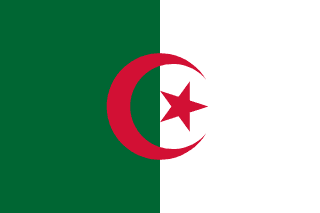
Algeria
People's Democratic Republic of Algeria
Population: UN WPP 2024, revision 1, projection for 1 July 2026. Sources and methodology.
Geography and territory
Algeria is the largest country in Africa and the tenth largest in the world, spanning 2,381,741 square kilometers from its Mediterranean coastline in the north to the deep reaches of the Sahara Desert in the south. Its Mediterranean shoreline runs for nearly 1,200 kilometers, lined with beaches, cliffs, and lively port cities. The Tell Atlas mountains run parallel to the coast across the north, while the Saharan Atlas farther south marks the transition into the country’s vast desert expanses.
The Sahara covers more than 80 percent of Algerian territory, forming a landscape of dunes, rocky plateaus, and dramatic geological formations such as the Hoggar massif and the Tassili n’Ajjer plateau. Rising from the heart of these desert mountains is Mount Tahat, at 3,003 meters the country’s highest point. Despite the dominant aridity, northern Algeria enjoys a Mediterranean climate of mild, rainy winters and hot, dry summers. Algeria borders Tunisia, Libya, Niger, Mali, Mauritania, Western Sahara, and Morocco.
This geographic range supports remarkably varied ecosystems. The coastal Tell plains are fertile and well suited to agriculture, while the interior steppes host vegetation adapted to prolonged drought. Deep in the south, the Sahara conceals ancient oases that have served as meeting points for caravans and cultures for centuries, genuine pockets of life amid the desert’s immensity. Between the Tell and the true desert lies the High Plateau, a semi-arid steppe of salt lakes and grazing land that has traditionally supported nomadic and semi-nomadic herding communities moving with the seasons.
History
Algeria’s history stretches back to the Berber civilizations, the region’s earliest known inhabitants. Phoenicians and Romans both left a lasting imprint, visible today in the ruins of Tipasa, Djémila, and Timgad, Roman cities now recognized as UNESCO World Heritage sites. After the fall of Rome, the territory passed successively to the Vandals, the Byzantines, and, from the seventh century onward, to Arab conquerors who introduced Islam and the Arabic language.
Through the Middle Ages, Algeria formed part of various Islamic empires, including Almoravid and Almohad rule extending from Morocco, and became a major hub of trans-Saharan trade in gold, salt, and slaves. In the sixteenth century, the territory came under Ottoman influence, and Algiers grew into a formidable base for Mediterranean corsairs whose exploits were feared by European navies for generations. In 1830, France invaded Algeria and began a colonial occupation that lasted 132 years, marked by land seizures, the marginalization of the indigenous population, and profound social upheaval that reshaped nearly every aspect of Algerian life.
The Algerian War of Independence, fought from 1954 to 1962, ranks among the twentieth century’s bloodiest decolonization conflicts. The National Liberation Front led an armed struggle that cost more than a million Algerian lives before independence was proclaimed on 5 July 1962, marking the birth of contemporary Algeria. The country later endured a painful civil war during the 1990s, often called the Black Decade, before achieving relative stability in the twenty-first century.
Culture and society
Algerian culture forms a fascinating mosaic shaped by centuries of Berber, Arab, Ottoman, and French influence. National identity rests on two linguistic pillars: Arabic, the official language and the vehicle of Islamic religious life, and Berber, or Amazigh, recognized as a national language in 2002 and granted official status in 2016, representing the heritage of North Africa’s original inhabitants.
Raï music, born in the city of Oran in the 1920s, is perhaps Algeria’s best-known artistic export. This genre, which fuses traditional Arabic melodies with modern Western rhythms, was carried to global audiences by artists such as Cheb Khaled, Cheb Mami, and Cheikha Rimitti. Alongside raï, chaabi, gnawa, and Kabyle musical traditions form a soundscape of extraordinary richness, while Algerian literature has produced writers of international stature, including Albert Camus, Kateb Yacine, Assia Djebar, and Mohammed Dib.
With a population of about 48.0 million, Algerian society is predominantly Sunni Muslim, and Islam shapes much of daily life, from religious holidays to the broader rhythms of social interaction. Hospitality holds a central place in Algerian culture: offering mint tea or coffee to guests is treated as something close to sacred duty. Family sits at the heart of the social structure, and communal celebrations such as weddings and religious festivals serve as occasions for gathering that reinforce bonds across generations.
Economy
Algeria’s economy is closely tied to its hydrocarbon sector, which accounts for roughly 95 percent of export earnings and around 60 percent of the state budget, with a gross domestic product of about $287.03 billion. Algeria ranks among the world’s leading natural gas exporters and holds a prominent seat within OPEC. The state-owned company Sonatrach anchors the national energy industry and stands among the largest oil companies on the African continent.
In recent years, the Algerian government has pursued ambitious plans to diversify the economy and reduce dependence on hydrocarbons. Investment has flowed into agriculture, particularly cereal, date, and olive production, as well as renewable energy, tapping the Sahara’s enormous solar potential. Manufacturing, petrochemicals, and pharmaceuticals have also seen notable growth.
Despite its wealth in natural resources, Algeria faces significant economic challenges, including youth unemployment, inflation, and the need to modernize infrastructure beyond the energy sector. The country has a large and growing young population in need of educational and employment opportunities, and successive governments have struggled to create enough jobs outside the public sector and the state-dominated hydrocarbon industry. Ongoing economic reforms aim to attract foreign investment, encourage entrepreneurship, and build up sectors such as tourism and information technology that could eventually broaden the economic base beyond oil and gas.
Food and cuisine
Algerian cuisine offers an exquisite reflection of the country’s cultural diversity, blending Berber, Arab, Ottoman, and Mediterranean culinary traditions. Couscous, considered the national dish, is prepared in countless regional variations: with lamb and vegetables in the north, with dates and butter in the south, or with fish along the coast. The craft of preparing couscous, passed down through generations, was inscribed on UNESCO’s Intangible Cultural Heritage list in 2020.
Among the most iconic dishes are chorba, a spiced soup essential during Ramadan; mechoui, lamb slow-roasted on a spit; chakchouka, a mix of peppers, tomatoes, and eggs; and bourek, crisp rolls filled with meat or cheese. Algerian pastry is equally celebrated, with sweets such as makroud, semolina pastry filled with dates, baklava, honey-soaked griouech, and crescent-shaped cornes de gazelle, all traditionally served alongside mint tea at family gatherings.
Mint tea, poured into small decorated glasses and generously sweetened, is far more than a beverage in Algeria: it functions as a ritual of hospitality that sets the pace of social life. Turkish coffee is also widely enjoyed, particularly in urban centers. The country’s markets and souks offer a sensory feast of colors, aromas, and flavors, where shoppers find spices, dried fruit, dates from Biskra, and olive oil from Kabylia, along with fresh seafood in the coastal cities and mountains of preserved lemons, dried chilies, and cured olives that flavor everyday home cooking.
Tourism and landmarks
Algeria is home to seven UNESCO World Heritage sites, a testament to its extraordinary historical and natural riches. The Roman ruins of Timgad, often called the African Pompeii, and Djémila, with its temples and triumphal arches, rank among the best-preserved archaeological sites in the Mediterranean. Tipasa, with its combined Phoenician, Roman, and early Christian remains overlooking the sea, inspired some of Albert Camus’s most celebrated writing.
Tassili n’Ajjer, in the country’s southeast, is an extraordinary open-air museum containing more than 15,000 rock paintings and engravings dating back as far as 10,000 years. This lunar landscape of wind-eroded rock formations has been recognized as both a UNESCO World Heritage site and a biosphere reserve. The M’Zab Valley, with its five fortified towns built by the Mozabite people in the eleventh century, offers a unique example of Islamic urban planning adapted to desert conditions.
Algiers, the capital, charms visitors with its Casbah, a UNESCO-listed labyrinth of steep alleyways cascading from the hilltop down to the harbor, blending Ottoman architecture, French colonial buildings, and modern construction into one vibrant whole. Oran, the country’s second city, is the birthplace of raï music and radiates a lively Mediterranean atmosphere. For adventurous travelers, the Algerian Sahara offers unforgettable experiences, from camel treks and nights under the stars in Tuareg encampments to awe-inspiring desert vistas.
Fun facts about Algeria
- Algeria is the largest country in Africa and the tenth largest in the world, bigger than the whole of Western Europe combined.
- The Great Mosque of Algiers, opened in 2019, is the largest mosque in Africa and the third largest in the world, with a minaret standing 265 meters tall.
- The Algerian Sahara contains the Grand Erg Oriental, one of the world’s largest seas of sand, with dunes exceeding 100 meters in height.
- The rock art of Tassili n’Ajjer proves the Sahara was once a green, fertile region inhabited by communities of herders and hunters thousands of years ago.
- Algeria is one of the few countries in the world that bans the import of vehicles more than three years old.
Algeria in numbers
Latest World Bank and UNDP observations, each with its own year. “World median” is the middle value among the countries that report the same indicator; “#” ranks from the highest value.
Population since 1960
Algeria had 11.4 million people in 1960 and 47.4 million in 2025 — 4.2 times as many.
People
75.8% of people live in towns and cities (world median 63.4%). 29.9% are under 15 and 6.8% are 65 or older — a middle-aged population. Women have 2.72 children on average, above the replacement level of about 2.1.
Economy
The economy grew by 3.8% in real terms in 2025. Consumer prices rose by 1.4% in 2025. Services make up the largest share of output (45.7% of GDP); agriculture contributes 14.5%.
Development and environment
UNDP rates human development in Algeria as high, with an index of 0.763 in 2023 (rank 96 of 193). 77.4% of people use the internet and 100.0% have access to electricity. Forest covers 0.7% of the land (world median 32.8%).
Sources: World Bank, World Development Indicators (CC BY 4.0), most recent observation from 2015 onward; UNDP Human Development Report 2025. Retrieved 2026-10-10. Sector shares need not add up to 100% because taxes and subsidies on products are excluded. Missing values are left blank rather than estimated. Sources and methodology.
Climate of Algeria
Averaged across Algeria, the warmest month is July (33.5 °C) and the coolest is January (12.5 °C), a seasonal swing of 21.0 °C. The annual mean is 23.5 °C.
About 84 mm of precipitation falls in a typical year. January is the wettest month (10 mm) and July the driest (3 mm).
Less than 250 mm a year is typical of desert climates.
Show monthly values as a table
| Month | Mean °C | Low °C | High °C | Precipitation, mm |
|---|---|---|---|---|
| January | 12.5 | 5.6 | 19.5 | 10 |
| February | 15.2 | 8.0 | 22.4 | 8 |
| March | 19.0 | 11.7 | 26.3 | 8 |
| April | 23.1 | 15.6 | 30.6 | 7 |
| May | 27.6 | 20.1 | 35.1 | 6 |
| June | 31.9 | 24.4 | 39.5 | 3 |
| July | 33.5 | 25.9 | 41.1 | 3 |
| August | 33.0 | 25.7 | 40.4 | 7 |
| September | 29.8 | 22.8 | 37.0 | 8 |
| October | 24.7 | 17.8 | 31.6 | 9 |
| November | 18.4 | 11.5 | 25.2 | 9 |
| December | 13.7 | 7.0 | 20.4 | 9 |
Figures are 1991–2020 averages across the whole land area of Algeria, from the World Bank Climate Change Knowledge Portal, CRU TS 4.08 (CC BY 4.0). They are not readings from one weather station: the capital, the coast and high ground can be much warmer, cooler, wetter or drier.
Travel essentials for Algeria
The practical details visitors ask about first. Traffic in Algeria drives on the right, like most of the world. Mains electricity is 230 V at 50 Hz, so devices made only for 110–120 V (common in North America) need a converter unless they are dual-voltage — most phone and laptop chargers are.
- Emergency number
- 17Ambulance 14 · Fire 14
- Driving side
- Right
- Plug types
- Type C, Type FC: two round pins (Europlug); F: two round pins with side earth clips (Schuko)
- Voltage
- 230 V50 Hz
- Dialling code
- +213From abroad: your exit code, then 213 and the number
- Currency
- Algerian Dinar (DZD)
- Time zone
- CET (UTC+1)Current local time in Algeria
Compiled from IEC plug and voltage standards, national emergency-service listings and the UN road-traffic conventions. Emergency numbers and local coverage can change — confirm them locally on arrival. Algeria's internet domain is .dz.
Where Algeria ranks in the world
Each position counts only the countries with data in that ranking guide. First place is the highest value — for price levels, the most expensive. Select a card to see the full table.
- Population32nd of 19648.0 millionUN projection, July 2026
- Land area10th of 1952,381,740 km²World Bank, 2023
- Population density167th of 19419 per km²World Bank, 2023
- GDP (nominal)50th of 187$269.3BWorld Bank, 2024, current US$
- GDP per capita109th of 187$5,753World Bank, 2024, current US$
- Life expectancy72nd of 19476.5 yearsWorld Bank, 2024
- Price level152nd of 16529 (US = 100)ICP 2021, household consumption
Bordering countries of Algeria


Compare Algeria with another country
Frequently asked questions about Algeria
What is the capital of Algeria?
The capital of Algeria is Algiers.
What is the population of Algeria?
The UN World Population Prospects projection for Algeria is 48,028,334 people (48.0 million) on 1 July 2026. National statistical offices may publish different estimates.
What language is spoken in Algeria?
The official language of Algeria is Arabic and Berber.
What currency is used in Algeria?
The currency of Algeria is the Algerian Dinar (DZD).
How big is Algeria?
Algeria covers an area of 2,381,741 km².
What type of government does Algeria have?
Algeria is a semi-presidential republic.
Which countries border Algeria?
Algeria shares land borders with Tunisia, Libya, Niger, Mali, Mauritania, Western Sahara, Morocco.
What is the highest point in Algeria?
The highest point in Algeria is Mount Tahat (3,003 m).

