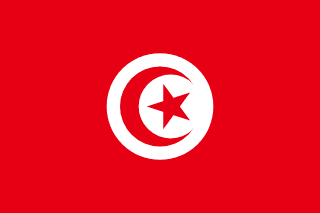
Tunisia
Tunisian Republic
Population: UN WPP 2024, revision 1, projection for 1 July 2026. Sources and methodology.
Geography and territory
Tunisia occupies the northernmost point of the African continent, a strategic position at the heart of the Mediterranean that has shaped its history and identity for millennia. Covering 163,610 square kilometers, it is among the smaller countries of the Maghreb, bordered by Algeria to the west and southwest, Libya to the southeast, and the Mediterranean Sea to the north and east. Its coastline runs for roughly 1,300 kilometers, ranging from rocky cliffs and hidden coves to broad stretches of golden sand.
Tunisia’s terrain divides into three main regions. The north, shaped by the eastern foothills of the Atlas Mountains, is mountainous and fertile, with irrigated valleys that produce most of the country’s agricultural output. Jebel ech Chambi, at 1,544 meters, is the country’s highest point. The center consists of a moderate-altitude steppe plateau. The south marks the transition into the Sahara, which covers more than 30 percent of national territory and contains Chott el Jerid, the largest salt depression in North Africa.
A Mediterranean climate prevails in the north, with mild, rainy winters and warm, dry summers, contrasting sharply with the desert climate of the south, where rainfall is scarce and summer temperatures can exceed 50 degrees Celsius. This climatic range produces a striking variety of landscapes: cork oak and holm oak forests in the northwest, centuries-old olive groves across the Sahel, date-palm oases in the south, and the sand dunes of the Grand Erg Oriental at the country’s southern edge. Tunisia holds rich Mediterranean biodiversity, though human pressure has significantly reduced its natural habitats.
History
Few places in the Mediterranean carry as much layered history as Tunisia. In 814 BC, Phoenician settlers from Tyre founded Carthage on the Tunisian coast, building one of antiquity’s most formidable civilizations. Carthage dominated western Mediterranean trade for centuries and rivaled Rome in the Punic Wars (264–146 BC), producing legendary figures such as the general Hannibal Barca, whose crossing of the Alps with war elephants remains one of the boldest military feats in history.
After Rome destroyed Carthage in 146 BC, the region became the province of Africa Proconsularis, the granary of the Roman Empire. Cities such as Dougga, El Jem, and Bulla Regia flourished as centers of Roman prosperity and culture. The amphitheater at El Jem, the third largest in the Roman world, testifies to the region’s wealth. The Arab conquest of the seventh century transformed society profoundly, introducing Islam and the Arabic language that came to define Tunisian identity. The Aghlabid, Fatimid, and Hafsid dynasties governed the territory in succession over the following centuries.
France established a protectorate in 1881, modernizing infrastructure while fueling growing nationalist resistance. Habib Bourguiba led the independence movement that culminated in Tunisian sovereignty on March 20, 1956. Bourguiba governed for three decades, pushing through modernizing reforms including universal education, women’s emancipation, and the secularization of the state. He was ousted in 1987 by Zine el-Abidine Ben Ali, who held power until the Jasmine Revolution of 2011, which ignited the Arab Spring and made Tunisia the first Arab country to complete a successful democratic transition, even as political and economic challenges persist.
Culture and society
Tunisian culture is an extraordinary synthesis of Phoenician, Roman, Arab, Ottoman, Andalusian, and French heritage layered across three thousand years of history. Contemporary Tunisian identity draws on this confluence of influences, visible in the country’s architecture, cuisine, music, and daily customs. Tunisian Arabic, with loanwords from French, Italian, Turkish, and Amazigh, reflects this multicultural richness linguistically.
The Medina of Tunis, a UNESCO World Heritage Site, is a labyrinth of narrow lanes lined with mosques, madrasas, hammams, and specialized souks that have operated for centuries. The University of Ez-Zitouna, founded in the year 737, ranks among the oldest educational institutions in the world. Tunisia stands out in the Arab world for its progressive legislation on women’s rights: since 1956, the Code of Personal Status has banned polygamy, established equal rights in divorce, and set a minimum marriage age, making Tunisia a pioneer in the Muslim world.
Tunisian music spans from malouf, an Andalusian musical tradition brought by Moriscos expelled from Spain, to mezoued, a popular urban genre played on a goatskin bagpipe that provides the soundtrack to popular celebrations. Nabeul ceramics, Kairouan textiles, orange-blossom perfumes, and silver filigree represent craft traditions passed down through generations. Tunisian cinema enjoys international recognition, with directors such as Abdellatif Kechiche winning the Palme d’Or at Cannes.
Economy
Tunisia’s economy is one of the most diversified in North Africa, built on manufacturing, services, tourism, and agriculture, with a gross domestic product of roughly $57.5 billion. The textile and garment sector has traditionally been an industrial mainstay, benefiting from geographic proximity to Europe and preferential trade agreements with the European Union. The aeronautics and automotive components industries have grown considerably, with European multinationals establishing production plants in Tunisian free-trade zones.
Tourism makes an essential contribution to the economy, drawing millions of visitors each year with a combination of beaches, historical heritage, culture, and competitive prices. The resort towns of Hammamet, Sousse, Djerba, and Tabarka are established fixtures of Mediterranean tourism. Agriculture, while employing a shrinking share of the workforce, remains significant: Tunisia is the fourth-largest producer of olive oil in the world and an important exporter of dates, citrus fruit, and wine.
Tunisia’s economic challenges are considerable. Unemployment, particularly among young people and university graduates, was one of the root causes of the 2011 revolution and remains largely unresolved. Regional disparities between the developed coast and an impoverished interior continue to fuel social tension. The country’s democratic transition has coincided with economic difficulty, rising inflation, and heavy public debt, testing the patience of a population still waiting for democracy to translate into tangible material gains.
Food and cuisine
Tunisian cuisine ranks among the most flavorful and spiciest in the Mediterranean, forged from a fusion of Berber, Arab, Ottoman, Andalusian, and French culinary traditions. Couscous, considered the national dish, is prepared many ways: with lamb and vegetables, with fish along the coast, with chicken and chickpeas, or even in a sweet version with dates and dried fruit. Every family holds its own recipe, and the Friday couscous remains a culinary ritual that anchors the weekly rhythm of Tunisian households.
Harissa, a paste of dried red chilies, garlic, cumin, and coriander, is the ever-present condiment of Tunisian cooking and something of a national culinary symbol. It accompanies nearly everything, from salads to stews, and every region produces its own variant with subtly different flavors. Brik, a crisp thin pastry filled with egg, tuna, capers, and parsley and fried until golden, is the most iconic Tunisian appetizer and a Ramadan staple. Lablabi, a chickpea soup served with bread, harissa, and cumin, is the classic winter breakfast.
Tunisian sweets are elaborate and generous with honey, nuts, and orange-blossom water. Makroudh from Kairouan, semolina pastries filled with dates and soaked in honey, are perhaps the country’s most emblematic dessert. Bambalouni, a Tunisian doughnut dusted with sugar, is the most popular street snack. Mint tea, served very sweet with floating pine nuts, is the drink of Tunisian hospitality, offered without fail to any guest. Thick Turkish coffee, flavored with orange-blossom water, is savored in traditional cafés where men gather to play cards and dominoes.
Tourism and landmarks
Tunisia packs an exceptional density of attractions into a small territory. The archaeological site of Carthage, a UNESCO World Heritage property, lets visitors walk among the ruins of Rome’s great rival, including the Baths of Antoninus, the Punic ports, and the Tophet, a Phoenician sanctuary. Nearby, Sidi Bou Said is one of the most photographed villages in the Mediterranean, its whitewashed houses trimmed in cobalt-blue doors and windows overlooking the Gulf of Tunis from a bougainvillea-covered cliff.
The amphitheater at El Jem, a UNESCO World Heritage Site, is the third-largest Roman amphitheater in the world, with a capacity of 35,000 spectators, and rises from the Tunisian plain with striking grandeur. Dougga, also a World Heritage Site, is one of the best-preserved Roman cities in North Africa, its capitol, theater, temples, and mosaics remarkably intact. Kairouan, the fourth-holiest city in Islam, is home to the Great Mosque, founded in the year 670 and among the oldest and most important in the Islamic world.
Southern Tunisia reveals a radically different landscape. The mountain oases of Chebika, Tamerza, and Mides, tucked into the Atlas foothills, appear as gardens set amid desert canyons. Chott el Jerid, a vast salt lake known for its hypnotic mirages, connects to the Sahara, where the dunes near Douz and Ksar Ghilane offer camel excursions and nights under the stars. The island of Djerba, identified with the Lotus-Eaters of Homer’s Odyssey, combines beaches, Africa’s oldest synagogue, and a distinctive vernacular architecture.
Fun facts about Tunisia
- Tunisia is home to Africa’s northernmost point, Cape Angela, which lies farther north than several cities in southern Europe.
- The amphitheater at El Jem was used as a staging ground for real battles over the centuries and served as a refuge during numerous conflicts.
- The Ghriba synagogue on the island of Djerba is the oldest in Africa, with a history spanning more than 2,500 years.
- Tunisia was the first Arab country to ban polygamy and establish legal equality for women, in 1956.
- Several Star Wars films were shot in locations across southern Tunisia, and the planet Tatooine takes its name from the Tunisian town of Tataouine.
- Tunisia sparked the Arab Spring in 2011 and was the only country in the region to achieve a successful democratic transition in its aftermath.
Tunisia in numbers
Latest World Bank and UNDP observations, each with its own year. “World median” is the middle value among the countries that report the same indicator; “#” ranks from the highest value.
Population since 1960
Tunisia had 4.3 million people in 1960 and 12.3 million in 2025 — 2.9 times as many.
People
70.7% of people live in towns and cities (world median 63.4%). 23.6% are under 15 and 9.9% are 65 or older — a middle-aged population. Women have 1.82 children on average, below the replacement level of about 2.1 needed to keep a population stable in the long run without migration.
Economy
The economy grew by 2.5% in real terms in 2025. Consumer prices rose by 5.2% in 2025. Services make up the largest share of output (62.7% of GDP); agriculture contributes 10.3%.
Development and environment
UNDP rates human development in Tunisia as high, with an index of 0.746 in 2023 (rank 105 of 193). 76.5% of people use the internet and 100.0% have access to electricity. Forest covers 4.4% of the land (world median 32.8%).
Sources: World Bank, World Development Indicators (CC BY 4.0), most recent observation from 2015 onward; UNDP Human Development Report 2025. Retrieved 2026-10-10. Sector shares need not add up to 100% because taxes and subsidies on products are excluded. Missing values are left blank rather than estimated. Sources and methodology.
Climate of Tunisia
Averaged across Tunisia, the warmest month is August (30.1 °C) and the coolest is January (11.0 °C), a seasonal swing of 19.1 °C. The annual mean is 20.5 °C.
About 281 mm of precipitation falls in a typical year. October is the wettest month (36 mm) and July the driest (2 mm). The wettest stretch is October to December, with 36% of the year's total.
Show monthly values as a table
| Month | Mean °C | Low °C | High °C | Precipitation, mm |
|---|---|---|---|---|
| January | 11.0 | 6.1 | 16.0 | 35 |
| February | 12.2 | 6.8 | 17.7 | 28 |
| March | 15.2 | 9.6 | 20.8 | 31 |
| April | 18.9 | 12.9 | 24.8 | 26 |
| May | 22.8 | 16.6 | 29.1 | 16 |
| June | 27.5 | 20.9 | 34.1 | 7 |
| July | 29.8 | 22.9 | 36.7 | 2 |
| August | 30.1 | 23.5 | 36.8 | 7 |
| September | 26.8 | 21.0 | 32.7 | 29 |
| October | 22.5 | 17.1 | 28.0 | 36 |
| November | 16.6 | 11.6 | 21.8 | 30 |
| December | 12.2 | 7.4 | 17.1 | 35 |
Figures are 1991–2020 averages across the whole land area of Tunisia, from the World Bank Climate Change Knowledge Portal, CRU TS 4.08 (CC BY 4.0). They are not readings from one weather station: the capital, the coast and high ground can be much warmer, cooler, wetter or drier.
Travel essentials for Tunisia
The practical details visitors ask about first. Traffic in Tunisia drives on the right, like most of the world. Mains electricity is 230 V at 50 Hz, so devices made only for 110–120 V (common in North America) need a converter unless they are dual-voltage — most phone and laptop chargers are.
- Emergency number
- 197Ambulance 190 · Fire 198
- Driving side
- Right
- Plug types
- Type C, Type EC: two round pins (Europlug); E: two round pins, earth pin in the socket
- Voltage
- 230 V50 Hz
- Dialling code
- +216From abroad: your exit code, then 216 and the number
- Currency
- Tunisian Dinar (TND)
- Time zone
- CET (UTC+1)Current local time in Tunisia
Compiled from IEC plug and voltage standards, national emergency-service listings and the UN road-traffic conventions. Emergency numbers and local coverage can change — confirm them locally on arrival. Tunisia's internet domain is .tn.
Where Tunisia ranks in the world
Each position counts only the countries with data in that ranking guide. First place is the highest value — for price levels, the most expensive. Select a card to see the full table.
- Population81st of 19612.4 millionUN projection, July 2026
- Land area91st of 195155,360 km²World Bank, 2023
- Population density106th of 19479 per km²World Bank, 2023
- GDP (nominal)90th of 187$51.4BWorld Bank, 2024, current US$
- GDP per capita125th of 187$4,188World Bank, 2024, current US$
- Life expectancy69th of 19476.7 yearsWorld Bank, 2024
- Price level144th of 16531 (US = 100)ICP 2021, household consumption
Bordering countries of Tunisia


Compare Tunisia with another country
Frequently asked questions about Tunisia
What is the capital of Tunisia?
The capital of Tunisia is Tunis.
What is the population of Tunisia?
The UN World Population Prospects projection for Tunisia is 12,415,138 people (12.4 million) on 1 July 2026. National statistical offices may publish different estimates.
What language is spoken in Tunisia?
The official language of Tunisia is Arabic.
What currency is used in Tunisia?
The currency of Tunisia is the Tunisian Dinar (TND).
How big is Tunisia?
Tunisia covers an area of 163,610 km².
What type of government does Tunisia have?
Tunisia is a presidential republic.
Which countries border Tunisia?
Tunisia shares land borders with Algeria, Libya.
What is the highest point in Tunisia?
The highest point in Tunisia is Jebel ech Chambi (1,544 m).


