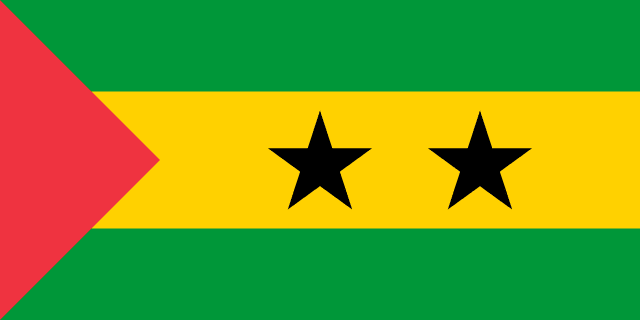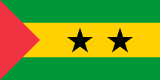
Flag of Sao Tome and Principe
Democratic Republic of São Tomé and Príncipe
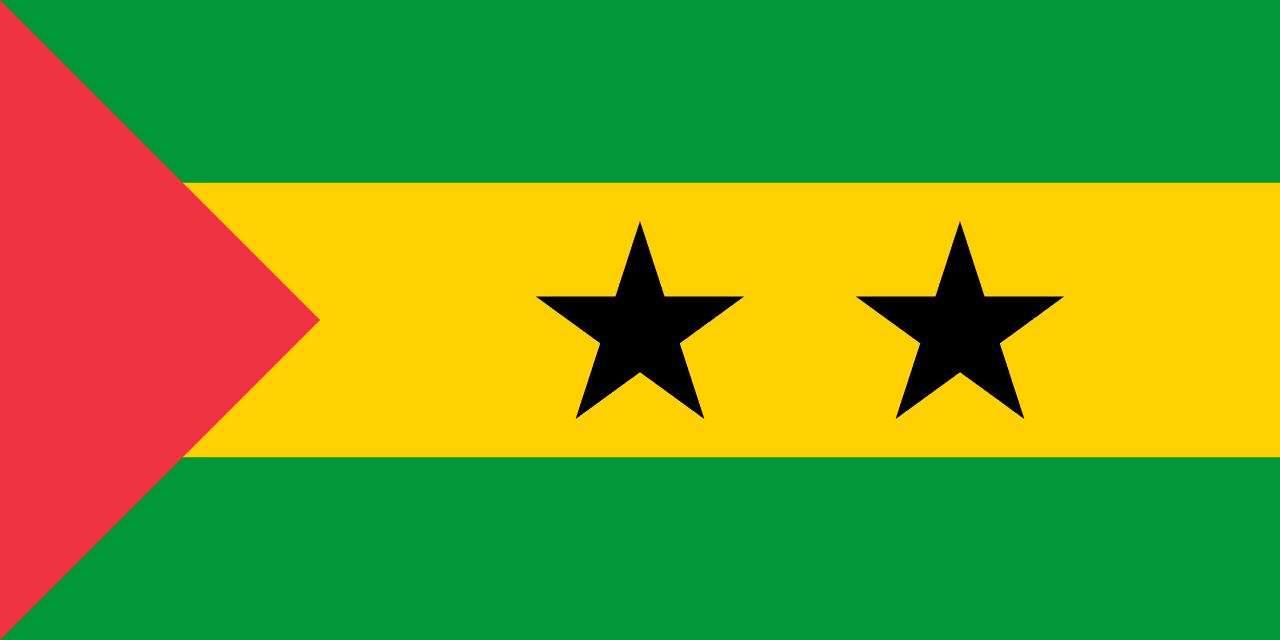
Flag details
- Proportions
- 1:2 height : width
- ISO code
- ST / STP
- Emoji
- Unicode
- U+1F1F8 U+1F1F9
Flag colors
- green#00973951%
- yellow#ffd10030%
- red#ef334012%
Share of the flag's surface, measured from the image. Names describe the measured shade.
Download the flag
Meaning and history of the flag of Sao Tome and Principe
The flag of Sao Tome and Principe has three horizontal stripes: green on top, a wider yellow band in the middle, and green on the bottom. A red triangle sits at the hoist, and two black five-pointed stars appear on the yellow stripe, representing the archipelago's two main islands, Sao Tome and Principe.
Adopted on July 12, 1975, the day of independence from Portugal, the flag uses the pan-African colors as a symbol of solidarity with the African continent. Green represents the islands' lush tropical vegetation, yellow symbolizes cacao, the country's chief export and a historic source of wealth, and the red of the triangle embodies the blood shed in the struggle for independence. The two black stars can also be read as a symbol of the African peoples. The design draws on the flag of the Movement for the Liberation of Sao Tome and Principe, the party that led the country to independence.
Colours and shape
Measured from the image, the main colours of the flag of Sao Tome and Principe are green, yellow and red; green alone covers about 51% of the surface. Its official proportions are 1:2 (height to width), the same shape as at least 51 other national flags.
The flag emoji 🇸🇹 is built from the two regional indicator letters S and T (U+1F1F8 U+1F1F9). Most phones and Macs draw it as a flag; Windows shows the two letters instead.
Part of a flag family: Pan-African colours
Red, yellow and green, the colours of Ethiopia’s flag. Ethiopia was never colonised (apart from the Italian occupation of 1936–1941), and Ghana took its colours at independence in 1957; many states followed.
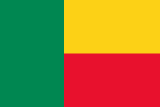 Benin
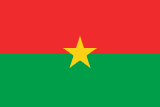 Burkina Faso
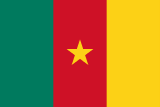 Cameroon
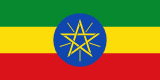 Ethiopia
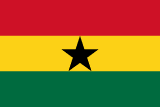 Ghana
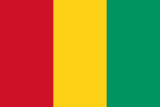 Guinea
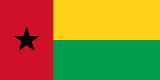 Guinea-Bissau
 Mali
 Republic of the Congo
 Senegal
 Togo