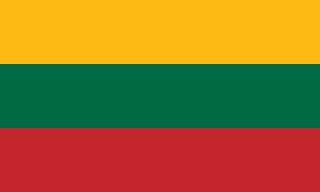
Lithuania
Republic of Lithuania
Population: UN WPP 2024, revision 1, projection for 1 July 2026. Sources and methodology.
Geography and territory
Lithuania is the southernmost and most populous of the three Baltic states, located in northeastern Europe. Covering 65,300 square kilometers, it borders Latvia to the north, Belarus to the east and southeast, Poland to the southwest, the Russian exclave of Kaliningrad, and the Baltic Sea to the west. Lithuania’s landscape is predominantly flat, shaped by glaciation that left gentle hills, thousands of lakes, and broad plains.
The country holds more than 3,000 lakes and roughly 800 rivers and streams, with the Nemunas (Niemen) as the most important, crossing the country from east to west before emptying into the Curonian Lagoon. This lagoon, separated from the Baltic by the Curonian Spit, is one of Europe’s most distinctive aquatic ecosystems. The sand dunes of this peninsula, some rising to 60 meters, form an extraordinary landscape recognized as a UNESCO World Heritage Site.
Forests cover roughly a third of Lithuania’s territory, dominated by pine, spruce, and birch. The climate is a humid continental transitional type, with cold winters (temperatures can drop below -20°C) and mild summers. Lithuania has five national parks and more than 300 nature reserves. A curious geographic footnote: the geographic center of Europe, according to calculations by France’s National Geographic Institute, lies in Lithuania, near the village of Purnuškės, 26 kilometers north of Vilnius.
History
Lithuania has one of the most fascinating histories in Europe. It was the last European country to adopt Christianity, remaining pagan until the close of the 14th century. In the 13th century, King Mindaugas unified the Lithuanian tribes and founded the state, halting the advance of the Teutonic crusaders. Under the Grand Duchy of Lithuania, especially during the 14th and 15th centuries, the Lithuanian state became the largest in Europe, stretching from the Baltic to the Black Sea.
The union with Poland in 1386, sealed through the marriage of Grand Duke Jogaila to Queen Jadwiga, created one of the most important powers in Europe. The 1569 Union of Lublin formally merged the two states into the Polish-Lithuanian Commonwealth, one of Europe’s largest and most multicultural monarchies until it was partitioned at the end of the 18th century. Lithuania then fell under the rule of the Russian Empire.
On February 16, 1918, Lithuania declared independence, establishing a democratic republic. Soviet occupation (1940-1941), Nazi occupation (1941-1944), and renewed Soviet annexation marked the following decades. The Holocaust was especially devastating, virtually annihilating Lithuania’s Jewish community. On March 11, 1990, Lithuania became the first Soviet republic to declare independence, an act of great courage that inspired other nations to follow. The country joined NATO and the European Union in 2004.
Culture and society
Lithuanian culture is distinguished by an extraordinarily rich oral tradition and a deep connection to nature and ancient pagan roots. Lithuanian is one of the most archaic living Indo-European languages, preserving grammatical features that link it to Sanskrit and the classical languages, making it a subject of fascination for linguists worldwide.
Lithuania’s musical tradition is vibrant and varied. Sutartinės, polyphonic songs sung by women and unique in Europe, have been recognized by UNESCO as intangible cultural heritage. The Song and Dance Festival, held every four years, brings together thousands of singers and dancers in a celebration of national identity. Mikalojus Konstantinas Čiurlionis, a Lithuanian painter and composer of the early 20th century, is considered a pioneer of abstract art whose work fuses music and painting in a visionary way.
Lithuanian society combines strong national identity with growing cosmopolitanism, especially in Vilnius. Basketball is practically a national religion: the Lithuanian national team has been a world basketball power, with multiple Olympic and world championship medals. Traditional crafts such as wood cross-carving, recognized by UNESCO, and amber crafting reflect a deep connection to cultural heritage. Carnival celebrations (Užgavėnės) and Christmas traditions keep folk customs alive.
Economy
Lithuania’s economy has been among the fastest-growing in the European Union since it joined in 2004. With a GDP of roughly $95 billion, Lithuania has transformed its economic base from dependence on Soviet-era heavy industry into a diversified economy oriented toward services and technology. The country adopted the euro in 2015.
Information technology and financial technology (fintech) have become key drivers of growth. Vilnius hosts one of Europe’s most dynamic fintech ecosystems, with more than 200 companies in the sector. Manufacturing remains important, with strengths in furniture, processed food, chemicals, and lasers, Lithuania is one of the world’s leading producers of high-precision lasers, used in scientific laboratories around the globe.
The agricultural sector produces grain, sugar beet, and dairy products, while fishing and the timber industry round out the productive base. Tourism is expanding, with Vilnius as the main destination. The port of Klaipėda is the country’s most important and a significant logistics node on the eastern Baltic coast. Economic challenges include the emigration of young people, regional inequality, and adaptation to a complex geopolitical environment.
Food and cuisine
Lithuanian cuisine is hearty, comforting Nordic-style cooking, built around local ingredients such as potatoes, pork, dairy products, grains, and forest mushrooms. The definitive national dish is cepelinai (zeppelins), large potato dumplings filled with meat, curd cheese, or mushrooms and served with sour cream sauce and crispy bacon bits. The name comes from their shape, resembling the famous airship.
Cold beet soup (šaltibarščiai), a vivid pink dish, is a summer classic served with hot potatoes and dill. Kugelis (a baked potato pudding), varškėčiai (curd cheese pancakes), kibinai (meat-filled pastries of Karaite origin), and skilandis (a traditional smoked sausage) are other emblematic dishes. Dairy products play a constant role, with curd cheese, sour cream, and fresh cheeses appearing in nearly every meal.
Dark rye bread is a pillar of the Lithuanian diet, with a baking tradition that includes šakotis, a spectacular tree-shaped cake made by roasting layers of batter on a rotating spit, traditionally prepared for weddings and celebrations. Lithuanian beer has a centuries-old history, and the country has numerous craft breweries producing distinctive styles. Honey, mead (midus), and herbal liqueurs are traditional drinks that round out a cuisine deeply rooted in the land and the seasons.
Tourism and landmarks
Vilnius, the capital, has one of the largest and best-preserved baroque old towns in Eastern Europe, a UNESCO World Heritage Site. The city surprises with more than 40 churches, winding lanes, the bohemian Republic of Užupis (an artists’ quarter that declared itself an independent republic in 1997, complete with its own constitution, translated into more than 50 languages), and a lively cultural and culinary scene.
The Curonian Spit is a unique natural wonder: a narrow strip of sand nearly 100 kilometers long separating the Curonian Lagoon from the Baltic Sea. Its shifting dunes, the tallest in Europe, pine forests, and picturesque fishing villages form a UNESCO World Heritage landscape. Trakai, the former medieval capital, enchants with its red-brick castle set on an island in the middle of a lake, one of the most photogenic island castles in Europe.
The Hill of Crosses, near Šiauliai, is a unique pilgrimage site where thousands upon thousands of crosses of every size have been placed over the centuries as an expression of faith and national resistance. Aukštaitija National Park offers crystalline lakes and ancient pine forests. Kaunas, the country’s second city, combines Art Deco architecture with a thriving contemporary art scene. The Lithuanian coast, with the beaches of Palanga and Nida, offers a serene, sunlit Baltic summer.
Fun facts about Lithuania
- Lithuania was the first republic to break away from the Soviet Union, declaring independence on March 11, 1990.
- The geographic center of Europe lies in Lithuania, according to calculations by France’s National Geographic Institute.
- Basketball is practically a national religion: the Lithuanian national team ranks among the world’s best, generating a passion comparable to soccer elsewhere.
- The Lithuanian language is one of the oldest and most conservative living Indo-European languages, with grammatical similarities to Sanskrit.
- The Hill of Crosses holds more than 200,000 crosses and was bulldozed several times by Soviet authorities, but Lithuanians always rebuilt it as an act of resistance.
Lithuania in numbers
Latest World Bank and UNDP observations, each with its own year. “World median” is the middle value among the countries that report the same indicator; “#” ranks from the highest value.
Population since 1960
Lithuania had 2.8 million people in 1960 and 2.9 million in 2025 — almost the same number.
The population peaked at 3.7 million in 1991 and has since declined.
People
69.1% of people live in towns and cities (world median 63.4%). 14.5% are under 15 and 20.7% are 65 or older — one of the oldest age structures in the world. Women have 1.11 children on average, below the replacement level of about 2.1 needed to keep a population stable in the long run without migration.
Economy
The economy grew by 2.9% in real terms in 2025. Consumer prices rose by 3.8% in 2025. Services make up the largest share of output (64.8% of GDP); agriculture contributes 2.3%.
Development and environment
UNDP rates human development in Lithuania as very high, with an index of 0.895 in 2023 (rank 39 of 193). 89.2% of people use the internet and 100.0% have access to electricity. Forest covers 35.4% of the land (world median 32.8%).
Sources: World Bank, World Development Indicators (CC BY 4.0), most recent observation from 2015 onward; UNDP Human Development Report 2025. Retrieved 2026-10-10. Sector shares need not add up to 100% because taxes and subsidies on products are excluded. Missing values are left blank rather than estimated. Sources and methodology.
Climate of Lithuania
Averaged across Lithuania, the warmest month is July (18.3 °C) and the coolest is January (−3.3 °C), a seasonal swing of 21.6 °C. The annual mean is 7.3 °C.
3 months have a national mean temperature below freezing.
About 679 mm of precipitation falls in a typical year. July is the wettest month (85 mm) and April the driest (38 mm).
Show monthly values as a table
| Month | Mean °C | Low °C | High °C | Precipitation, mm |
|---|---|---|---|---|
| January | −3.3 | −5.6 | −1.1 | 49 |
| February | −2.8 | −5.5 | −0.2 | 40 |
| March | 1.0 | −2.6 | 4.5 | 39 |
| April | 7.3 | 2.4 | 12.2 | 38 |
| May | 12.6 | 7.0 | 18.2 | 55 |
| June | 16.0 | 10.7 | 21.4 | 68 |
| July | 18.3 | 13.1 | 23.6 | 85 |
| August | 17.8 | 12.5 | 23.1 | 75 |
| September | 12.9 | 8.5 | 17.4 | 61 |
| October | 7.4 | 4.1 | 10.7 | 64 |
| November | 2.5 | 0.4 | 4.5 | 54 |
| December | −1.6 | −3.6 | 0.5 | 53 |
Figures are 1991–2020 averages across the whole land area of Lithuania, from the World Bank Climate Change Knowledge Portal, CRU TS 4.08 (CC BY 4.0). They are not readings from one weather station: the capital, the coast and high ground can be much warmer, cooler, wetter or drier.
Travel essentials for Lithuania
The practical details visitors ask about first. Traffic in Lithuania drives on the right, like most of the world. Mains electricity is 230 V at 50 Hz, so devices made only for 110–120 V (common in North America) need a converter unless they are dual-voltage — most phone and laptop chargers are.
- Emergency number
- 112
- Driving side
- Right
- Plug types
- Type C, Type FC: two round pins (Europlug); F: two round pins with side earth clips (Schuko)
- Voltage
- 230 V50 Hz
- Dialling code
- +370From abroad: your exit code, then 370 and the number
- Currency
- Euro (EUR)
- Time zone
- EET (UTC+2)Current local time in Lithuania
Compiled from IEC plug and voltage standards, national emergency-service listings and the UN road-traffic conventions. Emergency numbers and local coverage can change — confirm them locally on arrival. Lithuania's internet domain is .lt.
Where Lithuania ranks in the world
Each position counts only the countries with data in that ranking guide. First place is the highest value — for price levels, the most expensive. Select a card to see the full table.
- Population141st of 1962.8 millionUN projection, July 2026
- Land area120th of 19562,600 km²World Bank, 2023
- Population density139th of 19446 per km²World Bank, 2023
- GDP (nominal)77th of 187$85.5BWorld Bank, 2024, current US$
- GDP per capita41st of 187$29,604World Bank, 2024, current US$
- Life expectancy66th of 19477.2 yearsWorld Bank, 2024
- Price level54th of 16558 (US = 100)ICP 2021, household consumption
Bordering countries of Lithuania


Compare Lithuania with another country
Frequently asked questions about Lithuania
What is the capital of Lithuania?
The capital of Lithuania is Vilnius.
What is the population of Lithuania?
The UN World Population Prospects projection for Lithuania is 2,797,338 people (2.8 million) on 1 July 2026. National statistical offices may publish different estimates.
What language is spoken in Lithuania?
The official language of Lithuania is Lithuanian.
What currency is used in Lithuania?
The currency of Lithuania is the Euro (EUR).
How big is Lithuania?
Lithuania covers an area of 65,300 km².
What type of government does Lithuania have?
Lithuania is a semi-presidential republic.
Which countries border Lithuania?
Lithuania shares land borders with Latvia, Belarus, Poland, Russia.
What is the highest point in Lithuania?
The highest point in Lithuania is Aukstojas (294 m).


