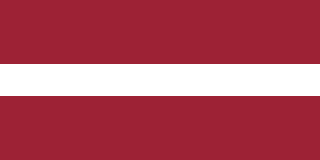
Latvia
Republic of Latvia
Population: UN WPP 2024, revision 1, projection for 1 July 2026. Sources and methodology.
Geography and territory
Latvia occupies a central position among the three Baltic states, bordered by Estonia to the north, Lithuania to the south, Russia and Belarus to the east, and the Baltic Sea to the west. Covering 64,589 square kilometers, the country is predominantly flat and remarkably rich in water: more than 12,000 rivers and over 3,000 lakes dot the landscape, making Latvia one of the most water-abundant countries in Europe.
Latvia’s terrain is gently rolling, with glacially formed hills that barely exceed 300 meters. Gaizinkalns, at 312 meters, is the country’s highest point. Forests, mainly conifers such as pine and spruce along with birch, cover more than half the territory. The Baltic coastline stretches roughly 500 kilometers, alternating white sand beaches with cliffs and small fishing harbors.
The Gulf of Riga, a broad, sheltered bay off the Baltic Sea, is the most prominent feature of the coastline. Latvia’s climate is humid continental, with long, cold winters, snow can blanket the ground for several months, and cool, pleasant summers. Latvian nature holds notable biodiversity, with deer, wild boar, lynx, wolves, and beavers in its forests, and the highest concentration of black storks in Europe.
History
Latvia’s history has been shaped by its strategic position among Europe’s great powers. Ancestors of the Latvians, Baltic peoples related to the Lithuanians, settled the region as far back as the third millennium BCE. In the 13th century, German crusaders of the Livonian Brothers of the Sword conquered the territory, establishing Riga as a major trading center of the Hanseatic League, a legacy that endures today.
For centuries, the Latvian lands were contested among the Teutonic Order, Poland, Sweden, and Russia. Peter the Great absorbed the region into the Russian Empire in the 18th century following the Great Northern War. A Latvian national awakening took hold in the 19th century, marked by a flourishing of language, literature, and folk music. On November 18, 1918, Latvia proclaimed independence and established a democratic republic.
That independence was interrupted by Soviet occupation in 1940 and Nazi occupation from 1941 to 1944, followed by the reimposition of Soviet rule that lasted until 1991. Thousands of Latvians were deported to Siberia, and the country underwent massive Russian immigration that altered its demographic makeup. Independence was restored on August 21, 1991, propelled by the “Singing Revolution” and the historic Baltic Way of 1989, when two million people formed a 600-kilometer human chain linking Tallinn, Riga, and Vilnius. Latvia joined NATO and the EU in 2004.
Culture and society
Latvian culture carries a deep connection to nature and pagan traditions that persist beneath a layer of Christianity. The summer solstice, celebrated as Jāņi (Saint John’s Eve), is the most important date on the calendar: on the shortest night of the year, Latvians gather in the countryside to light bonfires, sing dainas (folk songs), and search for the mythical fern flower said to grant wishes.
Dainas are Latvia’s most treasured cultural asset. These short folk verses form one of the largest collections of oral literature in the world, with more than 1.2 million recorded texts. Recognized as UNESCO cultural heritage, they cover every aspect of human life and constitute a poetic encyclopedia of Latvian folk wisdom. Choral tradition is equally powerful, with the Song and Dance Festival, held every five years, serving as a pillar of national identity.
Latvian society values discretion, reserve, and respect for personal space, in contrast to more expressive cultures of southern Europe, though Latvian hospitality runs deep once trust is established. The country maintains a literacy rate near 100 percent, and education is highly valued. Ice hockey and basketball are the most popular sports, and Latvia has produced standout athletes in disciplines such as bobsled and luge.
Economy
Latvia’s economy has undergone a remarkable transformation since independence in 1991. With a GDP of roughly $48.6 billion, Latvia is an open, dynamic economy fully integrated into the European single market. The country adopted the euro in 2014, cementing its economic integration. Riga functions as a regional financial and logistics hub, leveraging its position as a gateway to Baltic and Nordic markets.
Services dominate the economy, accounting for more than 70 percent of GDP, with logistics, information technology, and financial services as the leading subsectors. The port of Riga is one of the busiest on the Baltic and a key logistics node for trade between Europe and Asia. Manufacturing, centered on timber, food, metals, and pharmaceuticals, remains an important pillar.
The timber and forestry industry carries significant weight given that forests cover more than half the country. Latvia is a major exporter of wood and wood products. Tourism has grown considerably, with Riga as the main draw. Economic challenges include emigration (the country has lost a significant share of its population since joining the EU), an aging population, and disparities between the prosperity of Riga and the rural regions.
Food and cuisine
Latvian cuisine is hearty and comforting, shaped by the demands of a northern climate and rooted in the products of the land and the Baltic Sea. Dark rye bread is the essential staple, present at every meal and often baked with caraway seeds, molasses, and malt. Cold beet soup (auksta zupa), served with a hard-boiled egg and kefir, is an emblematic summer dish with a striking pink color.
Dairy products are fundamental to Latvian cooking. Quark (biezpiens), a fresh cheese similar to cottage cheese, appears in both savory dishes and desserts. Jāņi cheese (Jāņu siers), made from quark, eggs, and caraway seeds, is prepared specifically for the Jāņi festival. Herring, sprats, and other Baltic fish are eaten smoked, pickled, or marinated, forming a central part of the diet.
Among the most typical dishes are pīrāgi (pastries filled with bacon and onion), pelēkie zirņi (stewed gray peas), kotletes (meat patties), and sklandrausis (rye tartlets filled with carrot and potato). Desserts include rupjmaizes kārtojums, a layered dessert of dark rye bread with whipped cream and berries, and the Alexander torte, a raspberry cake with marzipan. Latvian craft beer has a long tradition, and Riga Black Balsam, a bitter herbal liqueur invented in 1752, is the country’s most iconic drink.
Tourism and landmarks
Riga, the capital, is the largest city in the Baltic states and an architectural gem of the first order. Its old town, a UNESCO World Heritage Site, combines medieval buildings, Gothic churches, and Hanseatic warehouses with the largest concentration of Art Nouveau architecture in Europe, more than 800 buildings in this style, especially concentrated on Alberta Street, display facades of extraordinary decorative flourish.
Beyond Riga, Latvia offers serene, largely undiscovered nature. Gauja National Park, the country’s largest, encompasses the Gauja River valley with sandstone cliffs, caves, and Turaida Castle, surrounded by sculpture gardens. Jūrmala, just 25 kilometers from Riga, is a coastal resort town with white sand beaches stretching more than 30 kilometers, Art Nouveau wooden houses, and thermal springs.
Rundāle Palace, designed by the Italian architect Bartolomeo Rastrelli (who also designed the Winter Palace in Saint Petersburg), is considered the “Versailles of the Baltics” for its Baroque grandeur. The town of Cēsis preserves the ruins of one of the region’s most important medieval castles. Cape Kolka, at the tip of the Gulf of Riga, marks the meeting point of the Baltic Sea and the gulf, while the Latgale region to the east offers a landscape of lakes and distinctive craft traditions.
Fun facts about Latvia
- Latvian dainas form one of the largest collections of folk songs in the world, with more than 1.2 million recorded texts.
- The 1989 Baltic Way, a 600-kilometer human chain linking Tallinn, Riga, and Vilnius, was one of the most striking peaceful demonstrations in history.
- Riga has the largest concentration of Art Nouveau buildings in Europe, with more than 800 structures in the style.
- Riga Black Balsam is a medicinal herbal liqueur whose recipe has remained secret since 1752.
- More than half of Latvia’s territory is covered in forest, and the country has one of the highest concentrations of black storks in the world.
Latvia in numbers
Latest World Bank and UNDP observations, each with its own year. “World median” is the middle value among the countries that report the same indicator; “#” ranks from the highest value.
Population since 1960
Latvia had 2.1 million people in 1960 and 1.8 million in 2025 — 13% fewer.
The population peaked at 2.7 million in 1989 and has since declined.
People
68.6% of people live in towns and cities (world median 63.4%). 15.2% are under 15 and 22.2% are 65 or older — one of the oldest age structures in the world. Women have 1.24 children on average, below the replacement level of about 2.1 needed to keep a population stable in the long run without migration.
Economy
The economy grew by 2.1% in real terms in 2025. Consumer prices rose by 3.7% in 2025. Services make up the largest share of output (64.2% of GDP); agriculture contributes 4.0%.
Development and environment
UNDP rates human development in Latvia as very high, with an index of 0.889 in 2023 (rank 41 of 193). 92.7% of people use the internet and 100.0% have access to electricity. Forest covers 55.6% of the land (world median 32.8%).
Sources: World Bank, World Development Indicators (CC BY 4.0), most recent observation from 2015 onward; UNDP Human Development Report 2025. Retrieved 2026-10-10. Sector shares need not add up to 100% because taxes and subsidies on products are excluded. Missing values are left blank rather than estimated. Sources and methodology.
Climate of Latvia
Averaged across Latvia, the warmest month is July (18.0 °C) and the coolest is January (−3.6 °C), a seasonal swing of 21.6 °C. The annual mean is 6.8 °C.
3 months have a national mean temperature below freezing.
About 676 mm of precipitation falls in a typical year. July is the wettest month (76 mm) and March the driest (37 mm).
Show monthly values as a table
| Month | Mean °C | Low °C | High °C | Precipitation, mm |
|---|---|---|---|---|
| January | −3.6 | −6.0 | −1.2 | 49 |
| February | −3.4 | −6.2 | −0.6 | 39 |
| March | 0.2 | −3.4 | 3.7 | 37 |
| April | 6.4 | 1.6 | 11.2 | 37 |
| May | 11.7 | 6.3 | 17.2 | 51 |
| June | 15.3 | 10.2 | 20.5 | 66 |
| July | 18.0 | 12.9 | 23.0 | 76 |
| August | 17.3 | 12.4 | 22.2 | 76 |
| September | 12.6 | 8.4 | 16.9 | 63 |
| October | 6.9 | 3.8 | 10.1 | 71 |
| November | 2.1 | 0.0 | 4.3 | 58 |
| December | −1.7 | −3.9 | 0.5 | 53 |
Figures are 1991–2020 averages across the whole land area of Latvia, from the World Bank Climate Change Knowledge Portal, CRU TS 4.08 (CC BY 4.0). They are not readings from one weather station: the capital, the coast and high ground can be much warmer, cooler, wetter or drier.
Travel essentials for Latvia
The practical details visitors ask about first. Traffic in Latvia drives on the right, like most of the world. Mains electricity is 230 V at 50 Hz, so devices made only for 110–120 V (common in North America) need a converter unless they are dual-voltage — most phone and laptop chargers are.
- Emergency number
- 112
- Driving side
- Right
- Plug types
- Type C, Type FC: two round pins (Europlug); F: two round pins with side earth clips (Schuko)
- Voltage
- 230 V50 Hz
- Dialling code
- +371From abroad: your exit code, then 371 and the number
- Currency
- Euro (EUR)
- Time zone
- EET (UTC+2)Current local time in Latvia
Compiled from IEC plug and voltage standards, national emergency-service listings and the UN road-traffic conventions. Emergency numbers and local coverage can change — confirm them locally on arrival. Latvia's internet domain is .lv.
Where Latvia ranks in the world
Each position counts only the countries with data in that ranking guide. First place is the highest value — for price levels, the most expensive. Select a card to see the full table.
- Population149th of 1961.8 millionUN projection, July 2026
- Land area121st of 19562,230 km²World Bank, 2023
- Population density150th of 19430 per km²World Bank, 2023
- GDP (nominal)97th of 187$44.0BWorld Bank, 2024, current US$
- GDP per capita50th of 187$23,579World Bank, 2024, current US$
- Life expectancy74th of 19476.4 yearsWorld Bank, 2024
- Price level39th of 16565 (US = 100)ICP 2021, household consumption
Bordering countries of Latvia


Compare Latvia with another country
Frequently asked questions about Latvia
What is the capital of Latvia?
The capital of Latvia is Riga.
What is the population of Latvia?
The UN World Population Prospects projection for Latvia is 1,835,935 people (1.8 million) on 1 July 2026. National statistical offices may publish different estimates.
What language is spoken in Latvia?
The official language of Latvia is Latvian.
What currency is used in Latvia?
The currency of Latvia is the Euro (EUR).
How big is Latvia?
Latvia covers an area of 64,589 km².
What type of government does Latvia have?
Latvia is a parliamentary republic.
Which countries border Latvia?
Latvia shares land borders with Estonia, Lithuania, Russia, Belarus.
What is the highest point in Latvia?
The highest point in Latvia is Gaizinkalns (312 m).


