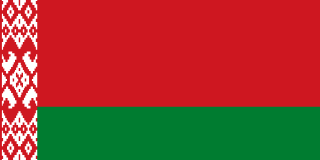
Belarus
Republic of Belarus
Population: UN WPP 2024, revision 1, projection for 1 July 2026. Sources and methodology.
Geography and territory
Belarus sits landlocked at the heart of Eastern Europe, covering 207,600 square kilometers of gently rolling terrain. The country is overwhelmingly flat, defined by sweeping plains, soft hills, dense forests, and an extraordinary abundance of fresh water. Woodland covers more than 40 percent of the national territory, a share so large that Belarus is sometimes called one of the lungs of Europe.
The landscape owes its shape to the glaciers of the last ice age, which left behind moraines, lake basins, and extensive wetlands as they retreated. The country’s highest point, Mount Dzyarzhynskaya, reaches a modest 346 meters. A dense network of rivers, including the Dnieper, the Pripyat, and the Neman, drains the land toward the Black Sea and the Baltic Sea. More than 11,000 lakes dot the territory, the largest being Lake Narach, which spans about 80 square kilometers.
The Bialowieza Forest, shared with neighboring Poland, ranks among the last remaining stretches of primeval forest in Europe and holds UNESCO World Heritage status. This ancient sanctuary shelters the largest wild population of European bison, a species that came perilously close to extinction in the twentieth century. Belarus experiences a moderate continental climate, with cold, snowy winters and mild, humid summers.
Wetlands cover a substantial share of the southern Polesia region, an area of marshes and floodplain forest so extensive it has earned the nickname “the lungs of Europe” alongside the country’s woodlands. This vast, sparsely populated lowland supports rare bird species and remains one of the least disturbed wetland ecosystems on the continent. Administratively, Belarus is divided into six regions centered on Minsk, Brest, Vitebsk, Gomel, Grodno, and Mogilev, each with its own distinct blend of forest, farmland, and river valley scenery.
History
Belarusian history has been shaped, above all, by its exposed position between larger powers, which repeatedly turned the region into a battleground. East Slavic peoples settled the area from around the sixth century onward, and through the Middle Ages the territory formed part of the Grand Duchy of Lithuania, one of the largest states in Europe at the time, where the Belarusian language served as the official language of the chancery.
After Lithuania’s union with Poland formed the Polish-Lithuanian Commonwealth, Belarusian lands fell under Polish influence until the partitions of the eighteenth century placed them within the Russian Empire. Russification pressures were intense, yet Belarusian national identity survived through literature and folk culture. A short-lived Belarusian People’s Republic was proclaimed in 1918 before being absorbed into the Soviet Union.
World War II devastated Belarus: the country lost roughly a quarter of its population, including nearly its entire Jewish community, and Minsk was almost completely destroyed in the fighting between German and Soviet forces. Partisan resistance against the German occupation was among the fiercest anywhere in occupied Europe, and the memory of that wartime sacrifice remains central to national identity today. Postwar Soviet reconstruction rebuilt the country as an industrial center, and Belarus became one of the more prosperous republics of the Soviet Union, known for its factories and its role in Soviet manufacturing.
Belarus declared independence in 1991 as the Soviet Union dissolved, and since 1994 it has been governed by Alexander Lukashenko, a leader often described as Europe’s last dictator. His government has maintained close political and economic ties with Russia while resisting the market reforms adopted by most of its post-Soviet neighbors. Disputed elections and crackdowns on opposition movements, particularly the mass protests that followed the 2020 presidential vote, have drawn sustained international criticism and left Belarus increasingly isolated from the West.
Culture and society
Belarusian culture reflects centuries of interaction among Slavic traditions, Polish-Lithuanian influence, and the more recent Soviet legacy. The Belarusian language, though official alongside Russian, has seen declining everyday use, fueling ongoing efforts at linguistic revival. National literature traces its foundations to Yanka Kupala and Yakub Kolas, poets who celebrated the beauty of the rural landscape and the character of the Belarusian people.
Folk traditions remain very much alive through festivals such as Kupalle, a midsummer solstice celebration built around fire and water rituals with roots reaching back to pre-Christian times. Belarusian textile patterns, geometric red designs on white cloth, serve as a national emblem that still appears in traditional dress. Folk music performed on instruments like the duda (a type of bagpipe) and the tsymbaly (a hammered dulcimer) accompanies community gatherings and celebrations.
Belarusian society retains a close bond with nature and rural life. Foraging for mushrooms and berries in the forest is a near-ritual family activity, and the banya, or sauna, remains a deeply rooted social custom. The Soviet legacy also lives on in the monumental architecture of Minsk, rebuilt after the war as a showcase of socialist planning, with its wide avenues and Stalinist-era buildings giving the capital a distinctive character.
Economy
The Belarusian economy is notable for its strong state involvement, a direct inheritance from Soviet-era central planning. Industry remains the backbone of the economy, with significant output in heavy machinery, vehicles such as BelAZ mining trucks and MAZ trucks, tractors, military equipment, petrochemicals, and potash fertilizers, of which Belarus is one of the world’s largest producers.
Agriculture also plays a major role, with substantial production of potatoes, flax, grains, sugar beets, and dairy products. Belarus ranks among the largest dairy exporters in the former Soviet space, and its food industry enjoys a strong regional reputation. The energy sector depends heavily on imported Russian oil and gas, though the construction of a nuclear power plant has been pursued as a step toward diversifying energy sources.
The information technology sector has grown considerably, anchored by the Hi-Tech Park in Minsk, an incubator that has nurtured a number of successful digital companies. The messaging app Viber and the video game World of Tanks both originated with Belarusian developers, and the park’s preferential tax regime helped turn software outsourcing into one of the country’s fastest-growing export earners before recent political upheaval slowed its momentum. Even so, the broader economy faces real headwinds from international sanctions, heavy dependence on Russia for energy and trade, and the ongoing need to modernize an industrial base still shaped by Soviet-era planning.
Food and cuisine
Belarusian cuisine is built around the potato, an ingredient the country has elevated to something close to a culinary art form. Draniki, crisp grated-potato pancakes served with sour cream, are the undisputed national dish. Kalduny, potato dumplings filled with meat or curd cheese, and babka, baked potato casseroles studded with bacon, showcase the endless creativity Belarusians bring to this humble tuber.
Soups anchor the everyday diet. Zhur, a sour rye-based soup, and cold borscht, a chilled beet soup served in summer, both reflect careful adaptation to climate and season. Machanka, a creamy pork stew served with potato pancakes or thick crepes, is a warming staple through the winter months. Homemade sausages and smoked salo, cured pork fat, round out a pantry built on rich, hearty flavors.
Belarusian baking is known for its honey cakes, jam-filled bulava pastries, and kalachi, braided festive breads. Traditional drinks include kvass, sbiten made with honey and spices, and various liqueurs distilled from wild berries such as blueberries and blackberries gathered in the forest. Honey holds a place of pride in Belarusian sweets, a legacy of a long-standing beekeeping tradition.
Tourism and landmarks
Minsk, the capital, greets visitors with imposing Soviet-era architecture, broad avenues, and leafy parks. Independence Avenue, one of the longest boulevards in Europe, presents a striking, unified stretch of Stalinist-era buildings, while the painstakingly rebuilt Old Town offers churches, restaurants, and an inviting atmosphere along the Svislach River. The Great Patriotic War Museum honors the enormous sacrifice Belarus endured during World War II.
The Bialowieza Forest stands as the country’s natural crown jewel, a primeval ecosystem where European bison roam freely beneath centuries-old oaks and firs. Brest Fortress, near the Polish border, is a moving monument to Soviet resistance against the Nazi invasion of 1941. Mir Castle and Nesvizh Castle, both UNESCO World Heritage Sites, capture the golden age of Polish-Lithuanian nobility with their elegant gardens and Renaissance and Baroque interiors.
The lake country of northern Belarus, often called the nation’s “blue-eyed land,” offers idyllic scenery for rural tourism and fishing. Pripyatsky National Park protects extensive marshlands and floodplain forests in the south. The cities of Grodno, with its well-preserved historic center, and Vitebsk, birthplace of painter Marc Chagall, draw visitors interested in the country’s history and culture.
Fun facts about Belarus
- Belarus has more than 11,000 lakes, earning it the nickname “the land of blue eyes.”
- The Bialowieza Forest shelters the largest free-roaming population of European bison anywhere in the world, with over 1,000 animals.
- Brest Fortress held out for roughly a month against the German invasion in June 1941, long after the surrounding region had already fallen.
- Belarusians eat an average of about 180 kilograms of potatoes per person each year, one of the highest rates in the world.
- The Hi-Tech Park in Minsk was the birthplace of the popular messaging app Viber.
- Belarus is one of the few remaining countries in Europe that still retains the death penalty in its legal code.
Belarus in numbers
Latest World Bank and UNDP observations, each with its own year. “World median” is the middle value among the countries that report the same indicator; “#” ranks from the highest value.
Population since 1960
Belarus had 8.2 million people in 1960 and 9.1 million in 2025 — 11% more.
The population peaked at 10.2 million in 1993 and has since declined.
People
79.5% of people live in towns and cities (world median 63.4%). 15.9% are under 15 and 18.3% are 65 or older — an ageing population. Women have 1.22 children on average, below the replacement level of about 2.1 needed to keep a population stable in the long run without migration.
Economy
The economy grew by 1.3% in real terms in 2025. Consumer prices rose by 6.6% in 2025. Services make up the largest share of output (50.0% of GDP); agriculture contributes 6.9%.
Development and environment
UNDP rates human development in Belarus as very high, with an index of 0.824 in 2023 (rank 65 of 193). 94.3% of people use the internet and 100.0% have access to electricity. Forest covers 44.1% of the land (world median 32.8%).
Sources: World Bank, World Development Indicators (CC BY 4.0), most recent observation from 2015 onward; UNDP Human Development Report 2025. Retrieved 2026-10-10. Sector shares need not add up to 100% because taxes and subsidies on products are excluded. Missing values are left blank rather than estimated. Sources and methodology.
Climate of Belarus
Averaged across Belarus, the warmest month is July (19.2 °C) and the coolest is January (−4.6 °C), a seasonal swing of 23.8 °C. The annual mean is 7.4 °C.
3 months have a national mean temperature below freezing.
About 644 mm of precipitation falls in a typical year. July is the wettest month (87 mm) and March the driest (37 mm).
Show monthly values as a table
| Month | Mean °C | Low °C | High °C | Precipitation, mm |
|---|---|---|---|---|
| January | −4.6 | −7.2 | −2.0 | 42 |
| February | −3.6 | −6.7 | −0.6 | 40 |
| March | 0.9 | −3.1 | 4.8 | 37 |
| April | 8.2 | 3.0 | 13.5 | 38 |
| May | 13.8 | 8.1 | 19.6 | 64 |
| June | 17.2 | 11.6 | 22.8 | 73 |
| July | 19.2 | 13.7 | 24.7 | 87 |
| August | 18.3 | 12.7 | 24.1 | 64 |
| September | 13.1 | 8.1 | 18.2 | 55 |
| October | 7.1 | 3.4 | 11.0 | 55 |
| November | 1.7 | −0.6 | 4.1 | 45 |
| December | −2.6 | −4.9 | −0.4 | 44 |
Figures are 1991–2020 averages across the whole land area of Belarus, from the World Bank Climate Change Knowledge Portal, CRU TS 4.08 (CC BY 4.0). They are not readings from one weather station: the capital, the coast and high ground can be much warmer, cooler, wetter or drier.
Travel essentials for Belarus
The practical details visitors ask about first. Traffic in Belarus drives on the right, like most of the world. Mains electricity is 230 V at 50 Hz, so devices made only for 110–120 V (common in North America) need a converter unless they are dual-voltage — most phone and laptop chargers are.
- Emergency number
- 112Police 102 · Ambulance 103 · Fire 101
- Driving side
- Right
- Plug types
- Type C, Type FC: two round pins (Europlug); F: two round pins with side earth clips (Schuko)
- Voltage
- 230 V50 Hz
- Dialling code
- +375From abroad: your exit code, then 375 and the number
- Currency
- Belarusian Ruble (BYN)
- Time zone
- MSK (UTC+3)Current local time in Belarus
Compiled from IEC plug and voltage standards, national emergency-service listings and the UN road-traffic conventions. Emergency numbers and local coverage can change — confirm them locally on arrival. Belarus's internet domain is .by.
Where Belarus ranks in the world
Each position counts only the countries with data in that ranking guide. First place is the highest value — for price levels, the most expensive. Select a card to see the full table.
- Population102nd of 1968.9 millionUN projection, July 2026
- Land area83rd of 195202,983 km²World Bank, 2023
- Population density140th of 19445 per km²World Bank, 2023
- GDP (nominal)81st of 187$78.6BWorld Bank, 2024, current US$
- GDP per capita84th of 187$8,606World Bank, 2024, current US$
- Life expectancy93rd of 19474.4 yearsWorld Bank, 2024
- Price level153rd of 16529 (US = 100)ICP 2021, household consumption
Bordering countries of Belarus


Compare Belarus with another country
Frequently asked questions about Belarus
What is the capital of Belarus?
The capital of Belarus is Minsk.
What is the population of Belarus?
The UN World Population Prospects projection for Belarus is 8,937,018 people (8.9 million) on 1 July 2026. National statistical offices may publish different estimates.
What language is spoken in Belarus?
The official language of Belarus is Belarusian and Russian.
What currency is used in Belarus?
The currency of Belarus is the Belarusian Ruble (BYN).
How big is Belarus?
Belarus covers an area of 207,600 km².
What type of government does Belarus have?
Belarus is a presidential republic.
Which countries border Belarus?
Belarus shares land borders with Russia, Ukraine, Poland, Lithuania, Latvia.
What is the highest point in Belarus?
The highest point in Belarus is Mount Dzyarzhynskaya (346 m).
