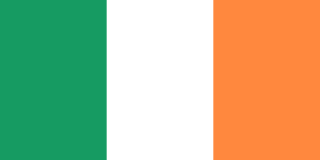
Ireland
Republic of Ireland
Population: UN WPP 2024, revision 1, projection for 1 July 2026. Sources and methodology.
Geography and territory
Ireland occupies roughly five-sixths of the island of Ireland, the second-largest of the British Isles, set at the northwestern edge of Europe. Covering 70,273 square kilometers, the country is bordered by the Atlantic Ocean to the west and south, St. George’s Channel to the southeast, and the Irish Sea to the east. Its only land border runs with the United Kingdom’s Northern Ireland, making the rest of the country’s perimeter entirely coastal.
The Irish landscape is defined by a low central plain ringed by coastal hills and modest mountains. The highest point, Carrauntoohil, rises 1,038 meters in the MacGillycuddy’s Reeks range in County Kerry. The interior is dotted with peat bogs, lakes, and the River Shannon, the longest river in the British Isles at 360 kilometers, which effectively divides the country into east and west as it flows from County Cavan to the Atlantic. Along the dramatic western seaboard, sea cliffs, fjord-like bays, and countless small islands give counties such as Donegal, Clare, and Kerry their rugged, wind-battered character.
Ireland’s climate is temperate and oceanic, moderated by the Gulf Stream, which brings mild winters and cool summers rarely marked by extremes of heat or cold. Rain falls generously throughout the year, especially along the western coast, nourishing the lush green countryside that earned the country its nickname, the Emerald Isle. That steady moisture also sustains the vast pastures underpinning Ireland’s important livestock industry, and it has shaped a rural landscape of stone-walled fields, hedgerows, and small market towns that remain central to national identity even as the population has grown increasingly urban around Dublin, Cork, Limerick, and Galway.
History
Ireland’s story stretches back thousands of years, with evidence of human settlement dating to the Mesolithic period around 8000 BCE. Celtic peoples arrived on the island around the sixth century BCE and established a culture whose language, music, and traditions endure today. Saint Patrick, the country’s patron saint, arrived in the fifth century CE and converted the island to Christianity, ushering in a golden age of monasteries that preserved classical learning through the early Middle Ages — earning Ireland the epithet the Island of Saints and Scholars.
From the twelfth century, the Anglo-Norman invasion marked the beginning of centuries of English domination. The Plantations of the sixteenth and seventeenth centuries brought Protestant settlers, particularly to Ulster, laying the groundwork for sectarian tensions that would persist for generations. The Great Famine of 1845–1852, triggered by potato blight, was a demographic catastrophe that cut the population from roughly 8 million to 4 million through death and mass emigration, leaving a lasting mark on national identity.
The independence movement gained momentum in the twentieth century with the 1916 Easter Rising and the War of Independence of 1919–1921, which led to the Anglo-Irish Treaty and the creation of the Irish Free State in 1922. The partition of the island left six northern counties under British sovereignty, giving rise to decades of conflict known as the Troubles. The Good Friday Agreement of 1998 brought peace and cross-border cooperation, transforming relations between the two parts of the island. The state formally became a republic in 1949 and joined the European Economic Community, the forerunner of the European Union, in 1973, a step that opened new markets and access to development funding that would later underpin the country’s economic transformation.
Culture and society
Ireland boasts an extraordinary literary tradition that has produced four Nobel laureates in Literature: W. B. Yeats, George Bernard Shaw, Samuel Beckett, and Seamus Heaney. James Joyce, with his masterwork Ulysses, revolutionized the modern novel, while Oscar Wilde, Bram Stoker, and Jonathan Swift remain towering figures of English-language literature. Dublin was named a UNESCO City of Literature in 2010 in recognition of this unmatched heritage.
Traditional Irish music, played on fiddles, tin whistles, uilleann pipes, and bodhráns, remains remarkably vibrant. Pub sessions are a living tradition that draws locals and visitors alike. On the contemporary stage, Ireland has produced world-famous acts such as U2, Enya, The Cranberries, Sinéad O’Connor, and Hozier, while Irish dance found global fame through the stage show Riverdance.
Saint Patrick’s Day on March 17 is the country’s best-known national celebration, with parades held in cities across the world. Irish society has undergone a profound transformation in recent decades, moving from one of Europe’s most conservative countries to approving marriage equality by referendum in 2015 and legalizing abortion in 2018. The Irish language, though spoken daily by only a minority, is actively promoted in the Gaeltacht regions and throughout the education system, with road signs, official documents, and primary schooling reflecting its status as the country’s first official language alongside English.
Sport also occupies a central place in Irish life. Gaelic football and hurling, organized by the Gaelic Athletic Association, draw enormous crowds to county rivalries that predate professional sport as most of the world knows it, while rugby and soccer command passionate followings of their own. Family, community, and a strong sense of local identity tied to individual counties remain defining threads running through Irish social life, even as the country has become markedly more diverse through immigration in recent decades.
Economy
Ireland’s economy has undergone a remarkable transformation, evolving from one of Western Europe’s poorest nations into one of its most prosperous. The period of rapid growth between 1995 and 2007, known as the Celtic Tiger, turned the country into a global hub for technology and financial services. After the severe 2008–2010 financial crisis, Ireland rebounded strongly and has maintained growth rates among the highest in the eurozone.
The country has established itself as the European headquarters for numerous technology and pharmaceutical multinationals, including Apple, Google, Microsoft, Meta, Pfizer, and Johnson & Johnson, drawn by a competitive 12.5% corporate tax rate and a highly skilled, English-speaking workforce. The technology and pharmaceutical sectors account for a substantial share of Irish exports, which far outstrip imports.
Agriculture remains vital to the rural economy, with Ireland ranking among the world’s top exporters of dairy and beef products. The food industry, led by companies such as Kerry Group, has a significant global footprint. Tourism also contributes substantially, drawing millions of visitors each year to Ireland’s landscapes, culture, and hospitality, while Dublin’s financial services district, the International Financial Services Centre, has grown into a major hub for banking, insurance, and fund administration serving clients across Europe.
Food and cuisine
Irish cuisine has evolved dramatically from its traditional base of potatoes, meat, and bread into a sophisticated culinary scene built on exceptional local ingredients. Irish stew, a comforting dish of lamb simmered with potatoes, carrots, and onions, remains the country’s most iconic dish. Soda bread, leavened with baking soda rather than yeast, accompanies nearly every meal.
Seafood is central to Irish cooking, especially Galway oysters, smoked salmon, mussels, and shellfish from the Atlantic coast. The Galway International Oyster Festival, held annually since 1954, ranks among the world’s oldest food festivals. The full Irish breakfast — bacon, sausages, eggs, black and white pudding, tomato, beans, and toast — is practically an institution.
Pub culture is inseparable from Irish food traditions. Guinness, the world’s most famous stout, was first brewed in Dublin in 1759 and remains a national symbol, its distinctive creamy head and roasted flavor recognized around the world. Irish whiskey, with labels such as Jameson, Bushmills, and Redbreast, is enjoying a global renaissance driven by a wave of new craft distilleries opening across the country. The contemporary dining scene is flourishing, with restaurants blending modern technique and local ingredients, while an artisan food movement has spurred excellent cheesemakers, craft breweries, and small-batch producers celebrating the quality of Irish beef, seafood, and dairy.
Tourism and landmarks
Ireland offers a rare combination of dramatic natural scenery and centuries of cultural heritage. The Cliffs of Moher, rising 214 meters above the Atlantic in County Clare, are the country’s most visited natural attraction. The Ring of Kerry winds through 179 kilometers of stunning coastal scenery in the southwest, while the Giant’s Causeway in Northern Ireland, with its 40,000 interlocking hexagonal basalt columns, is a UNESCO World Heritage Site.
Dublin blends history and modernity: Trinity College houses the Book of Kells, a ninth-century illuminated manuscript; the Temple Bar district pulses with live music and historic pubs; and the Guinness Storehouse at St. James’s Gate ranks among Europe’s most popular visitor attractions. Beyond the capital, Galway charms with its bohemian atmosphere, Cork draws food lovers, and Killarney serves as the gateway to the dramatic landscapes of the southwest.
Ireland’s ancient heritage includes Neolithic sites such as Newgrange, a passage tomb older than the pyramids of Egypt and Stonehenge, and a UNESCO World Heritage Site in its own right. The medieval monastic settlements of Glendalough and Clonmacnoise testify to Ireland’s role in preserving knowledge through the Middle Ages. The Aran Islands, off the Galway coast, preserve a traditional way of life alongside striking prehistoric forts such as Dún Aengus, perched at the edge of 100-meter cliffs. Further south, the Wild Atlantic Way, one of the world’s longest defined coastal driving routes, links these attractions along nearly 2,500 kilometers of scenery stretching from Donegal to County Cork.
Fun facts about Ireland
- Ireland is the only country in the world whose national symbol is a musical instrument: the harp.
- Sean’s Bar in Athlone, dating to around 900 CE, is considered one of the oldest pubs in the world.
- Halloween traces its roots to the ancient Celtic festival of Samhain, celebrated in Ireland more than 2,000 years ago.
- Ireland has no native snakes; legend credits Saint Patrick with banishing them, though in reality none survived the last Ice Age.
- Irish holds the oldest vernacular literature in Western Europe after Greek and Latin.
Ireland in numbers
Latest World Bank and UNDP observations, each with its own year. “World median” is the middle value among the countries that report the same indicator; “#” ranks from the highest value.
Population since 1960
Ireland had 2.8 million people in 1960 and 5.5 million in 2025 — 94% more.
People
64.6% of people live in towns and cities (world median 63.4%). 18.1% are under 15 and 16.2% are 65 or older — an ageing population. Women have 1.47 children on average, below the replacement level of about 2.1 needed to keep a population stable in the long run without migration.
Economy
The economy grew by 12.3% in real terms in 2025. Consumer prices rose by 2.2% in 2025. Services make up the largest share of output (56.7% of GDP); agriculture contributes 1.1%.
Development and environment
UNDP rates human development in Ireland as very high, with an index of 0.949 in 2023 (rank 11 of 193). 97.2% of people use the internet and 100.0% have access to electricity. Forest covers 12.0% of the land (world median 32.8%).
Sources: World Bank, World Development Indicators (CC BY 4.0), most recent observation from 2015 onward; UNDP Human Development Report 2025. Retrieved 2026-10-10. Sector shares need not add up to 100% because taxes and subsidies on products are excluded. Missing values are left blank rather than estimated. Sources and methodology.
Climate of Ireland
Averaged across Ireland, the warmest month is July (15.2 °C) and the coolest is January (5.4 °C), a seasonal swing of 9.8 °C. The annual mean is 9.8 °C.
About 1,211 mm of precipitation falls in a typical year. December is the wettest month (135 mm) and May the driest (78 mm).
Show monthly values as a table
| Month | Mean °C | Low °C | High °C | Precipitation, mm |
|---|---|---|---|---|
| January | 5.4 | 2.8 | 8.1 | 121 |
| February | 5.7 | 2.7 | 8.7 | 98 |
| March | 6.8 | 3.4 | 10.3 | 85 |
| April | 8.6 | 4.6 | 12.6 | 78 |
| May | 10.9 | 6.8 | 15.1 | 78 |
| June | 13.4 | 9.4 | 17.4 | 78 |
| July | 15.2 | 11.4 | 19.0 | 91 |
| August | 14.9 | 11.1 | 18.8 | 95 |
| September | 13.1 | 9.4 | 16.9 | 100 |
| October | 10.3 | 7.1 | 13.5 | 122 |
| November | 7.5 | 4.7 | 10.3 | 132 |
| December | 5.8 | 3.2 | 8.4 | 135 |
Figures are 1991–2020 averages across the whole land area of Ireland, from the World Bank Climate Change Knowledge Portal, CRU TS 4.08 (CC BY 4.0). They are not readings from one weather station: the capital, the coast and high ground can be much warmer, cooler, wetter or drier.
Travel essentials for Ireland
The practical details visitors ask about first. Traffic in Ireland drives on the left, one of 54 of the 196 countries profiled here that do — see the full list. Mains electricity is 230 V at 50 Hz, so devices made only for 110–120 V (common in North America) need a converter unless they are dual-voltage — most phone and laptop chargers are.
- Emergency number
- 112Police 999 · Ambulance 999 · Fire 999
- Driving side
- Left
- Plug types
- Type GG: three rectangular pins (British)
- Voltage
- 230 V50 Hz
- Dialling code
- +353From abroad: your exit code, then 353 and the number
- Currency
- Euro (EUR)
- Time zone
- GMT (UTC+0)Current local time in Ireland
Compiled from IEC plug and voltage standards, national emergency-service listings and the UN road-traffic conventions. Emergency numbers and local coverage can change — confirm them locally on arrival. Ireland's internet domain is .ie.
Where Ireland ranks in the world
Each position counts only the countries with data in that ranking guide. First place is the highest value — for price levels, the most expensive. Select a card to see the full table.
- Population124th of 1965.4 millionUN projection, July 2026
- Land area119th of 19568,890 km²World Bank, 2023
- Population density108th of 19477 per km²World Bank, 2023
- GDP (nominal)24th of 187$609.2BWorld Bank, 2024, current US$
- GDP per capita4th of 187$112,895World Bank, 2024, current US$
- Life expectancy18th of 19483.0 yearsWorld Bank, 2024
- Price level5th of 165116 (US = 100)ICP 2021, household consumption
Bordering countries of Ireland

Compare Ireland with another country
Frequently asked questions about Ireland
What is the capital of Ireland?
The capital of Ireland is Dublin.
What is the population of Ireland?
The UN World Population Prospects projection for Ireland is 5,356,950 people (5.4 million) on 1 July 2026. National statistical offices may publish different estimates.
What language is spoken in Ireland?
The official language of Ireland is English, Irish (Gaelic).
What currency is used in Ireland?
The currency of Ireland is the Euro (EUR).
How big is Ireland?
Ireland covers an area of 70,273 km².
What type of government does Ireland have?
Ireland is a parliamentary republic.
Which countries border Ireland?
Ireland shares land borders with United Kingdom.
What is the highest point in Ireland?
The highest point in Ireland is Carrauntoohil (1,038 m).


