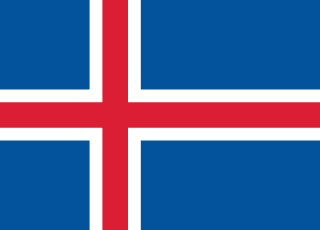
Iceland
Republic of Iceland
Population: UN WPP 2024, revision 1, projection for 1 July 2026. Sources and methodology.
Geography and territory
Iceland is a volcanic island in the North Atlantic, lying just south of the Arctic Circle on the Mid-Atlantic Ridge, where the North American and Eurasian tectonic plates are slowly pulling apart. Covering 103,000 square kilometers, it is Europe’s second-largest island nation after the United Kingdom, though its population numbers just 392,404. Its unique geological setting makes it one of the most volcanically active places on Earth, with more than 30 active volcanic systems, including Hekla, Katla, and Eyjafjallajokull, whose 2010 eruption grounded air traffic across Europe.
The Icelandic landscape is one of raw, dramatic beauty, where glaciers covering 11 percent of the territory coexist with lava fields, volcanic ash deserts, geysers, hot springs, spectacular waterfalls, and fjords. Vatnajokull, at 8,100 square kilometers, is the largest glacier in Europe and conceals several active volcanoes beneath its ice cap. The ongoing interplay between volcanic fire and glacial ice has earned Iceland its nickname, the land of fire and ice.
Iceland’s climate is subarctic oceanic, milder than its latitude would suggest thanks to the Gulf Stream. Winters are relatively mild along the coast, with average temperatures near Reykjavik hovering around freezing, though winds can be extreme. Summers are cool, with highs of 10 to 15 degrees Celsius. Natural vegetation is sparse, with less than 2 percent of the land forested, a legacy of centuries of deforestation and grazing, though ongoing reforestation programs are gradually reversing the trend.
History
Iceland was one of the last major landmasses on Earth to be settled by humans. The first permanent inhabitants were Norse colonists from Norway who arrived around the year 874, traditionally led by Ingolfur Arnarson, who founded Reykjavik. These settlers, joined by Celtic slaves brought from Ireland and Scotland, built a society of free farmers that in the year 930 established the Althingi, considered the oldest continuously operating parliament in the world.
The Saga Age, spanning the tenth through thirteenth centuries, was the most creative period in Icelandic literature, producing the Norse sagas, masterworks of medieval storytelling that recount the lives of the early settlers, the Norwegian kings, and Norse mythological legends. In 1262, Iceland came under the Norwegian crown and later the Danish crown. The centuries that followed brought hardship, marked by devastating volcanic eruptions, epidemics, and famine, most notably the 1783 eruption of Laki, which killed roughly a quarter of the population.
The independence movement gained momentum in the nineteenth century under the leadership of Jon Sigurdsson. Iceland achieved home rule from Denmark in 1918, while retaining the Danish king as head of state. During World War II, British and later American occupation cut Iceland off from a Denmark under Nazi control. In a referendum held on June 17, 1944, Icelanders voted overwhelmingly for full independence and the founding of a republic. The so-called Cod Wars against the United Kingdom later in the twentieth century underscored Iceland’s firm defense of its fishing grounds.
Culture and society
Icelandic culture retains an extraordinary connection to its medieval Norse heritage. Modern Icelandic remains remarkably close to Old Norse, allowing Icelanders to read thirteenth-century sagas with relative ease, a rare linguistic continuity. Icelandic society actively resists foreign loanwords, coining new terms from native roots instead: the word for telephone is simi, meaning “thread,” while the word for computer is tolva, a blend meaning roughly “number prophetess.”
Iceland maintains an exceptionally rich cultural life for a country of its size. It publishes more books per capita than any other nation, and the tradition of giving books as Christmas Eve gifts, known as jolabokaflod, or the “Christmas book flood,” reflects the country’s deep passion for reading. Authors such as Halldor Laxness, who won the Nobel Prize in Literature in 1955, and contemporary writer Sjon have brought Icelandic literature international acclaim. The music scene is equally vibrant, having produced globally famous artists such as Bjork and Sigur Ros.
Icelandic society is among the most egalitarian in the world, consistently topping global rankings for gender equality. In 1980, Iceland elected Vigdis Finnbogadottir as the world’s first democratically elected female president. The country uses a patronymic naming system rather than fixed surnames, with a person’s last name formed from a parent’s first name followed by “-son” (son) or “-dottir” (daughter). With a population small enough that most people are only a few connections apart, a well-known mobile app even lets Icelanders check for shared ancestry before dating.
Economy
Iceland’s economy has undergone remarkable transformation over its history. Traditionally built on fishing, which still accounts for a significant share of exports, the country has diversified into tourism, renewable energy, and high-tech services. The Icelandic fishing industry is among the most advanced in the world, operating a quota system that has helped keep marine resources sustainable.
Geothermal and hydroelectric power supply virtually 100 percent of the country’s electricity and heating, making Iceland a world leader in renewable energy per capita. This abundant, low-cost energy has drawn energy-intensive industries, most notably aluminum smelting, which has become a major export sector. Data centers have also set up operations in the country, taking advantage of cheap clean power and a naturally cold climate for cooling.
Tourism has become Iceland’s largest economic sector, drawing more than 2 million visitors annually, a figure several times the country’s own population. The 2008 financial crisis hit Iceland especially hard when its three largest banks collapsed, but the recovery that followed was notable. The country made the unusual choice not to bail out its banks with public money and prosecuted several banking executives, an approach that drew international attention.
Food and cuisine
Icelandic cuisine is among the most distinctive in Europe, shaped by centuries of isolation and the need to preserve food through long Arctic winters. Hakarl, shark fermented for several months until it develops a powerful ammonia-like flavor, is the country’s most notorious dish and a real test for unaccustomed palates. Traditionally, this food was essential for survival when other resources ran scarce.
Icelandic lamb, which grazes freely in the highlands through summer on wild herbs and moss, yields exceptionally flavorful meat that remains the country’s most prized protein. Hangikjot, smoked lamb, is a Christmas classic. Seafood is equally central: cod, Arctic salmon, and langoustine are prepared simply to let their remarkable freshness shine. Plokkfiskur, a comforting fish and potato stew, is a staple of Icelandic home cooking.
Skyr, a dairy product resembling yogurt but technically a fresh cheese, has been an Icelandic staple for more than a thousand years and has won over international markets in recent decades. Geothermally baked rye bread, buried near hot springs and slow-baked for 24 hours, is a unique culinary curiosity. Reykjavik’s dining scene has flourished remarkably, led by restaurants such as Dill, the first in Iceland to earn a Michelin star, which reimagines local ingredients through contemporary technique.
Tourism and landmarks
The Golden Circle is Iceland’s most popular tourist route, a 300-kilometer loop connecting three spectacular sites: Thingvellir National Park, where visitors can walk between the North American and Eurasian tectonic plates and where the Althingi was founded in the year 930; the Geysir geothermal area, which lent its name to geysers worldwide; and Gullfoss, a two-tiered waterfall that plunges 32 meters into a narrow canyon. Together, these three destinations distill the essence of Iceland’s geology.
The south coast offers a succession of natural wonders: the waterfalls of Seljalandsfoss, which visitors can walk behind, and Skogafoss; the black-sand beach of Reynisfjara with its striking basalt columns; the Solheimajokull glacier; and the Jokulsarlon glacier lagoon, where blue icebergs drift out toward the sea. In the north, Lake Myvatn and the geothermal area of Namafjall present otherworldly landscapes of fumaroles and lava formations. Akureyri, the capital of the north, serves as the gateway to whale watching in nearby Husavik.
The Blue Lagoon, a geothermal spa with milky waters kept at 38 to 40 degrees Celsius and set amid black lava fields near Keflavik Airport, is Iceland’s single most visited attraction. Reykjavik, the world’s northernmost national capital, charms visitors with its colorful architecture, lively nightlife and cultural scene, the Harpa concert hall, and views of Mount Esja. Northern lights viewing between September and March, along with excursions into the highland interior accessible only in summer, round out a tourism offering unlike anywhere else on Earth. Many visitors also make time for the Snaefellsnes Peninsula in the west, sometimes called “Iceland in miniature” for its glacier-topped volcano, lava fields, fishing villages, and dramatic coastline packed into a single compact region.
Fun facts about Iceland
- Iceland has no army, navy, or air force; national defense is provided through NATO and a coast guard.
- The Althingi, founded in the year 930, is considered the oldest parliament in the world still in operation.
- A majority of Icelanders say they believe elves and other hidden beings (huldufolk) may exist, and some construction projects have been rerouted to avoid disturbing supposed elf rocks.
- Iceland is the most sparsely populated country in Europe, with only a few people per square kilometer.
- Beer was banned in Iceland from 1915 to 1989; the country now celebrates Beer Day every March 1 to mark the end of prohibition.
Iceland in numbers
Latest World Bank and UNDP observations, each with its own year. “World median” is the middle value among the countries that report the same indicator; “#” ranks from the highest value.
Population since 1960
Iceland had 175,574 people in 1960 and 392,404 in 2025 — 2.2 times as many.
People
94.2% of people live in towns and cities (world median 63.4%). 17.5% are under 15 and 16.0% are 65 or older — an ageing population. Women have 1.56 children on average, below the replacement level of about 2.1 needed to keep a population stable in the long run without migration.
Economy
The economy grew by 1.3% in real terms in 2025. Consumer prices rose by 4.1% in 2025. Services make up the largest share of output (66.2% of GDP); agriculture contributes 3.7%.
Development and environment
UNDP rates human development in Iceland as very high, with an index of 0.972 in 2023 (rank 1 of 193). 98.2% of people use the internet and 100.0% have access to electricity. Forest covers 0.6% of the land (world median 32.8%).
Sources: World Bank, World Development Indicators (CC BY 4.0), most recent observation from 2015 onward; UNDP Human Development Report 2025. Retrieved 2026-10-10. Sector shares need not add up to 100% because taxes and subsidies on products are excluded. Missing values are left blank rather than estimated. Sources and methodology.
Climate of Iceland
Averaged across Iceland, the warmest month is July (8.9 °C) and the coolest is February (−3.1 °C), a seasonal swing of 12.0 °C. The annual mean is 1.8 °C.
5 months have a national mean temperature below freezing.
About 1,195 mm of precipitation falls in a typical year. September is the wettest month (127 mm) and June the driest (63 mm).
Show monthly values as a table
| Month | Mean °C | Low °C | High °C | Precipitation, mm |
|---|---|---|---|---|
| January | −2.8 | −5.5 | −0.1 | 120 |
| February | −3.1 | −5.8 | −0.4 | 106 |
| March | −2.5 | −5.3 | 0.3 | 99 |
| April | 0.0 | −2.9 | 3.0 | 74 |
| May | 3.4 | 0.3 | 6.6 | 75 |
| June | 6.9 | 3.6 | 10.2 | 63 |
| July | 8.9 | 5.7 | 12.1 | 78 |
| August | 8.4 | 5.3 | 11.6 | 92 |
| September | 5.6 | 2.8 | 8.4 | 127 |
| October | 1.5 | −0.9 | 3.9 | 125 |
| November | −1.4 | −3.9 | 1.1 | 119 |
| December | −2.8 | −5.5 | −0.1 | 117 |
Figures are 1991–2020 averages across the whole land area of Iceland, from the World Bank Climate Change Knowledge Portal, CRU TS 4.08 (CC BY 4.0). They are not readings from one weather station: the capital, the coast and high ground can be much warmer, cooler, wetter or drier.
Travel essentials for Iceland
The practical details visitors ask about first. Traffic in Iceland drives on the right, like most of the world. Mains electricity is 230 V at 50 Hz, so devices made only for 110–120 V (common in North America) need a converter unless they are dual-voltage — most phone and laptop chargers are.
- Emergency number
- 112
- Driving side
- Right
- Plug types
- Type C, Type FC: two round pins (Europlug); F: two round pins with side earth clips (Schuko)
- Voltage
- 230 V50 Hz
- Dialling code
- +354From abroad: your exit code, then 354 and the number
- Currency
- Icelandic Króna (ISK)
- Time zone
- GMT (UTC+0)Current local time in Iceland
Compiled from IEC plug and voltage standards, national emergency-service listings and the UN road-traffic conventions. Emergency numbers and local coverage can change — confirm them locally on arrival. Iceland's internet domain is .is.
Where Iceland ranks in the world
Each position counts only the countries with data in that ranking guide. First place is the highest value — for price levels, the most expensive. Select a card to see the full table.
- Population173rd of 196402,329UN projection, July 2026
- Land area104th of 195100,830 km²World Bank, 2023
- Population density191st of 1943.8 per km²World Bank, 2023
- GDP (nominal)105th of 187$33.2BWorld Bank, 2024, current US$
- GDP per capita9th of 187$85,863World Bank, 2024, current US$
- Life expectancy21st of 19482.8 yearsWorld Bank, 2024
- Price level3rd of 165123 (US = 100)ICP 2021, household consumption
Compare Iceland with another country
Frequently asked questions about Iceland
What is the capital of Iceland?
The capital of Iceland is Reykjavik.
What is the population of Iceland?
The UN World Population Prospects projection for Iceland is 402,329 people (402,329) on 1 July 2026. National statistical offices may publish different estimates.
What language is spoken in Iceland?
The official language of Iceland is Icelandic.
What currency is used in Iceland?
The currency of Iceland is the Icelandic Króna (ISK).
How big is Iceland?
Iceland covers an area of 103,000 km².
What type of government does Iceland have?
Iceland is a parliamentary republic.
What is the highest point in Iceland?
The highest point in Iceland is Hvannadalshnjúkur (2,110 m).


