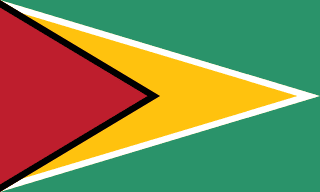
Guyana
Co-operative Republic of Guyana
Population: UN WPP 2024, revision 1, projection for 1 July 2026. Sources and methodology.
Geography and territory
Guyana covers 214,969 square kilometers on the northeastern shoulder of South America, bordered by Venezuela to the west, Brazil to the south and southwest, Suriname to the east, and the Atlantic Ocean to the north. With a population of about 835,986 people, it is the continent’s third-smallest country by area and its only English-speaking nation, a legacy of British colonial rule. The name Guyana derives from an indigenous word meaning “land of many waters,” an apt description for a country crisscrossed by powerful rivers and blanketed in dense tropical forest.
Roughly 80 percent of Guyana’s territory remains covered by pristine rainforest, one of the largest expanses of intact tropical forest left on the planet. The narrow, low-lying coastal strip, much of it below sea level, is where most of the population and agricultural activity are concentrated, protected by an extensive system of sea walls and drainage canals. Inland, the terrain rises gradually toward the Guiana Highlands, a region of table-top mountains known as tepuis, including Mount Roraima, a peak shared with Venezuela and Brazil whose flat summit hosts a strange and isolated ecosystem found nowhere else.
Kaieteur Falls, plunging 226 meters in a single, uninterrupted drop, roughly five times the height of Niagara Falls, ranks among the most spectacular waterfalls on Earth and stands as Guyana’s premier natural landmark. The Essequibo River, Guyana’s longest at more than 1,000 kilometers, drains a vast portion of the country’s interior and is dotted with countless islands and rapids along its course. Together with the Demerara, Berbice, and Corentyne rivers, it has historically shaped settlement patterns, the economy, and transportation throughout the nation, since much of the interior still lacks paved roads connecting it to the coast.
History
Guyana’s territory was originally home to indigenous peoples including the Arawak, Carib, and Warrau, all of whom retain a presence in the country today. Europeans arrived in the late fifteenth century, but it was the Dutch who established the first lasting colonies in the seventeenth century. Dutch settlers built a sugar plantation economy dependent on enslaved labor and engineered the extensive network of dikes and drainage canals that still define the low-lying coastal landscape.
Britain assumed permanent control of the territory in 1814, uniting the colonies of Demerara, Essequibo, and Berbice into what became British Guiana. Following the abolition of slavery in 1834, the colony turned to large-scale importation of indentured laborers from India, China, Portugal, and elsewhere, laying the foundation for the strikingly multiethnic society that characterizes Guyana today. Descendants of enslaved Africans and of Indian indentured laborers now make up the country’s two largest ethnic communities.
Independence arrived on May 26, 1966, and Guyana became a republic in 1970. The decades that followed were marked by ethnic tension between Afro-Guyanese and Indo-Guyanese communities, the cooperative socialism pursued under Forbes Burnham, and persistent economic hardship. The long-running territorial dispute with Venezuela over the Essequibo region, which makes up roughly two-thirds of Guyana’s landmass, remains unresolved and continues to generate diplomatic friction to this day.
Culture and society
Guyanese culture is a striking mosaic shaped by the contributions of its many communities: Amerindians, Afro-Guyanese, Indo-Guyanese, Chinese, Portuguese, and other Europeans. This diversity is on full display in the country’s calendar of festivals, which ranges from Mashramani, a lively celebration of republic status marked by parades and Caribbean music, to Hindu Diwali, the color-drenched Phagwah festival, Christmas, and Muslim Eid, all observed enthusiastically throughout the year.
Guyanese music draws on Caribbean, Indian, and African influences alike. Calypso, chutney (a fusion of Indian melodies with Caribbean rhythms), and reggae all have a strong presence in daily life. The country’s literary tradition has produced internationally acclaimed writers such as Wilson Harris, whose novels probe the relationship between the rainforest landscape and human consciousness, and Martin Carter, the national poet whose work gave voice to the anti-colonial struggle. Georgetown, the capital, retains notable colonial architecture, including St. George’s Cathedral, built entirely of wood and counted among the tallest wooden structures in the world.
With fewer than 800,000 people, Guyanese society is one of the most ethnically diverse in the Americas relative to its size. Cricket, a British colonial inheritance, is by far the most popular sport, and Guyana has produced players of genuine international caliber. Across cuisine, festivals, and everyday life, Guyana’s multiethnic character has produced a culture that, while not free of tension, is genuinely unlike anywhere else in South America.
Economy
Guyana’s economy has undergone a dramatic transformation since 2015, when enormous offshore oil and gas reserves were discovered in the country’s waters. Extraction led by ExxonMobil in the Stabroek Block has since made Guyana one of the fastest-growing economies in the world by GDP. With estimated reserves exceeding 11 billion barrels of oil, this small nation has rapidly become a significant player in the global energy industry.
Before the oil boom, Guyana’s economy rested on gold, bauxite, and diamond mining, agriculture (chiefly sugar, rice, and timber), and fishing. These sectors remain important and continue to employ a substantial share of the workforce, even as oil reshapes the country’s broader economic outlook. The sugar industry, for centuries the backbone of the economy, has declined in recent decades, while rice has emerged as a significant export crop in its own right.
Guyana’s newfound oil wealth brings both opportunity and risk. Oil revenue has the potential to transform infrastructure, education, and healthcare across the country, but it also raises the specter of Dutch disease, corruption, and environmental damage. In response, Guyana has established a sovereign wealth fund to manage petroleum revenues and has sought international support to strengthen governance over its rapidly expanding natural resource sector.
Food and cuisine
Guyanese cuisine directly reflects the country’s ethnic diversity, blending Caribbean, Indian, African, Amerindian, and European flavors into something distinctly its own. Pepperpot, widely regarded as the national dish, is a slow-cooked meat stew, usually beef, simmered with cassareep (a thick seasoning derived from bitter cassava), cinnamon, cloves, and pepper. Famously, a well-maintained pot of pepperpot can be kept simmering for days or even weeks without spoiling, its flavor deepening with time.
Indian influence runs throughout Guyanese cooking. Curry is an everyday preparation, with chicken, goat, duck, and shrimp versions commonly served alongside roti or rice. Dal, a lentil soup, and Guyanese-style chow mein, a local adaptation of Chinese noodles, are staples of daily eating. Cook-up rice, made with rice, beans, coconut, and meat all cooked together in one pot, is Guyana’s answer to comfort food and is traditionally prepared on Saturdays.
Freshwater and saltwater seafood are both abundant, with gilbaka and hassar ranking among the most prized river fish. Tropical fruits such as mango, guava, papaya, sapodilla, and West Indian cherry are enjoyed fresh or blended into juices. Fresh sugarcane juice and mauby, a beverage made from bittersweet tree bark, are popular refreshments. Guyanese rum, especially the Demerara variety, is celebrated internationally for its quality and complex flavor.
Tourism and landmarks
Kaieteur Falls, set within Kaieteur National Park, is Guyana’s most spectacular natural treasure. Its single, uninterrupted 226-meter drop, the largest by volume of any single-drop waterfall in the world, thunders through pristine rainforest accessible only by small aircraft, ensuring visitors a remote and exclusive experience. The surrounding forest is home to the tiny golden Kaieteur frog, the Guianan cock-of-the-rock, and a wealth of hummingbird species.
The Iwokrama rainforest, a nearly one-million-acre reserve at the heart of the country, offers one of the most authentic ecotourism experiences anywhere in South America. Its canopy walkway allows visitors to observe the forest from high above the ground, and local indigenous communities work as guides and hosts throughout the reserve. Further south, the Rupununi River and its surrounding savannas shelter jaguars, giant otters, macaws, black caimans, and a wealth of wildlife that rivals any nature destination on the continent.
Georgetown, the capital, retains a faded colonial charm with its wooden houses, bustling markets, and the imposing St. George’s Cathedral. Mount Roraima, the tepui shared with Venezuela and Brazil, offers a singular trekking experience up to an otherworldly flat summit scattered with strange rock formations, carnivorous plants, and quartz crystals. On the northwest coast, Shell Beach serves as a critical nesting site for four species of sea turtles.
Fun facts about Guyana
- Guyana is the only English-speaking country in South America, a legacy of its history as British Guiana.
- Kaieteur Falls stands roughly five times taller than Niagara Falls and is the largest single-drop waterfall by volume anywhere on Earth.
- More than 80 percent of Guyana’s land remains covered by untouched rainforest, one of the highest proportions of any country in the world.
- Mount Roraima, a tepui on the Venezuelan and Brazilian border, is said to have inspired Arthur Conan Doyle’s novel “The Lost World.”
- Guyana holds one of the largest per-capita oil reserves in the world following major offshore discoveries starting in 2015.
- St. George’s Cathedral in Georgetown, built entirely of wood, is one of the tallest wooden buildings on the planet.
Guyana in numbers
Latest World Bank and UNDP observations, each with its own year. “World median” is the middle value among the countries that report the same indicator; “#” ranks from the highest value.
Population since 1960
Guyana had 569,143 people in 1960 and 835,986 in 2025 — 47% more.
People
26.5% of people live in towns and cities (world median 63.4%). 28.9% are under 15 and 7.0% are 65 or older — a middle-aged population. Women have 2.40 children on average, close to the replacement level of about 2.1.
Economy
The economy grew by 19.3% in real terms in 2025. Consumer prices rose by 3.3% in 2025. Industry makes up the largest share of output (75.1% of GDP); agriculture contributes 7.7%.
Development and environment
UNDP rates human development in Guyana as high, with an index of 0.776 in 2023 (rank 89 of 193). 83.0% of people use the internet and 93.0% have access to electricity. Forest covers 87.1% of the land (world median 32.8%).
Sources: World Bank, World Development Indicators (CC BY 4.0), most recent observation from 2015 onward; UNDP Human Development Report 2025. Retrieved 2026-10-10. Sector shares need not add up to 100% because taxes and subsidies on products are excluded. Missing values are left blank rather than estimated. Sources and methodology.
Climate of Guyana
Averaged across Guyana, the mean temperature stays between 25.5 °C (July) and 27.1 °C (October) — a swing of only 1.6 °C, so seasons are marked by rainfall rather than by heat.
About 2,409 mm of precipitation falls in a typical year. May is the wettest month (362 mm) and October the driest (90 mm). The wettest stretch is May to July, with 43% of the year's total.
Show monthly values as a table
| Month | Mean °C | Low °C | High °C | Precipitation, mm |
|---|---|---|---|---|
| January | 25.7 | 21.4 | 30.0 | 166 |
| February | 25.6 | 21.1 | 30.1 | 146 |
| March | 25.9 | 21.5 | 30.4 | 139 |
| April | 26.0 | 21.8 | 30.4 | 204 |
| May | 25.9 | 21.9 | 30.0 | 362 |
| June | 25.8 | 21.8 | 29.8 | 358 |
| July | 25.5 | 21.4 | 29.8 | 307 |
| August | 26.2 | 21.7 | 30.7 | 214 |
| September | 26.8 | 21.9 | 31.8 | 115 |
| October | 27.1 | 22.0 | 32.2 | 90 |
| November | 26.9 | 22.0 | 31.7 | 123 |
| December | 26.1 | 21.7 | 30.6 | 185 |
Figures are 1991–2020 averages across the whole land area of Guyana, from the World Bank Climate Change Knowledge Portal, CRU TS 4.08 (CC BY 4.0). They are not readings from one weather station: the capital, the coast and high ground can be much warmer, cooler, wetter or drier.
Travel essentials for Guyana
The practical details visitors ask about first. Traffic in Guyana drives on the left, one of 54 of the 196 countries profiled here that do — see the full list.
- Emergency number
- 911
- Driving side
- Left
- Plug types
- Type A, Type B, Type D, Type GA: two flat parallel pins; B: two flat pins plus a round earth pin; D: three large round pins in a triangle; G: three rectangular pins (British)
- Dialling code
- +592From abroad: your exit code, then 592 and the number
- Currency
- Guyanese Dollar (GYD)
- Time zone
- UTC-4Current local time in Guyana
Compiled from IEC plug and voltage standards, national emergency-service listings and the UN road-traffic conventions. Emergency numbers and local coverage can change — confirm them locally on arrival. Guyana's internet domain is .gy.
Where Guyana ranks in the world
Each position counts only the countries with data in that ranking guide. First place is the highest value — for price levels, the most expensive. Select a card to see the full table.
- Population162nd of 196840,890UN projection, July 2026
- Land area82nd of 195211,140 km²World Bank, 2023
- Population density190th of 1943.9 per km²World Bank, 2023
- GDP (nominal)117th of 187$24.7BWorld Bank, 2024, current US$
- GDP per capita40th of 187$29,675World Bank, 2024, current US$
- Life expectancy129th of 19470.3 yearsWorld Bank, 2024
- Price level81st of 16548 (US = 100)ICP 2021, household consumption
Bordering countries of Guyana


Compare Guyana with another country
Frequently asked questions about Guyana
What is the capital of Guyana?
The capital of Guyana is Georgetown.
What is the population of Guyana?
The UN World Population Prospects projection for Guyana is 840,890 people (840,890) on 1 July 2026. National statistical offices may publish different estimates.
What language is spoken in Guyana?
The official language of Guyana is English.
What currency is used in Guyana?
The currency of Guyana is the Guyanese Dollar (GYD).
How big is Guyana?
Guyana covers an area of 214,969 km².
What type of government does Guyana have?
Guyana is a semi-presidential republic.
Which countries border Guyana?
Guyana shares land borders with Venezuela, Brazil, Suriname.
What is the highest point in Guyana?
The highest point in Guyana is Mount Roraima (2,810 m).


