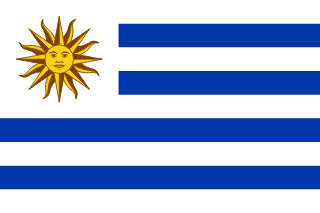
Uruguay
Oriental Republic of Uruguay
Population: UN WPP 2024, revision 1, projection for 1 July 2026. Sources and methodology.
Geography and territory
Uruguay covers 176,215 square kilometers, making it the second-smallest country in South America after Suriname. Tucked along the Atlantic coast between Brazil to the north and Argentina to the west, its terrain rolls gently across low hills and grasslands without any dramatic elevation changes. Cerro Catedral, the country’s highest point, reaches just 514 meters, placing Uruguay among the flattest nations in the region.
An extensive network of waterways shapes the country’s borders and interior. The Uruguay River forms the western boundary with Argentina, the Río de la Plata marks the southern edge, and the Atlantic coastline runs for more than 600 kilometers, alternating between broad sandy beaches and rocky outcrops. Inland, countless rivers and streams feed the natural grasslands that have long defined the country’s ranching economy and rural identity.
Uruguay enjoys a temperate, subtropical climate with no extreme temperature swings and rainfall spread fairly evenly across the year. That combination of fertile soil, abundant water, and mild weather has made Uruguay a disproportionately productive agricultural powerhouse relative to its modest size. The wetlands of Rocha, the Laguna Merín, and the coastal palm groves of the eastern shore form ecosystems of significant ecological value, complemented by dune systems and marine habitats important for conservation.
History
Uruguay’s history was shaped for centuries by its position as contested ground, first between the Spanish and Portuguese empires and later between Argentina and Brazil. The Charrúa people, the territory’s original inhabitants, resisted colonization fiercely, a resistance that ended tragically with their near-total extermination in the early years of the republic. José Gervasio Artigas, revered as the father of the nation, led both the independence struggle and a federalist movement in the early nineteenth century.
After a period of Portuguese and Brazilian rule as the so-called Cisplatine Province, the Crusade of the Thirty-Three Orientals in 1825 and subsequent British mediation paved the way for the founding of the Oriental Republic of Uruguay in 1828, created deliberately as a buffer state between Argentina and Brazil. The decades that followed were dominated by civil wars between the Colorado and Blanco (National) parties, a rivalry that shaped Uruguayan politics for more than a century.
At the turn of the twentieth century, President José Batlle y Ordóñez transformed the country with a series of pioneering social reforms, including the eight-hour workday, divorce initiated by women, free public education, and the separation of church and state, earning Uruguay the nickname “the Switzerland of America.” A military dictatorship ruled from 1973 to 1985, interrupting this democratic tradition, but the restoration of constitutional government put the country back on a path of stability and progressive social policy.
Culture and society
Uruguayan culture is often described as intimate, reflective, and distinctly Rioplatense, sharing with Buenos Aires a cultural sensibility expressed through tango, candombe, and a rich literary tradition. Candombe, a musical genre of African origin performed on three types of drums known as chico, repique, and piano, is recognized as Intangible Cultural Heritage of Humanity and stands as the most authentically Uruguayan art form, filling the streets of Montevideo during the candombe processions of Carnival.
Montevideo’s Carnival is the longest in the world, running for roughly 40 days and featuring murgas — ensembles that blend choral singing, theatrical performance, and biting social satire — alongside candombe troupes, costumed performers, and comedy acts. The murga tradition, a singular fusion of music, theater, and humor, is deeply woven into Uruguayan identity and reflects the society’s critical, irreverent spirit.
Uruguay has produced literary figures of remarkable stature for a country its size. Mario Benedetti, whose poetry and prose captured everyday life with warmth and clarity, remains one of the most widely read Spanish-language authors in the world. Juan Carlos Onetti built an entire fictional universe around the town of Santa María, Horacio Quiroga mastered the short story, Eduardo Galeano wrote the landmark “Open Veins of Latin America,” and poet Juana de Ibarbourou rounds out an exceptional literary tradition. Uruguayan society is notably secular, tolerant, and firmly committed to individual liberties, having been among the earliest countries in the region to extend civil protections and expand social welfare to its citizens.
Football also runs deep in the national character, and success on the world stage looms disproportionately large in how Uruguayans see themselves, a source of collective pride often summed up in the phrase “garra charrúa,” or Charrúa grit, describing the tenacious fighting spirit Uruguayan teams are known for on the pitch.
Economy
Uruguay’s economy rests on agriculture, services, and a growing technology sector. Cattle and sheep ranching, the country’s founding industry, produces high-quality beef exported to demanding markets around the world. Uruguay also ranks as a significant producer of soybeans, rice, wheat, dairy, and wool, while its forestry industry, built on eucalyptus and pine plantations, has grown substantially and now includes large-scale pulp production facilities.
Uruguay has positioned itself as a regional leader in renewable energy, with more than 95 percent of its electricity generated from renewable sources, mainly wind and hydropower — a remarkable achievement given its historical reliance on fossil fuel imports. The information technology sector has expanded rapidly, with Montevideo emerging as a regional tech hub hosting operations centers for international companies alongside a growing startup ecosystem.
Tourism contributes significantly to national income, led by Punta del Este, a glamorous resort destination that draws affluent visitors, particularly from Argentina and Brazil. The free-trade zone at Nueva Palmira, the Port of Montevideo, and a well-developed financial services sector round out an open, diversified economy. Uruguay stands out regionally for its institutional stability, low corruption, and business-friendly environment, factors that have made it one of the most predictable economies in Latin America.
Food and cuisine
Beef dominates Uruguayan cuisine, prized as among the finest in the world thanks to cattle raised on open pasture across the country’s natural grasslands. The asado — meat slow-cooked over wood coals on a parrilla — sits at the center of Uruguayan social life, with family gatherings, celebrations, and weekends built around the grill. Short ribs, flank steak, sausages, blood sausage, and sweetbreads make up a culinary ritual that can stretch on for hours.
The chivito, a hearty sandwich piled with sliced beef, ham, cheese, bacon, lettuce, tomato, fried egg, and mayonnaise, may be Uruguay’s most iconic culinary creation — despite its name, which translates to “little goat,” it contains no goat meat at all. Breaded milanesas, choripán sandwiches, pamplona (stuffed rolled meat), fried dough called tortas fritas eaten on rainy days, and pastries from neighborhood bakeries round out the everyday table.
Mate is far more than a beverage in Uruguay; it is a symbol of national identity and an ever-present social ritual. Uruguayans carry their thermos and mate gourd everywhere, from the office to the beach, and sharing mate is a gesture of friendship and trust. The country’s sweet tooth shows in alfajores, delicate pastries, and chajá, a meringue dessert layered with cream, sponge cake, and peaches that originated in the city of Paysandú. Uruguayan wine, especially Tannat, the country’s signature grape, has earned growing international recognition in recent decades.
Tourism and landmarks
Punta del Este, often called the pearl of the Atlantic, is South America’s most exclusive coastal resort. Its shoreline splits between the calm Playa Mansa on the Río de la Plata and the wilder Playa Brava facing the open Atlantic, connected by the peninsula where La Mano, a sculpture of giant fingers emerging from the sand, has become an iconic photo stop. Casapueblo, the whimsical hillside creation of artist Carlos Páez Vilaró, and Isla de Lobos, home to a large colony of sea lions, add further appeal to this cosmopolitan beach town.
Montevideo, the capital, is home to roughly half the country’s population and offers an authentic, relaxed urban experience. The Ciudad Vieja (Old City) preserves eclectic architecture around Plaza Independencia, the Solís Theatre, the old city gate, and the Mercado del Puerto, a beloved temple of grilled meat and wine. The Rambla, a coastal promenade running more than 20 kilometers, is the city’s most cherished public space.
Colonia del Sacramento, whose historic quarter is a UNESCO World Heritage Site, charms visitors with cobblestone streets, old lampposts, and views over the Río de la Plata within a well-preserved Portuguese colonial town. Cabo Polonio, a village with no electricity accessible only by crossing sand dunes, offers total disconnection alongside sea lions, whale watching, and dazzling starry skies. The hot springs of Salto and Paysandú, the wineries of Canelones, and the rugged landscapes of the Quebrada de los Cuervos round out a varied and welcoming tourism offering.
Fun facts about Uruguay
- Uruguay became the first country in the world to fully legalize the production, sale, and consumption of cannabis, in 2013, a pioneering regulatory model watched closely worldwide.
- Montevideo’s Carnival runs for around 40 days, making it the longest carnival celebration on the planet, even outlasting Rio de Janeiro’s famous festivities.
- Uruguay won the very first FIFA World Cup, hosted in Montevideo in 1930, and won again in 1950 in the legendary upset known as the Maracanazo.
- With a population of just under 3.4 million, Uruguay is home to nearly four head of cattle for every person in the country.
- Former president José Mujica, in office from 2010 to 2015, became known as “the world’s poorest president” for donating about 90 percent of his salary and living on a modest farm.
Uruguay in numbers
Latest World Bank and UNDP observations, each with its own year. “World median” is the middle value among the countries that report the same indicator; “#” ranks from the highest value.
Population since 1960
Uruguay had 2.5 million people in 1960 and 3.4 million in 2025 — 34% more.
People
95.7% of people live in towns and cities (world median 63.4%). 17.9% are under 15 and 16.3% are 65 or older — an ageing population. Women have 1.40 children on average, below the replacement level of about 2.1 needed to keep a population stable in the long run without migration.
Economy
The economy grew by 1.8% in real terms in 2025. Consumer prices rose by 4.7% in 2025. Services make up the largest share of output (65.2% of GDP); agriculture contributes 6.4%.
Development and environment
UNDP rates human development in Uruguay as very high, with an index of 0.862 in 2023 (rank 48 of 193). 92.0% of people use the internet and 100.0% have access to electricity. Forest covers 11.5% of the land (world median 32.8%).
Sources: World Bank, World Development Indicators (CC BY 4.0), most recent observation from 2015 onward; UNDP Human Development Report 2025. Retrieved 2026-10-10. Sector shares need not add up to 100% because taxes and subsidies on products are excluded. Missing values are left blank rather than estimated. Sources and methodology.
Climate of Uruguay
Averaged across Uruguay, the warmest month is January (24.4 °C) and the coolest is July (11.5 °C), a seasonal swing of 12.9 °C. The annual mean is 18.0 °C.
About 1,293 mm of precipitation falls in a typical year. April is the wettest month (139 mm) and July the driest (88 mm). Rain is spread fairly evenly through the year.
Show monthly values as a table
| Month | Mean °C | Low °C | High °C | Precipitation, mm |
|---|---|---|---|---|
| January | 24.4 | 18.7 | 30.2 | 115 |
| February | 23.6 | 18.3 | 29.0 | 116 |
| March | 21.9 | 16.3 | 27.4 | 109 |
| April | 18.4 | 13.3 | 23.6 | 139 |
| May | 14.9 | 10.4 | 19.4 | 113 |
| June | 12.5 | 7.9 | 17.1 | 103 |
| July | 11.5 | 6.8 | 16.2 | 88 |
| August | 13.4 | 8.2 | 18.6 | 89 |
| September | 15.0 | 9.8 | 20.2 | 101 |
| October | 17.6 | 12.4 | 22.9 | 121 |
| November | 20.4 | 14.8 | 26.0 | 92 |
| December | 22.9 | 17.0 | 28.9 | 107 |
Figures are 1991–2020 averages across the whole land area of Uruguay, from the World Bank Climate Change Knowledge Portal, CRU TS 4.08 (CC BY 4.0). They are not readings from one weather station: the capital, the coast and high ground can be much warmer, cooler, wetter or drier.
Travel essentials for Uruguay
The practical details visitors ask about first. Traffic in Uruguay drives on the right, like most of the world. Mains electricity is 230 V at 50 Hz, so devices made only for 110–120 V (common in North America) need a converter unless they are dual-voltage — most phone and laptop chargers are.
- Emergency number
- 911Ambulance 105 · Fire 104
- Driving side
- Right
- Plug types
- Type C, Type F, Type I, Type LC: two round pins (Europlug); F: two round pins with side earth clips (Schuko); I: two angled flat pins plus earth; L: three round pins in a row (Italian)
- Voltage
- 230 V50 Hz
- Dialling code
- +598From abroad: your exit code, then 598 and the number
- Currency
- Uruguayan Peso (UYU)
- Time zone
- UTC-3Current local time in Uruguay
Compiled from IEC plug and voltage standards, national emergency-service listings and the UN road-traffic conventions. Emergency numbers and local coverage can change — confirm them locally on arrival. Uruguay's internet domain is .uy.
Where Uruguay ranks in the world
Each position counts only the countries with data in that ranking guide. First place is the highest value — for price levels, the most expensive. Select a card to see the full table.
- Population133rd of 1963.4 millionUN projection, July 2026
- Land area89th of 195175,020 km²World Bank, 2023
- Population density168th of 19419 per km²World Bank, 2023
- GDP (nominal)79th of 187$82.3BWorld Bank, 2024, current US$
- GDP per capita47th of 187$24,308World Bank, 2024, current US$
- Life expectancy51st of 19478.3 yearsWorld Bank, 2024
- Price level36th of 16568 (US = 100)ICP 2021, household consumption
Bordering countries of Uruguay


Compare Uruguay with another country
Frequently asked questions about Uruguay
What is the capital of Uruguay?
The capital of Uruguay is Montevideo.
What is the population of Uruguay?
The UN World Population Prospects projection for Uruguay is 3,382,537 people (3.4 million) on 1 July 2026. National statistical offices may publish different estimates.
What language is spoken in Uruguay?
The official language of Uruguay is Spanish.
What currency is used in Uruguay?
The currency of Uruguay is the Uruguayan Peso (UYU).
How big is Uruguay?
Uruguay covers an area of 176,215 km².
What type of government does Uruguay have?
Uruguay is a unitary presidential republic.
Which countries border Uruguay?
Uruguay shares land borders with Brazil, Argentina.
What is the highest point in Uruguay?
The highest point in Uruguay is Cerro Catedral (514 m).


