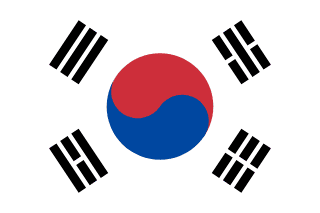
South Korea
Republic of Korea
Population: UN WPP 2024, revision 1, projection for 1 July 2026. Sources and methodology.
Geography and territory
South Korea occupies the southern half of the Korean Peninsula, at the eastern edge of Asia. Covering 100,210 square kilometers, the country borders North Korea to the north along the Demilitarized Zone, while the Yellow Sea washes its western coast and the East Sea, also known as the Sea of Japan, its eastern one. Its highly indented coastline runs roughly 2,400 kilometers and includes thousands of islands, most notably Jeju, of volcanic origin and designated a UNESCO Natural World Heritage site.
South Korean territory is predominantly mountainous, with the main ranges concentrated in the eastern half of the country and gradually descending toward the coastal plains of the west. The Taebaek Mountains run along the east coast, forming a rugged and beautiful shoreline, while the river valleys of the Han, Nakdong, and Geum hold the country’s main agricultural zones. Mount Hallasan, on Jeju Island, is the country’s highest point at 1,950 meters and crowns a spectacular volcanic landscape of lava caves and craters.
South Korea’s climate is humid continental, with four clearly defined seasons. Winters are cold and dry, driven by Siberian winds, while summers are hot and humid due to the Asian monsoon. Spring brings the flowering of cherry blossoms across cities and countryside, and autumn transforms the mountains into a spectacle of red and gold. The country’s ecological diversity spans temperate deciduous forests, internationally significant coastal wetlands, and the rich marine biodiversity of the waters around Jeju.
History
The history of the Korean Peninsula traces back to the legendary founding of the kingdom of Gojoseon in 2333 BCE. The Three Kingdoms of Korea, Goguryeo, Baekje, and Silla, flourished during the first millennium and laid the foundations of Korean culture, including the adoption of Buddhism and the development of sophisticated artistic traditions. Unification under Silla, and later under the Goryeo dynasty, which gave Korea its name, consolidated a distinct national identity.
The Joseon dynasty (1392-1897) represented five centuries of stability and extraordinary cultural achievement. Under King Sejong the Great, hangul, the Korean alphabet, was created, considered one of the most scientific and logical writing systems in the world. The Japanese invasion of 1592 and Japan’s colonization of Korea from 1910 to 1945 were traumatic periods that still shape bilateral relations today. Following liberation in 1945, the division of the peninsula into two occupation zones led to the Korean War (1950-1953).
Postwar South Korea was one of the poorest countries in the world. Yet what became known as the Miracle on the Han River transformed the country into an advanced economy within a single generation. Under authoritarian regimes that drove forced industrialization, and later through democratization achieved in the 1987 protests, South Korea became a prosperous and democratic nation that today exports not only technology and automobiles, but also culture and entertainment to the entire world.
Culture and society
South Korean culture is experiencing an unprecedented moment of global reach, a phenomenon known as Hallyu, or the Korean Wave. K-pop, with groups such as BTS and BLACKPINK, has conquered audiences on every continent. Korean cinema reached a historic milestone when Bong Joon-ho’s “Parasite” became the first non-English-language film to win the Academy Award for Best Picture, in 2020. Korean dramas, such as “Squid Game,” have broken viewership records on global streaming platforms.
Beneath this vibrant modernity, centuries-old traditions endure. Confucianism continues to shape social relationships, respect for elders, and the near-obsessive importance placed on education in South Korean society. Traditional arts such as celadon pottery and pansori, an epic narrative singing style recognized by UNESCO as Intangible Cultural Heritage, along with fan dance, continue to be practiced and reinvented.
Seoul is home to more than 200 museums and blends Joseon-dynasty palaces with cutting-edge contemporary architecture. Korean fashion, centered on the Gangnam district, sets global trends. An obsession with technological innovation has made South Korea one of the most digitally connected societies on the planet, boasting the fastest average internet speeds and early adoption of technologies such as 5G, mobile payments, and artificial intelligence.
Economy
South Korea is the world’s thirteenth-largest economy by nominal GDP, a remarkable achievement for a country devastated by war just seventy years ago. Chaebols, large family-run conglomerates such as Samsung, Hyundai, LG, and SK, lead an export-driven, high-technology economy. Samsung is the world’s largest manufacturer of semiconductors and displays, Hyundai-Kia is one of the planet’s leading automotive groups, and LG competes globally in electronics and electric vehicle batteries.
The technology sector is the main engine of the economy. South Korea invests more in research and development relative to GDP than nearly any other country, translating into leadership in 5G, artificial intelligence, robotics, and biotechnology. The South Korean shipbuilding industry is the second largest in the world, and the country is a major exporter of steel, petrochemicals, and cultural products. E-commerce and video games also generate billions in revenue.
The South Korean economic model, however, carries tensions. Heavy business concentration in the chaebols fuels inequality and makes it harder for entrepreneurs to break through. Extreme workplace pressure, with some of the longest working hours in the OECD, along with fierce educational competition, contributes to social problems such as youth stress. South Korea’s birth rate, the lowest in the world, poses a critical demographic challenge that threatens the long-term sustainability of economic growth.
Food and cuisine
Korean cuisine, centered on balance and fermentation, has grown enormously popular around the world in recent years. Kimchi, fermented cabbage with chili, garlic, and ginger, accompanies nearly every meal and stands as a national symbol recognized by UNESCO as Intangible Cultural Heritage. Every family has its own recipe passed down through generations, and the collective kimchi-making process known as kimjang is itself a protected tradition.
Korean barbecue, or gogigui, is perhaps the most popular dining experience among visitors: marinated meats such as bulgogi and galbi ribs are grilled tableside, accompanied by an array of banchan side dishes. Bibimbap, rice served in a hot stone bowl with vegetables, meat, egg, and gochujang sauce, embodies the Korean philosophy of mixing diverse ingredients into harmony. Cold naengmyeon noodles, pajeon pancakes, and kimchi jjigae stew round out a comforting everyday repertoire.
South Korean street food culture is vibrant and accessible. Tteokbokki, spicy rice cakes, crispy Korean fried chicken, hotteok, sweet pancakes filled with brown sugar, and bungeoppang, fish-shaped pastries filled with red bean paste, are irresistible temptations in Seoul’s night markets. Soju, a distilled rice spirit, is the most consumed alcoholic beverage in the world by volume, and the culture of anju, food paired with drinks, turns every social gathering into a feast.
Tourism and landmarks
Seoul fascinates visitors with its blend of ancient and ultramodern. The five grand palaces of the Joseon dynasty, particularly Gyeongbokgung with its spectacular changing of the guard ceremony, offer a window into the imperial past, while the Myeongdong district buzzes with cosmetics and fashion shops. The Bukchon Hanok Village, with its restored traditional houses, has become one of the most photographed corners of Asia. N Seoul Tower, atop Namsan Mountain, offers unforgettable nighttime panoramic views.
The Demilitarized Zone (DMZ), separating the two Koreas, is paradoxically one of the world’s most singular tourist destinations. The Joint Security Area at Panmunjom allows visitors to glimpse, quite literally, the most heavily guarded border on the planet. In contrast, Jeju Island, Korea’s most popular vacation destination, offers volcanic beaches, UNESCO-listed lava caves, spectacular waterfalls, and the picturesque haenyeo, traditional female divers who harvest shellfish by hand.
Beyond Seoul, the coastal city of Busan draws visitors with its fish markets, Haeundae Beach, and the colorful village of Gamcheon. Gyeongju, the ancient capital of the Silla kingdom, is an open-air museum with royal burial mounds, Bulguksa Temple, and the Seokguram Grotto. Mountain Buddhist temples such as Haeinsa, home to the Tripitaka Koreana woodblocks, and the historic villages of Hahoe and Yangdong offer immersion in Korea’s more traditional and contemplative side.
Fun facts about South Korea
- South Korea has one of the highest life expectancies in the world, averaging around 83 years, alongside one of the most efficient healthcare systems on the planet
- Korean is the only language spoken exclusively on the Korean Peninsula, and the hangul alphabet was scientifically designed in 1443 by King Sejong
- The Seoul Metro is one of the most extensive and advanced in the world, offering free wifi in every station and car, with signage in four languages
- South Korea has the fastest average internet speed in the world and was the first country to launch a nationwide commercial 5G network
- Taekwondo, a martial art born in Korea, is practiced by more than 80 million people in 210 countries and has been an Olympic sport since 2000
- South Koreans traditionally add a year to their age at birth under the Korean age-counting system, though the country has recently moved to standardize with the international system
South Korea in numbers
Latest World Bank and UNDP observations, each with its own year. “World median” is the middle value among the countries that report the same indicator; “#” ranks from the highest value.
Population since 1960
South Korea had 25.0 million people in 1960 and 51.7 million in 2025 — 2.1 times as many.
People
81.2% of people live in towns and cities (world median 63.4%). 10.2% are under 15 and 20.3% are 65 or older — one of the oldest age structures in the world. Women have 0.75 children on average, below the replacement level of about 2.1 needed to keep a population stable in the long run without migration.
Economy
The economy grew by 1.0% in real terms in 2025. Consumer prices rose by 2.1% in 2025. Services make up the largest share of output (57.2% of GDP); agriculture contributes 1.5%.
Development and environment
UNDP rates human development in South Korea as very high, with an index of 0.937 in 2023 (rank 20 of 193). 97.9% of people use the internet and 100.0% have access to electricity. Forest covers 64.4% of the land (world median 32.8%).
Sources: World Bank, World Development Indicators (CC BY 4.0), most recent observation from 2015 onward; UNDP Human Development Report 2025. Retrieved 2026-10-10. Sector shares need not add up to 100% because taxes and subsidies on products are excluded. Missing values are left blank rather than estimated. Sources and methodology.
Climate of South Korea
Averaged across South Korea, the warmest month is August (25.1 °C) and the coolest is January (−1.7 °C), a seasonal swing of 26.8 °C. The annual mean is 12.2 °C.
1 month has a national mean temperature below freezing.
About 1,370 mm of precipitation falls in a typical year. July is the wettest month (301 mm) and January the driest (27 mm). The three wettest consecutive months, June to August, bring 55% of the year's total — a pronounced rainy season.
Show monthly values as a table
| Month | Mean °C | Low °C | High °C | Precipitation, mm |
|---|---|---|---|---|
| January | −1.7 | −6.8 | 3.4 | 27 |
| February | 0.6 | −4.9 | 6.0 | 38 |
| March | 5.7 | −0.1 | 11.5 | 56 |
| April | 11.6 | 5.3 | 18.0 | 93 |
| May | 16.9 | 10.8 | 23.1 | 109 |
| June | 21.3 | 16.3 | 26.3 | 166 |
| July | 24.5 | 20.6 | 28.4 | 301 |
| August | 25.1 | 21.0 | 29.3 | 287 |
| September | 20.3 | 15.4 | 25.3 | 152 |
| October | 14.3 | 8.4 | 20.2 | 64 |
| November | 7.2 | 1.8 | 12.7 | 49 |
| December | 0.6 | −4.5 | 5.8 | 29 |
Figures are 1991–2020 averages across the whole land area of South Korea, from the World Bank Climate Change Knowledge Portal, CRU TS 4.08 (CC BY 4.0). They are not readings from one weather station: the capital, the coast and high ground can be much warmer, cooler, wetter or drier.
Travel essentials for South Korea
The practical details visitors ask about first. Traffic in South Korea drives on the right, like most of the world. Mains electricity is 220 V at 60 Hz, so devices made only for 110–120 V (common in North America) need a converter unless they are dual-voltage — most phone and laptop chargers are.
- Emergency number
- 112Ambulance 119 · Fire 119
- Driving side
- Right
- Plug types
- Type C, Type FC: two round pins (Europlug); F: two round pins with side earth clips (Schuko)
- Voltage
- 220 V60 Hz
- Dialling code
- +82From abroad: your exit code, then 82 and the number
- Currency
- South Korean Won (KRW)
- Time zone
- KST (UTC+9)Current local time in South Korea
Compiled from IEC plug and voltage standards, national emergency-service listings and the UN road-traffic conventions. Emergency numbers and local coverage can change — confirm them locally on arrival. South Korea's internet domain is .kr.
Where South Korea ranks in the world
Each position counts only the countries with data in that ranking guide. First place is the highest value — for price levels, the most expensive. Select a card to see the full table.
- Population31st of 19651.6 millionUN projection, July 2026
- Land area105th of 19597,600 km²World Bank, 2023
- Population density16th of 194530 per km²World Bank, 2023
- GDP (nominal)12th of 187$1.88TWorld Bank, 2024, current US$
- GDP per capita30th of 187$36,239World Bank, 2024, current US$
- Life expectancy11th of 19483.6 yearsWorld Bank, 2024
- Price level22nd of 16582 (US = 100)ICP 2021, household consumption
Bordering countries of South Korea

Compare South Korea with another country
Frequently asked questions about South Korea
What is the capital of South Korea?
The capital of South Korea is Seoul.
What is the population of South Korea?
The UN World Population Prospects projection for South Korea is 51,600,388 people (51.6 million) on 1 July 2026. National statistical offices may publish different estimates.
What language is spoken in South Korea?
The official language of South Korea is Korean.
What currency is used in South Korea?
The currency of South Korea is the South Korean Won (KRW).
How big is South Korea?
South Korea covers an area of 100,210 km².
What type of government does South Korea have?
South Korea is a presidential republic.
Which countries border South Korea?
South Korea shares land borders with North Korea.
What is the highest point in South Korea?
The highest point in South Korea is Hallasan (1,950 m, Jeju Island).


