Flag of Kiribati
Republic of Kiribati
Flag details
- Country
- Kiribati
- Official name
- Republic of Kiribati
- Capital
- Tarawa
- ISO code
- KI / KIR
- Region
- Micronesia
Flag colors
- #c8101044%
- #ffffff22%
- #18307021%
Share of the flag's surface, measured from the image.
Download the flag
Meaning and history of the flag of Kiribati
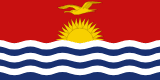
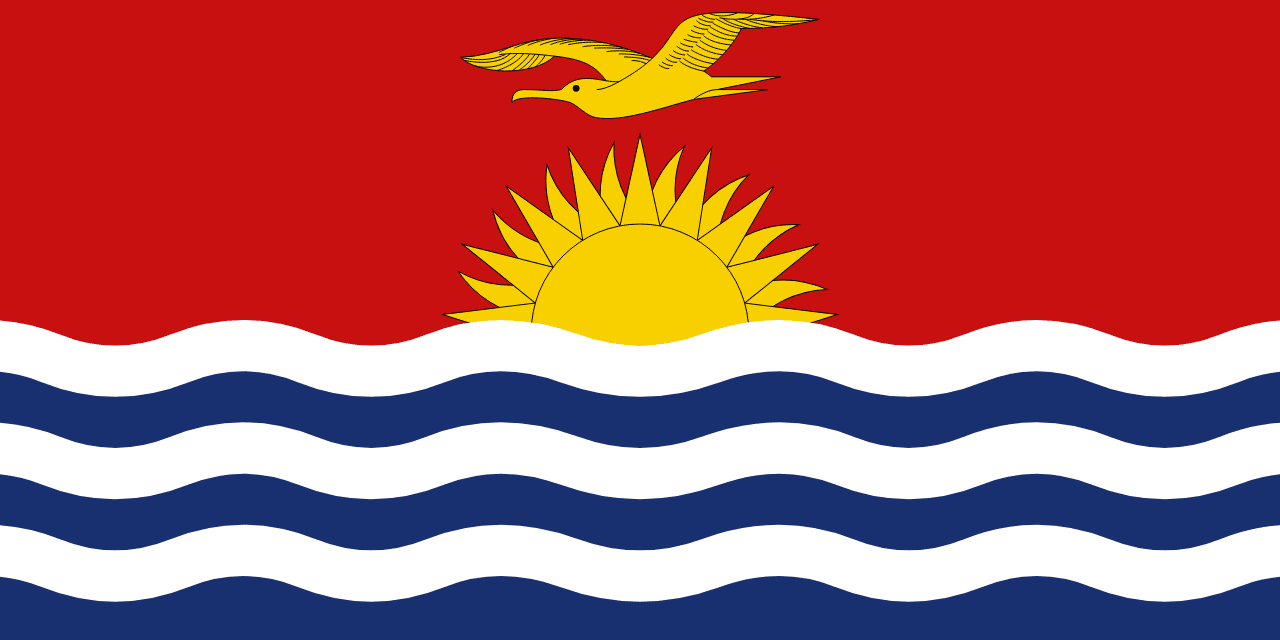
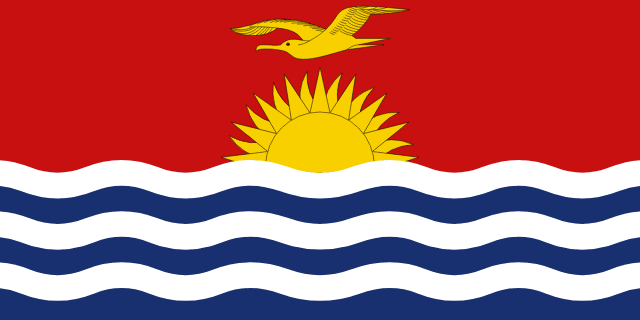
Kiribati's flag is a striking design with a red upper half and a lower half made up of six wavy stripes alternating blue and white, representing the Pacific Ocean. Against the red field above flies a golden frigatebird soaring over a rising golden sun with 17 rays. The frigatebird is a symbol of freedom, power, and authority in Kiribati's culture, while the rising sun reflects the country's position straddling the International Date Line.
The flag was adopted on July 12, 1979, when the British colony of the Gilbert Islands gained independence and became the Republic of Kiribati. The design was created by Sir Arthur Grimble in 1932 as a colonial coat of arms and was later adapted into the national flag. The sun's 17 rays represent the 16 Gilbert Islands plus Banaba Island, while the three blue and three white stripes symbolize the country's three island groups: the Gilbert, Phoenix, and Line Islands.
Kiribati's flag is one of the most pictorial and descriptive in the world, reading more like an illustration than a traditional heraldic design. The wavy lines across the lower half give it a character unlike any other national flag. It is also one of the few flags to depict a bird in full flight as its central element, setting it apart from the static heraldic eagles found on many other flags. The design perfectly captures the essence of this Pacific island nation.
You can view the flag of Kiribati in high resolution above and download it in several sizes for personal, educational or reference use. To explore more, visit the full Kiribati profile, its map, or the current local time in Tarawa.