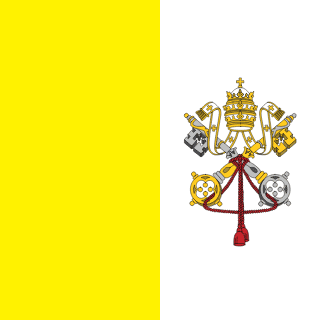
Vatican City
Vatican City State
Population: UN WPP 2024, revision 1, projection for 1 July 2026. Sources and methodology.
Geography and territory
Vatican City is the smallest sovereign state on Earth, measured by both territory and population. It covers a mere 0.44 square kilometers and is home to roughly 825 people, figures so small that the entire country could sit inside many public parks. Wholly enclosed within the city of Rome on the west bank of the Tiber River, Vatican City occupies Vatican Hill and the adjoining plain. Renaissance-era walls trace almost the entire boundary; the sole exception is St. Peter’s Square, where the border with Italy is marked simply by a line of travertine stone set into the pavement.
Within this compact footprint sits an extraordinary concentration of monuments: the vast St. Peter’s Square, St. Peter’s Basilica itself, the Vatican Museums, the Apostolic Palace, and the Sistine Chapel. The Vatican Gardens alone occupy more than half of the entire state’s land area. Beyond its own walls, the Holy See also holds extraterritorial rights over several churches and properties scattered across Rome, including the Basilica of St. John Lateran, Santa Maria Maggiore, and the papal residence at Castel Gandolfo in the Alban Hills.
Vatican Hill itself rises to just 75 meters, the state’s modest high point. Laid out during the Renaissance and Baroque periods, the Vatican Gardens combine fountains, statuary, a replica of the Lourdes grotto, and lush Mediterranean plantings. Despite its diminutive size, the country maintains a surprisingly full set of national infrastructure: a railway station, a heliport, its own post office, a pharmacy, a small supermarket, and a radio station, all packed into a territory smaller than most golf courses.
History
The Vatican’s role as the seat of the papacy stretches back to the earliest centuries of Christianity. Tradition holds that the apostle Peter was martyred and buried on Vatican Hill during Nero’s persecutions around 64 CE. In the fourth century, Emperor Constantine ordered the construction of the first basilica over the apostle’s tomb, cementing the site as the spiritual heart of Western Christendom.
Through the medieval period and into the Renaissance, popes ruled the Papal States, a broad swath of central Italy governed directly by the Church. Renaissance patron-popes such as Julius II, Leo X, and Sixtus IV turned the Vatican into an unrivaled artistic center, commissioning Michelangelo, Raphael, Bramante, and later Bernini to produce works that made St. Peter’s Basilica and the Sistine Chapel among humanity’s greatest artistic achievements.
Italian unification in 1870 stripped the papacy of the Papal States, opening the so-called Roman Question, a decades-long standoff during which popes considered themselves virtual prisoners within the Vatican walls. The dispute was finally settled by the 1929 Lateran Pacts, signed by Pope Pius XI and Benito Mussolini’s government, which formally recognized Vatican City as a sovereign state and defined relations between the Holy See and Italy. The Second Vatican Council of 1962-1965 reshaped Catholic practice for the modern era, and the long pontificates of John Paul II, Benedict XVI, and Francis carried Vatican influence onto the world stage. Following Pope Francis’s death in April 2025, the College of Cardinals elected Leo XIV, born Robert Francis Prevost, the first pope in history to hail from the United States.
Culture and society
Per square meter, Vatican City almost certainly holds the greatest concentration of art and cultural heritage anywhere in the world. The Vatican Museums house one of humanity’s most extraordinary collections, assembled through more than five centuries of papal patronage. The Sistine Chapel, with Michelangelo’s ceiling frescoes of the Creation of Adam and his monumental Last Judgment on the altar wall, along with Raphael’s nearby Rooms and their masterpiece The School of Athens, represent the summit of Renaissance art.
The Vatican Apostolic Library, formally founded in 1475, safeguards more than 80,000 manuscripts, 1.6 million printed books, and 150,000 engravings, making it one of the most valuable repositories of knowledge on the planet. Among its treasures is the Codex Vaticanus, one of the oldest surviving biblical manuscripts. The Vatican Apostolic Archives, renamed from the “Secret Archives” in 2019, preserve papal correspondence spanning over a thousand years of history.
Daily life inside Vatican City revolves entirely around the spiritual and administrative functions of the Holy See. Its small resident population includes cardinals, priests, religious sisters, members of the Swiss Guard, and lay staff. Founded in 1506, the Swiss Guard is the smallest standing military force in the world, tasked with the pope’s personal protection and instantly recognizable in Renaissance-style uniforms traditionally attributed to Michelangelo’s design. Latin remains the official language of papal documents, while Italian serves as the everyday language of communication.
Economy
Vatican City’s economy is unlike any other in the world, because it does not follow ordinary patterns of production and trade but instead exists to support the Holy See’s mission as the spiritual center of the Catholic Church. There is no published gross domestic product or Human Development Index figure for Vatican City, since it lacks a conventional productive economy in the usual statistical sense. Instead, its finances rest on several distinctive pillars: contributions from Catholic dioceses worldwide, known as Peter’s Pence; financial investments managed through the Institute for the Works of Religion, commonly called the Vatican Bank; the sale of postage stamps and commemorative coins; and admission revenue from the Vatican Museums.
The Museums alone draw more than six million visitors annually, and ticket sales form one of the state’s principal income streams. The Vatican Publishing House produces official texts and documents, the centuries-old Vatican Pharmacy serves residents and authorized visitors alike, and Vatican Radio, founded by Guglielmo Marconi in 1931, together with the Vatican Television Center, broadcasts the pope’s activities to a global audience.
Vatican City mints its own limited-run euro coins, prized by collectors worldwide, and its postage stamps are similarly sought after by philatelists. The state employs roughly 4,800 people, the great majority of whom live outside its walls in greater Rome. In recent decades, the Vatican has pursued financial reforms aimed at increasing transparency and bringing its institutions into line with international standards against money laundering.
Food and cuisine
Vatican City has no culinary tradition distinct from that of Italy; its kitchens draw directly on the rich cooking of Rome and the surrounding Lazio region. Papal kitchens have historically served classic Italian dishes, adjusted according to the occasion for either simplicity or celebration. During his pontificate from 2013 to 2025, the Argentine-born Pope Francis occasionally brought touches of South American home cooking into private meals at the Apostolic Palace.
Visitors to the Vatican Museums can sample Roman staples at the on-site cafeteria and dining hall, including pasta all’amatriciana, cacio e pepe, and saltimbocca alla romana. Most of the state’s food service, however, exists to feed its resident staff and employees rather than tourists. The Vatican Pharmacy also produces natural remedies and traditional preparations, while a small internal supermarket, accessible only to employees and residents, sells discounted Italian and imported goods.
Tucked within the Vatican Gardens is a small kitchen garden that has supplied vegetables and aromatic herbs for internal use for centuries. Wines served at papal tables have traditionally come from the pontifical estate at Castel Gandolfo, in the nearby Castelli Romani hills, supplemented by donations from vintners around the world. Formal papal celebrations and state dinners feature carefully composed menus that blend refined Italian cuisine with liturgical symbolism appropriate to each occasion.
Tourism and landmarks
St. Peter’s Basilica is the largest church in Christendom and one of the most awe-inspiring feats of architecture ever built. Its dome, designed by Michelangelo, soars to 136 meters and rewards visitors who climb its 551 steps with a sweeping panorama of Rome. Inside, the basilica holds Michelangelo’s Pietà, Bernini’s towering bronze baldachin over the papal altar, and the tomb of St. Peter in the grottoes below. Fronting the basilica, St. Peter’s Square is framed by Bernini’s elliptical colonnade of 284 columns, the setting for papal audiences and the famous urbi et orbi blessings.
The Vatican Museums offer a roughly seven-kilometer route through 54 galleries spanning art from ancient Egypt to the modern era. The Gallery of Maps, with its sixteenth-century cartographic frescoes, and the Gallery of Candelabra lead visitors toward the Raphael Rooms before culminating in the Sistine Chapel, whose ceiling, painted by Michelangelo between 1508 and 1512, is widely regarded as one of the supreme achievements of human artistry. The Pio-Clementino Museum houses classical sculptures including the Apollo Belvedere and the Laocoön.
The Vatican Gardens, covering more than half the country’s territory, can be toured by advance reservation and offer a tranquil escape with Renaissance fountains, groves of pine and cypress, and unique views of St. Peter’s dome. Beneath the basilica, the Vatican Necropolis allows visitors to explore excavations that uncovered the tomb long attributed to St. Peter. The pope’s general audiences, held on Wednesdays in the square or in the Paul VI Audience Hall, offer a memorable experience open to the public free of charge.
Fun facts about Vatican City
- Vatican City is the smallest sovereign state in the world, covering just 0.44 square kilometers with a population of only about 825 people.
- The Swiss Guard, the pontiff’s protective force since 1506, is the smallest standing army on Earth; its members must be Swiss, Catholic, and unmarried.
- St. Peter’s Basilica took more than 120 years to complete, with successive architects including Bramante, Raphael, Sangallo, and Michelangelo all contributing to its design.
- The Vatican operates its own postal service, widely considered more reliable than Italy’s, prompting many Romans to mail letters from Vatican post boxes.
- The Vatican Museums welcome more than six million visitors each year, ranking among the most visited museum complexes on the planet.
- Vatican City has its own railway station, opened in 1934, though today it is used almost exclusively for freight and occasional papal travel rather than passenger service.
Climate of Vatican City
Averaged across Vatican City, the warmest month is August (25.1 °C) and the coolest is January (8.8 °C), a seasonal swing of 16.3 °C. The annual mean is 16.3 °C.
About 700 mm of precipitation falls in a typical year. November is the wettest month (116 mm) and July the driest (12 mm). The wettest stretch is October to December, with 43% of the year's total.
Show monthly values as a table
| Month | Mean °C | Low °C | High °C | Precipitation, mm |
|---|---|---|---|---|
| January | 8.8 | 4.5 | 13.2 | 64 |
| February | 9.2 | 4.5 | 13.8 | 59 |
| March | 11.3 | 6.5 | 16.2 | 48 |
| April | 14.1 | 9.1 | 19.1 | 53 |
| May | 17.9 | 12.7 | 23.2 | 38 |
| June | 22.0 | 16.6 | 27.5 | 30 |
| July | 24.8 | 19.3 | 30.4 | 12 |
| August | 25.1 | 19.6 | 30.7 | 20 |
| September | 21.6 | 16.5 | 26.8 | 75 |
| October | 17.7 | 13.0 | 22.5 | 91 |
| November | 13.3 | 9.1 | 17.6 | 116 |
| December | 9.8 | 5.8 | 13.9 | 94 |
Figures are 1991–2020 averages across the whole land area of Vatican City, from the World Bank Climate Change Knowledge Portal, CRU TS 4.08 (CC BY 4.0). They are not readings from one weather station: the capital, the coast and high ground can be much warmer, cooler, wetter or drier.
Travel essentials for Vatican City
The practical details visitors ask about first. Traffic in Vatican City drives on the right, like most of the world. Mains electricity is 230 V at 50 Hz, so devices made only for 110–120 V (common in North America) need a converter unless they are dual-voltage — most phone and laptop chargers are.
- Emergency number
- 112
- Driving side
- Right
- Plug types
- Type C, Type F, Type LC: two round pins (Europlug); F: two round pins with side earth clips (Schuko); L: three round pins in a row (Italian)
- Voltage
- 230 V50 Hz
- Dialling code
- +379From abroad: your exit code, then 379 and the number
- Currency
- Euro (EUR)
- Time zone
- CET (UTC+1)Current local time in Vatican City
Compiled from IEC plug and voltage standards, national emergency-service listings and the UN road-traffic conventions. Emergency numbers and local coverage can change — confirm them locally on arrival. Vatican City's internet domain is .va.
Where Vatican City ranks in the world
Each position counts only the countries with data in that ranking guide. First place is the highest value — for price levels, the most expensive. Select a card to see the full table.
Bordering countries of Vatican City

Compare Vatican City with another country
Frequently asked questions about Vatican City
What is the capital of Vatican City?
The capital of Vatican City is Vatican City.
What is the population of Vatican City?
The UN World Population Prospects projection for Vatican City is 506 people (506) on 1 July 2026. National statistical offices may publish different estimates.
What language is spoken in Vatican City?
The official language of Vatican City is Italian (official), Latin (liturgical).
What currency is used in Vatican City?
The currency of Vatican City is the Euro (EUR).
How big is Vatican City?
Vatican City covers an area of 0.44 km².
What type of government does Vatican City have?
Vatican City is a elective theocratic absolute monarchy.
Which countries border Vatican City?
Vatican City shares land borders with Italy.
What is the highest point in Vatican City?
The highest point in Vatican City is Vatican Hill (75 m).


