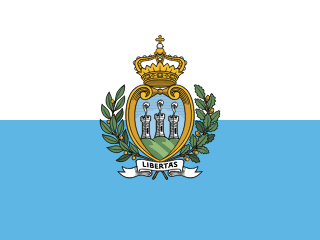
San Marino
Most Serene Republic of San Marino
Population: UN WPP 2024, revision 1, projection for 1 July 2026. Sources and methodology.
Geography and territory
San Marino is a microstate entirely surrounded by Italian territory, perched on the slopes of Mount Titano near Italy’s Emilia-Romagna region, just a short distance from the Adriatic coast. With a total area of only 61 square kilometers and a population of just 34,109, it ranks among the smallest countries in Europe and the smallest sovereign states in the world that are not city-states in the strictest sense. The country’s territory unfolds across the hills and valleys surrounding Mount Titano, whose 739-meter summit dominates the landscape and serves as the enduring symbol of the nation.
The terrain is hilly and rugged, with Mount Titano’s three peaks forming the geographic and symbolic center of the country, each crowned by a medieval tower depicted on the national flag and coat of arms. The slopes ease gently eastward into cultivated hillsides and woodlands of oak and chestnut. San Marino has no significant permanent rivers or lakes, and its modest water network consists mainly of seasonal streams flowing down from Mount Titano.
The climate is Mediterranean with continental influences, bringing hot, dry summers and cool winters with occasional snow on the higher peaks. The Adriatic Sea lies just 10 kilometers away as the crow flies, moderating temperatures and adding humidity to the air. From the heights of Mount Titano, panoramic views stretch to the Adriatic coastline and, on clear days, all the way to the Apennine mountains of the Italian interior, a vista striking enough to justify a visit on its own.
History
San Marino claims the distinction of being the world’s oldest continuously functioning republic, with a tradition of self-government tracing back to the year 301 AD. According to founding legend, a Christian stonemason named Marinus, originally from the island of Rab in present-day Croatia, fled persecution under Emperor Diocletian and took refuge on Mount Titano, where he established a small Christian community. That community grew steadily while preserving its independence from the powers surrounding it.
The earliest historical documents referencing the Sammarinese community date to the tenth century. Over the course of the Middle Ages, San Marino developed remarkably advanced republican institutions, including a Grand and General Council as its legislature and two Captains Regent who have served jointly as heads of state, with terms renewed every six months since the thirteenth century. The Statutes of 1600, which codified existing law, rank among the oldest written constitutions still in use anywhere in the world.
San Marino withstood attempted conquest by Cesare Borgia, papal ambitions, and the upheaval of the Napoleonic Wars, preserving its independence through diplomatic skill and the natural protection of Mount Titano. Abraham Lincoln once wrote to the republic expressing his admiration for its enduring republican tradition. During the Second World War, San Marino declared itself neutral and sheltered more than 100,000 Italian refugees, a number many times its own population. In 2008, the historic center of San Marino and Mount Titano were designated a UNESCO World Heritage Site.
Culture and society
Sammarinese culture is deeply rooted in Italian tradition, sharing language, religion, and customs with its larger neighbor, yet it retains a distinct identity shaped by centuries of independence and self-rule. Pride in the republic and its institutions runs deep, and the investiture ceremony for the Captains Regent, held every April 1 and October 1, stands as the country’s most solemn civic occasion, marked by military parades, flags, and music.
Popular traditions include the Feast of Saint Marinus on September 3, the national day commemorating the country’s legendary founding, celebrated with historical processions, medieval crossbow competitions, and religious ceremonies at the Basilica of San Marino. Crossbow shooting is the country’s signature traditional sport, practiced by the Federation of Crossbowmen since the Middle Ages, and matches between teams from the country’s different districts spark genuine local rivalry.
Sammarinese society is compact and close-knit, with strong community bonds within each of the nine municipalities, known as castelli, that make up the country. Social life centers on family, civic associations, and religious and civic festivals. San Marino maintains one of the lowest crime rates in the world alongside an advanced social welfare system. Its postage stamps enjoy renown among collectors worldwide for their artistic quality and represent a small but symbolic source of state revenue.
Economy
San Marino’s economy has evolved from an agricultural and artisanal base into a diversified modern model, delivering a standard of living comparable to Europe’s wealthiest nations. Tourism is the most visible sector, drawing more than two million visitors each year, a figure many times the resident population, who come for the historic heritage, sweeping views, and duty-free shopping.
Light industry plays a substantial role in the economy, with production spanning ceramics, electronics, textiles, furniture, and quality food products. Banking and financial services have traditionally held an important place as well, though San Marino has had to adapt to international standards of fiscal transparency in recent years. Artisanal manufacturing of ceramics, leather goods, and gourmet food items adds further value and supports local employment.
San Marino uses the euro as its official currency under a special agreement with the European Union and mints its own euro coins with unique designs that are highly sought after by collectors. The country is not an EU member but maintains close economic cooperation with Italy, on which it depends for the bulk of its imports and services. The sale of commemorative stamps and coins remains a distinctive source of revenue, drawing on the microstate’s outsized reputation among numismatists and philatelists.
Food and cuisine
Sammarinese cuisine is essentially that of Italy’s Emilia-Romagna and Marche regions, among the richest culinary traditions in the country, adapted with local touches. Filled pastas take center stage: cappelletti in brodo, small hat-shaped pasta stuffed with meat and cheese and served in broth, and passatelli, cylinders of breadcrumbs, parmesan, and egg cooked in broth, represent the quintessence of local cooking.
Piada, San Marino’s version of the flatbread known elsewhere as piadina romagnola, is an unleavened bread cooked on a griddle and filled with ham, cheese, arugula, and vegetables. Nidi di rondine, or “swallows’ nests,” are baked cannelloni filled with ham, cheese, and béchamel, a beloved dish for special occasions. Pork and rabbit, roasted or grilled, along with fagioli con le cotiche, beans cooked with pork rind, round out a repertoire of hearty, comforting flavors.
Local wine deserves special attention. Vineyards on the slopes of Mount Titano produce wines under their own designation of origin, including Biancale, a crisp and aromatic white, and Brugneto, a robust red made from the Sangiovese grape. Bustrengo, a rustic cake made from cornmeal, nuts, raisins, and honey, is the traditional dessert, while castagnaccio, a chestnut-flour cake, and artisanal gelato in classic flavors complete an irresistible array of sweets.
Tourism and landmarks
The three towers of Mount Titano stand as San Marino’s unmistakable symbol and its foremost tourist attraction. Guaita, the First Tower, built in the eleventh century, is the oldest and most visited, offering sweeping views from its battlements. Cesta, the Second Tower, sits atop the highest peak and houses a museum of ancient weapons. Montale, the Third Tower, is the smallest and has restricted public access, completing the trio that appears on the national flag. A scenic footpath connects all three towers along the ridge of the mountain.
The historic center of San Marino, a UNESCO World Heritage Site, invites exploration on foot along cobblestone streets lined with stone palaces, artisan shops, and restaurants with panoramic terraces. The Palazzo Pubblico, the seat of government since 1894, presides over Liberty Square with its elegant neo-Gothic facade. The Basilica of San Marino, built in neoclassical style, holds the relics of the republic’s founding saint, while the Church of San Francesco preserves fine works of Renaissance art.
San Marino’s museums offer surprising variety for such a small country: the State Museum traces the nation’s history, the Museum of Ancient Weapons inside the Second Tower displays centuries of arms and armor, and the Museum of Curiosities showcases unusual objects gathered from around the world. The nearby Ferrari Museum, a nod to San Marino’s proximity to Maranello, draws motorsport enthusiasts. The panoramic views from Mount Titano, which on clear days reach the Adriatic coast and the Apennines, remain an unforgettable experience for every visitor.
Fun facts about San Marino
- San Marino is widely considered the world’s oldest continuously functioning republic, tracing its founding to the year 301 AD.
- The country has two heads of state at once, the Captains Regent, who serve jointly and are replaced every six months, one of the shortest terms of office anywhere in the world.
- During the Second World War, San Marino sheltered more than 100,000 Italian refugees, a number several times larger than its own population.
- Abraham Lincoln wrote a letter to San Marino in 1861 praising it as one of the most honored governments in history.
- San Marino has one of the highest ratios of registered vehicles to residents in the world, with more cars than people.
- Sammarinese postage stamps have been famous worldwide since the nineteenth century and remain a source of state revenue to this day.
San Marino in numbers
Latest World Bank and UNDP observations, each with its own year. “World median” is the middle value among the countries that report the same indicator; “#” ranks from the highest value.
Population since 1960
San Marino had 15,428 people in 1960 and 34,109 in 2025 — 2.2 times as many.
People
97.2% of people live in towns and cities (world median 63.4%). 11.9% are under 15 and 23.1% are 65 or older — one of the oldest age structures in the world. Women have 1.16 children on average, below the replacement level of about 2.1 needed to keep a population stable in the long run without migration.
Economy
The economy grew by 0.4% in real terms in 2023. Consumer prices rose by 2.3% in 2025. Services make up the largest share of output (56.9% of GDP); agriculture contributes 0.0%.
Development and environment
UNDP rates human development in San Marino as very high, with an index of 0.915 in 2023 (rank 29 of 193). 97.4% of people use the internet and 100.0% have access to electricity. Forest covers 16.3% of the land (world median 32.8%).
Sources: World Bank, World Development Indicators (CC BY 4.0), most recent observation from 2015 onward; UNDP Human Development Report 2025. Retrieved 2026-10-10. Sector shares need not add up to 100% because taxes and subsidies on products are excluded. Missing values are left blank rather than estimated. Sources and methodology.
Climate of San Marino
Averaged across San Marino, the warmest month is August (22.6 °C) and the coolest is January (3.9 °C), a seasonal swing of 18.7 °C. The annual mean is 12.8 °C.
About 865 mm of precipitation falls in a typical year. November is the wettest month (128 mm) and July the driest (44 mm). The wettest stretch is September to November, with 36% of the year's total.
Show monthly values as a table
| Month | Mean °C | Low °C | High °C | Precipitation, mm |
|---|---|---|---|---|
| January | 3.9 | 1.0 | 6.8 | 54 |
| February | 4.7 | 1.4 | 8.0 | 55 |
| March | 7.7 | 3.8 | 11.6 | 59 |
| April | 11.4 | 7.2 | 15.6 | 77 |
| May | 15.7 | 11.2 | 20.2 | 76 |
| June | 19.7 | 15.0 | 24.5 | 62 |
| July | 22.5 | 17.4 | 27.6 | 44 |
| August | 22.6 | 17.7 | 27.6 | 50 |
| September | 17.9 | 13.6 | 22.2 | 90 |
| October | 13.4 | 10.0 | 16.9 | 93 |
| November | 9.0 | 6.0 | 12.0 | 128 |
| December | 4.8 | 2.2 | 7.5 | 77 |
Figures are 1991–2020 averages across the whole land area of San Marino, from the World Bank Climate Change Knowledge Portal, CRU TS 4.08 (CC BY 4.0). They are not readings from one weather station: the capital, the coast and high ground can be much warmer, cooler, wetter or drier.
Travel essentials for San Marino
The practical details visitors ask about first. Traffic in San Marino drives on the right, like most of the world. Mains electricity is 230 V at 50 Hz, so devices made only for 110–120 V (common in North America) need a converter unless they are dual-voltage — most phone and laptop chargers are.
- Emergency number
- 112
- Driving side
- Right
- Plug types
- Type C, Type F, Type LC: two round pins (Europlug); F: two round pins with side earth clips (Schuko); L: three round pins in a row (Italian)
- Voltage
- 230 V50 Hz
- Dialling code
- +378From abroad: your exit code, then 378 and the number
- Currency
- Euro (EUR)
- Time zone
- CET (UTC+1)Current local time in San Marino
Compiled from IEC plug and voltage standards, national emergency-service listings and the UN road-traffic conventions. Emergency numbers and local coverage can change — confirm them locally on arrival. San Marino's internet domain is .sm.
Where San Marino ranks in the world
Each position counts only the countries with data in that ranking guide. First place is the highest value — for price levels, the most expensive. Select a card to see the full table.
Bordering countries of San Marino

Compare San Marino with another country
Frequently asked questions about San Marino
What is the capital of San Marino?
The capital of San Marino is San Marino.
What is the population of San Marino?
The UN World Population Prospects projection for San Marino is 33,605 people (33,605) on 1 July 2026. National statistical offices may publish different estimates.
What language is spoken in San Marino?
The official language of San Marino is Italian.
What currency is used in San Marino?
The currency of San Marino is the Euro (EUR).
How big is San Marino?
San Marino covers an area of 61 km².
What type of government does San Marino have?
San Marino is a parliamentary republic with Captains Regent.
Which countries border San Marino?
San Marino shares land borders with Italy.
What is the highest point in San Marino?
The highest point in San Marino is Mount Titano (739 m).


