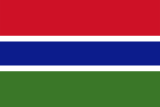
Flag of the Gambia
Republic of the Gambia
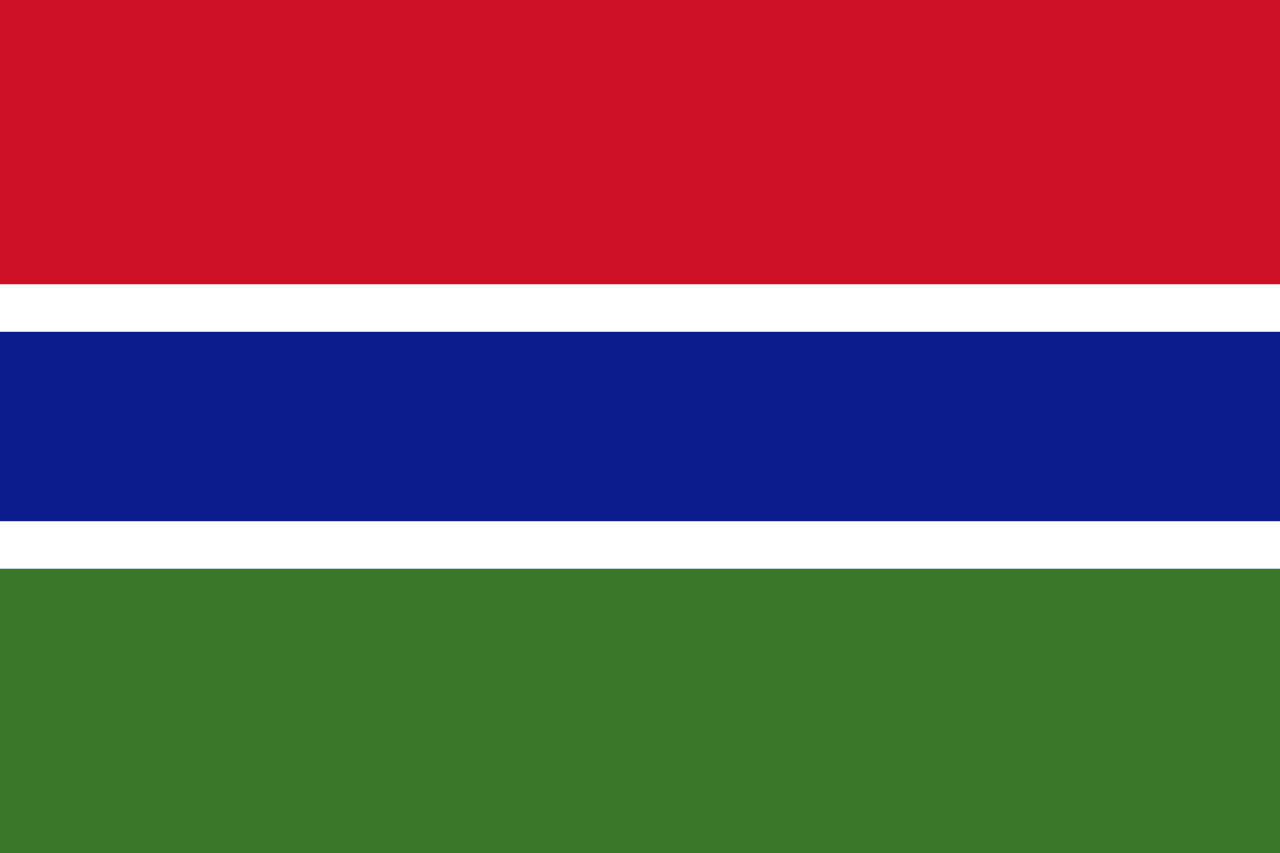
Flag details
- Country
- Gambia
- Official name
- Republic of the Gambia
- Capital
- Banjul
- ISO code
- GM / GMB
- Region
- West Africa
Flag colors
- #ce112633%
- #3a772833%
- #0c1c8c21%
- #ffffff9%
Share of the flag's surface, measured from the image.
Download the flag
Meaning and history of the flag of the Gambia
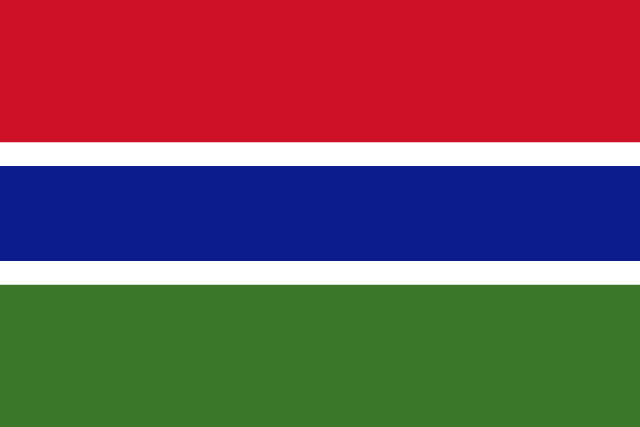
The Gambia's flag was adopted on February 18, 1965, upon independence from the United Kingdom. It consists of three horizontal stripes of red, blue, and green, separated by two thin white stripes. It is one of the few African flags whose design has no direct link to a political party, having been created instead to represent the country as a whole.
The red symbolizes the tropical sun and the savanna that covers much of Gambian territory. The central blue stripe represents the Gambia River, the country's most important geographic feature, which runs the full length of the nation from east to west and gives it its name. The green represents agriculture and the country's forests. The two thin white stripes separating the main colors symbolize unity and peace.
The flag's design mirrors the Gambia's geography with striking precision: a narrow country stretched along both banks of the Gambia River, bordered by Senegal on every side except its Atlantic coast. The central blue stripe flanked by red and green is almost a cartographic representation of this reality. The flag was designed by Louis Thomasi and has remained unchanged since independence.
You can view the flag of the Gambia in high resolution above and download it in several sizes for personal, educational or reference use. To explore more, visit the full the Gambia profile, its map, or the current local time in Banjul.