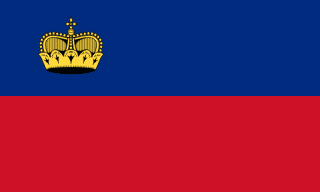
Liechtenstein
Principality of Liechtenstein
Population: UN WPP 2024, revision 1, projection for 1 July 2026. Sources and methodology.
Geography and territory
Liechtenstein is a tiny Alpine principality wedged between Switzerland to the west and Austria to the east, covering just 160 square kilometers, making it the sixth-smallest country in Europe. Its territory runs along the Rhine Valley, which marks its western border with Switzerland, and rises into the foothills of the Rätikon Alps to the east, reaching its highest point at Grauspitz, 2,599 meters above sea level.
Liechtenstein’s landscape shows a striking contrast between the flat alluvial plain of the Rhine, home to the main towns and farmland, and the Alpine mountains that cover roughly two-thirds of the territory. Forests cover 43 percent of the country, and mountain pastures create a bucolic setting home to rich Alpine wildlife, including deer, chamois, marmots, and golden eagles.
The climate is moderate continental with Alpine influence, bringing cold winters with heavy snow at higher elevations and mild, pleasant summers in the valley. The foehn, a warm, dry wind descending from the mountains, can sharply raise temperatures at any time of year. Despite its small size, Liechtenstein offers striking landscape variety, from the wetlands of the Rhine to snow-capped Alpine peaks.
History
Liechtenstein’s history as a political entity begins in 1699 and 1712, when the Liechtenstein family, one of the oldest and wealthiest noble houses of Austria, acquired the lordships of Schellenberg and Vaduz respectively. In 1719, Emperor Charles VI merged the two territories and elevated them to the rank of principality, creating the Principality of Liechtenstein as a sovereign member of the Holy Roman Empire.
After the dissolution of the Holy Roman Empire in 1806, Liechtenstein belonged first to the Confederation of the Rhine and later to the German Confederation, achieving full sovereignty in 1866. The principality remained closely tied to Austria until the First World War, when Austria’s defeat led Liechtenstein to reorient its relationships toward Switzerland, signing a customs union in 1923 that endures to this day. This partnership includes the adoption of the Swiss franc as currency and Swiss diplomatic representation in countries where Liechtenstein has no embassy of its own.
During the 20th century, the principality transformed from a small agrarian economy into one of the wealthiest countries in the world on a per-capita basis. Prince Hans-Adam II, who assumed full executive powers through a constitutional referendum in 2003, is one of the most powerful reigning monarchs in Europe, with the authority to dissolve parliament and veto legislation. In 2004, he transferred day-to-day governing duties to his son, Hereditary Prince Alois.
Culture and society
Liechtenstein’s culture is deeply shaped by Germanic and Alpine traditions, sharing cultural roots with Switzerland, Austria, and southern Germany. German is the official language, spoken locally in an Alemannic dialect used in everyday life that reinforces community identity. Musical tradition finds expression in local choirs and brass bands, with the accordion and wind instruments serving as identity markers.
Traditional festivities follow the Alpine seasonal calendar. Funkensonntag, celebrated on the first Sunday of Lent, involves lighting large bonfires on the hillsides to drive away winter. National Day, on August 15, combines the religious observance of the Assumption with patriotic celebration, including a speech by the prince and fireworks, followed by an open invitation from the monarch to citizens in the gardens of Vaduz Castle.
Liechtenstein’s society is compact and close-knit, spread across 11 municipalities where community bonds remain strong. The unemployment rate is among the lowest in the world, and living standards are extraordinarily high. Roughly a third of residents are foreign nationals, mainly from Switzerland, Austria, and Germany. The princely family’s art collection is one of the most significant privately held collections in the world, with works by Rubens, Van Dyck, and Raphael.
Economy
Liechtenstein has one of the most prosperous economies in the world in terms of per-capita GDP, with a diversified production model that defies stereotypes about microstates dependent on tourism or finance. High-precision manufacturing is the true engine of the economy, with companies such as Hilti (construction tools), Ivoclar Vivadent (dental products), and ThyssenKrupp Presta (automotive components) leading their respective global markets.
The financial sector and trust services complement the industrial base, with substantial private banking and wealth management activity. Liechtenstein has adapted its regulatory framework to international standards of fiscal transparency, moving away from its earlier reputation as an offshore haven. Close integration with Switzerland through the customs and monetary union provides stability and access to first-rate infrastructure.
A distinctive feature of Liechtenstein’s economy is that the number of jobs exceeds the resident population: more than half of all workers are cross-border commuters arriving daily from Switzerland, Austria, and Germany. The agricultural sector, though marginal in terms of GDP, maintains a presence with vineyards on the sunny slopes of the Rhine Valley, Alpine livestock farming, and artisanal dairy production.
Food and cuisine
Liechtenstein’s cuisine reflects its position at the crossroads of Swiss, Austrian, and Swabian culinary traditions, offering hearty, comforting Alpine cooking. The national dish is Käsknöpfle, fresh egg-and-flour pasta similar to spätzle, baked with plenty of mountain cheese and topped with crispy fried onions, typically served with applesauce as a sweet-and-savory accompaniment.
Riebel, a porridge of cornmeal or semolina toasted in butter, was for centuries the staple food of farming families and is served both sweet, with fruit compote, and savory, with cheese. Hafalaab, a thick oat-flour soup, and Kratzete, an Alpine-style torn crepe, are other traditional dishes still found in home cooking. Game meats, especially venison and wild boar, are prepared in stews and roasts during the autumn months.
Liechtenstein’s wines, grown on the steep slopes of the Rhine Valley under the care of the princely vineyards, are a well-kept oenological secret. Pinot Noir and Chardonnay dominate production, yielding quality wines that are rarely exported. Alpine dairy products, especially cheeses aged in mountain huts, and Austrian-influenced pastries, with apple strudels and walnut cakes, round out an authentic, deeply local cuisine.
Tourism and landmarks
Vaduz Castle, the official residence of the reigning prince, dominates the capital’s skyline from its perch atop a rocky bluff. While its interior is closed to the public, the views from the path leading up to its walls are spectacular. The Kunstmuseum Liechtenstein, a black concrete-and-basalt building designed by the Swiss architects Morger, Degelo, and Kerez, houses the principality’s collection of modern and contemporary art, featuring internationally significant works.
The Liechtenstein Trail, a 75-kilometer path crossing the entire country from north to south, offers a complete immersion in the principality’s Alpine landscapes, from the wetlands of the Rhine to the summits of the Falknis and Grauspitz. The Malbun ski resort, the country’s only one, is a welcoming family destination at 1,600 meters, with slopes for all levels and an intimate atmosphere far removed from the crowds of larger Alpine resorts.
The National Museum of Liechtenstein in Vaduz traces the principality’s history from prehistory onward, while the Postal Museum displays the renowned stamp collection that has made the principality famous among collectors. The village of Balzers, with its Gutenberg Castle, and the ruins of Schellenberg Castle, along with princely wine cellars open for tastings, round out a compact but surprisingly rich tourist route.
Fun facts about Liechtenstein
- Liechtenstein is one of only two doubly landlocked countries in the world (surrounded entirely by other landlocked countries), along with Uzbekistan.
- The principality has had no army since 1868, when it was abolished as too costly; its last military engagement was the Austro-Prussian War of 1866, from which the 80 soldiers sent home returned along with one extra Italian friend.
- The number of jobs in Liechtenstein exceeds the number of residents, making it a unique case of net labor importation.
- Vaduz Castle is an inhabited royal residence closed to the public, but the prince invites all citizens to a reception in its gardens every National Day.
- Liechtenstein’s postage stamps are famous among philatelists and have been a significant source of revenue for the state.
- Liechtenstein and Uzbekistan are the only countries in the world that require crossing at least two borders to reach the sea.
Liechtenstein in numbers
Latest World Bank and UNDP observations, each with its own year. “World median” is the middle value among the countries that report the same indicator; “#” ranks from the highest value.
Population since 1960
Liechtenstein had 16,451 people in 1960 and 41,024 in 2025 — 2.5 times as many.
People
14.6% of people live in towns and cities (world median 63.4%). 14.2% are under 15 and 21.4% are 65 or older — one of the oldest age structures in the world. Women have 1.37 children on average, below the replacement level of about 2.1 needed to keep a population stable in the long run without migration.
Economy
Services make up the largest share of output (57.4% of GDP); agriculture contributes 0.2%.
Development and environment
UNDP rates human development in Liechtenstein as very high, with an index of 0.938 in 2023 (rank 17 of 193). 98.3% of people use the internet and 100.0% have access to electricity. Forest covers 36.8% of the land (world median 32.8%).
Sources: World Bank, World Development Indicators (CC BY 4.0), most recent observation from 2015 onward; UNDP Human Development Report 2025. Retrieved 2026-10-10. Sector shares need not add up to 100% because taxes and subsidies on products are excluded. Missing values are left blank rather than estimated. Sources and methodology.
Climate of Liechtenstein
Averaged across Liechtenstein, the warmest month is July (16.6 °C) and the coolest is January (−1.0 °C), a seasonal swing of 17.6 °C. The annual mean is 7.6 °C.
3 months have a national mean temperature below freezing.
About 1,040 mm of precipitation falls in a typical year. July is the wettest month (136 mm) and February the driest (50 mm). The wettest stretch is June to August, with 37% of the year's total.
Show monthly values as a table
| Month | Mean °C | Low °C | High °C | Precipitation, mm |
|---|---|---|---|---|
| January | −1.0 | −4.0 | 2.0 | 58 |
| February | −0.4 | −3.8 | 3.0 | 50 |
| March | 3.0 | −1.1 | 7.1 | 59 |
| April | 7.0 | 2.5 | 11.5 | 64 |
| May | 11.1 | 6.6 | 15.7 | 116 |
| June | 14.7 | 10.1 | 19.3 | 118 |
| July | 16.6 | 11.8 | 21.5 | 136 |
| August | 16.3 | 11.8 | 20.9 | 126 |
| September | 12.5 | 8.4 | 16.6 | 98 |
| October | 8.2 | 4.7 | 11.7 | 77 |
| November | 3.3 | 0.5 | 6.2 | 74 |
| December | −0.2 | −2.9 | 2.5 | 62 |
Figures are 1991–2020 averages across the whole land area of Liechtenstein, from the World Bank Climate Change Knowledge Portal, CRU TS 4.08 (CC BY 4.0). They are not readings from one weather station: the capital, the coast and high ground can be much warmer, cooler, wetter or drier.
Travel essentials for Liechtenstein
The practical details visitors ask about first. Traffic in Liechtenstein drives on the right, like most of the world. Mains electricity is 230 V at 50 Hz, so devices made only for 110–120 V (common in North America) need a converter unless they are dual-voltage — most phone and laptop chargers are.
- Emergency number
- 112Police 117 · Ambulance 144 · Fire 118
- Driving side
- Right
- Plug types
- Type C, Type JC: two round pins (Europlug); J: three round pins (Swiss)
- Voltage
- 230 V50 Hz
- Dialling code
- +423From abroad: your exit code, then 423 and the number
- Currency
- Swiss Franc (CHF)
- Time zone
- CET (UTC+1)Current local time in Liechtenstein
Compiled from IEC plug and voltage standards, national emergency-service listings and the UN road-traffic conventions. Emergency numbers and local coverage can change — confirm them locally on arrival. Liechtenstein's internet domain is .li.
Where Liechtenstein ranks in the world
Each position counts only the countries with data in that ranking guide. First place is the highest value — for price levels, the most expensive. Select a card to see the full table.
- Population189th of 19640,368UN projection, July 2026
- Land area190th of 195160 km²World Bank, 2023
- Population density40th of 194249 per km²World Bank, 2023
- GDP (nominal)149th of 187$8.9BWorld Bank, 2024, current US$
- GDP per capita2nd of 187$220,167World Bank, 2024, current US$
- Life expectancy5th of 19484.2 yearsWorld Bank, 2024
Bordering countries of Liechtenstein


Compare Liechtenstein with another country
Frequently asked questions about Liechtenstein
What is the capital of Liechtenstein?
The capital of Liechtenstein is Vaduz.
What is the population of Liechtenstein?
The UN World Population Prospects projection for Liechtenstein is 40,368 people (40,368) on 1 July 2026. National statistical offices may publish different estimates.
What language is spoken in Liechtenstein?
The official language of Liechtenstein is German.
What currency is used in Liechtenstein?
The currency of Liechtenstein is the Swiss Franc (CHF).
How big is Liechtenstein?
Liechtenstein covers an area of 160 km².
What type of government does Liechtenstein have?
Liechtenstein is a constitutional monarchy.
Which countries border Liechtenstein?
Liechtenstein shares land borders with Switzerland, Austria.
What is the highest point in Liechtenstein?
The highest point in Liechtenstein is Grauspitz (2,599 m).


