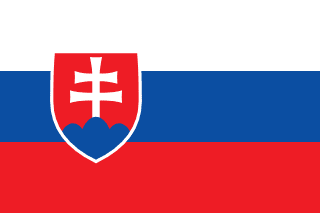
Slovakia
Slovak Republic
Population: UN WPP 2024, revision 1, projection for 1 July 2026. Sources and methodology.
Geography and territory
Slovakia is a landlocked Central European country covering 49,035 square kilometers at the heart of the continent. It borders Poland to the north, Ukraine to the east, Hungary to the south, Austria to the southwest, and the Czech Republic to the northwest. Despite its relatively modest size, the country boasts remarkable geographic diversity, dominated by the Western Carpathians, which cover most of its territory.
The High Tatras, part of the Carpathian range, are often called the smallest mountains in the world classified as alpine, and they contain the country’s highest point, Gerlachovský štít, at 2,655 meters. This compact but spectacular range offers landscapes of glacial lakes, jagged peaks, and deep valleys comparable to the Alps, though on a more intimate and accessible scale. To the south, the Danube lowlands form a fertile plain that contrasts sharply with the mountainous terrain of the north.
The country is richly endowed with water, boasting numerous rivers, lakes, and thermal springs. The Danube briefly skirts the southwest, where Bratislava sits as the only capital city in the world bordering two sovereign countries, Austria and Hungary. Slovakia has nine national parks and more than 1,000 caves, several of them UNESCO World Heritage sites, including unique ice caves and aragonite formations found nowhere else on Earth.
With a population of roughly 5.4 million spread across 49,035 square kilometers, Slovakia remains one of the more forested and rural countries in Central Europe, and its dense network of protected landscapes makes outdoor recreation, from hiking to thermal bathing, an everyday part of national life rather than an occasional getaway.
History
Slovakia’s history is deeply tied to the movements of peoples that swept across Central Europe. The territory was inhabited by Celts and Germanic tribes before Slavic peoples arrived in the fifth century. In the ninth century, Great Moravia became the first major Slavic state in the region, and it was here that Cyril and Methodius carried out their missionary work and laid the foundations of Slavic script.
After the fall of Great Moravia, Slovak territory was absorbed into the Kingdom of Hungary for nearly a thousand years, from the eleventh century until 1918. During this long period, Bratislava, then known as Pressburg or Pozsony, served as the capital of the Kingdom of Hungary from 1536 to 1783 and hosted the coronations of Hungarian kings at St. Martin’s Cathedral. This era of Hungarian rule left a deep imprint on Slovak culture and society.
After the First World War, Slovaks and Czechs joined to form Czechoslovakia in 1918. Following Nazi occupation and the postwar communist era, Czechoslovakia lived through the Prague Spring of 1968 and the Velvet Revolution of 1989. On January 1, 1993, the peaceful dissolution of Czechoslovakia, known as the Velvet Divorce, gave rise to the independent Slovak Republic. Slovakia has since joined NATO and the European Union in 2004 and adopted the euro in 2009.
The years immediately following independence were not without turbulence, as the young republic navigated economic restructuring and the transition from a planned to a market economy. The reforms of the early 2000s, including a flat tax and business-friendly regulation, proved decisive in attracting the foreign investment that would later define the country’s industrial success and its integration into Western European supply chains.
Culture and society
Slovak culture blends Central European and Slavic traditions with Hungarian, Austrian, and German influences. Folklore occupies a central place in national identity, with regional costumes, dances, and traditional music that vary notably from one area to the next. The fujara, a large Slovak shepherd’s flute, was declared Intangible Cultural Heritage by UNESCO and produces hypnotic sounds found nowhere else in the world.
Slovak craft traditions run exceptionally deep, with embroidery, pottery, and woodcarving techniques passed down through generations. The wooden churches of northern Slovakia, built without a single nail, are masterpieces of folk carpentry and UNESCO World Heritage sites. Naive village painting and Easter traditions such as the decorated eggs known as kraslice keep a centuries-old heritage alive.
Slovak society is predominantly Catholic and maintains strong family and community ties. Holidays such as Christmas and Easter are celebrated with deeply rooted customs. Ice hockey is the country’s most popular sport and a genuine national passion that unites the country, and victories by the national team routinely bring cities to a standstill. Education and technical training are highly valued, contributing to a skilled workforce, especially in engineering and technology, and Slovak universities maintain long-standing exchange relationships with institutions across neighboring Austria and the Czech Republic.
Economy
Slovakia is one of the most striking economic success stories in Central Europe. With a GDP of roughly $154.5 billion, the country has grown remarkably since independence in 1993 and especially since joining the European Union. Most strikingly, Slovakia is the world’s largest producer of automobiles per capita, with factories run by Volkswagen, Kia, Stellantis, and Jaguar Land Rover together turning out more than a million vehicles a year.
Industry drives the Slovak economy, with automotive manufacturing, electronics, and machinery as its foundational pillars. Screen and electronic component production has made the country a European technology hub. Slovakia’s central location, skilled workforce, and competitive costs have attracted substantial foreign direct investment.
The services sector has grown significantly, with shared service centers and IT operations established in Bratislava and Košice. Tourism makes a growing contribution, particularly through winter sports in the Tatras and thermal spa tourism. Economic challenges include regional disparities between the more developed west and the east of the country, along with the need to shift toward an innovation- and value-driven economy, an area where policymakers continue to invest through digitalization programs and support for domestic technology startups.
Food and cuisine
Slovak cuisine is hearty and comforting, well suited to Central Europe’s cold winters. The national dish is bryndzové halušky, small potato dumplings served with bryndza, a creamy, slightly tangy sheep’s cheese, and crispy bacon. This simple but delicious dish captures the essence of Slovak peasant cooking and appears on the menu of nearly every restaurant in the country.
Soups hold a prominent place at the Slovak table. Kapustnica, a sauerkraut soup with sausage and mushrooms, is the traditional Christmas Eve dish. Bryndza stew with potatoes, pierogi filled with cheese or potato, and homemade smoked sausages are other everyday classics. Hungarian influence shows up in dishes like goulash, while the pastry tradition reflects Austrian heritage with strudels and creamy cakes.
Slovakia has a notable winemaking tradition, particularly in the Little Carpathians region north of Bratislava, where wine has been produced since Roman times. Slovak Tokaj, made in a small wine region in the country’s southeast, is a prestigious sweet wine known internationally. Craft beer has boomed in recent years, and spirits such as slivovica, a plum brandy, and borovička, a juniper liqueur, are traditional drinks that accompany celebrations.
Tourism and landmarks
Bratislava, the capital, charms visitors with its compact and appealing old town, watched over by a castle perched above the Danube. Unlike other European capitals, Bratislava keeps an intimate, accessible atmosphere, with historic cafes, baroque palaces, and quirky street sculptures tucked into every corner. Its proximity to Vienna, barely 60 kilometers away, makes it one of the most distinctively located capitals in the world, and many visitors combine the two cities in a single trip, traveling between them by boat along the Danube or by a short train ride.
The High Tatras are the country’s flagship natural destination, offering spectacular alpine scenery with glacial lakes such as Štrbské Pleso, hiking routes for every skill level, and quality ski resorts. Slovak Paradise National Park fascinates with its gorges, metal ladders bolted into the rock, and hidden waterfalls. The city of Košice, European Capital of Culture in 2013, holds the easternmost Gothic cathedral in Western Europe.
Slovakia has more castles and fortresses per capita than any other country in Europe. Spiš Castle, one of the largest castle complexes in Central Europe, is a UNESCO World Heritage site. Bojnice Castle is considered one of the most romantic on the continent. Slovakia’s caves, including the Dobšiná Ice Cave and the Ochtiná Aragonite Cave, offer unique underground landscapes, while the historic towns of Banská Štiavnica and Levoča preserve exceptional architectural heritage.
Fun facts about Slovakia
- Slovakia is the world’s largest producer of automobiles per capita, manufacturing more than a million vehicles a year with a population under 5.5 million
- The country has more castles and fortresses per square kilometer than any other in Europe
- Bratislava is the only capital city in the world bordering two sovereign countries, Austria and Hungary
- Andy Warhol, the legendary pop art icon, was of Slovak descent; his parents emigrated to the United States from the village of Miková in northeastern Slovakia
- The Ochtiná Aragonite Cave is one of only three aragonite caves open to the public anywhere in the world
Slovakia in numbers
Latest World Bank and UNDP observations, each with its own year. “World median” is the middle value among the countries that report the same indicator; “#” ranks from the highest value.
Population since 1960
Slovakia had 4.1 million people in 1960 and 5.4 million in 2025 — 33% more.
People
53.2% of people live in towns and cities (world median 63.4%). 15.6% are under 15 and 19.0% are 65 or older — an ageing population. Women have 1.46 children on average, below the replacement level of about 2.1 needed to keep a population stable in the long run without migration.
Economy
The economy grew by 0.8% in real terms in 2025. Consumer prices rose by 4.0% in 2025. Services make up the largest share of output (59.8% of GDP); agriculture contributes 1.6%.
Development and environment
UNDP rates human development in Slovakia as very high, with an index of 0.880 in 2023 (rank 44 of 193). 89.8% of people use the internet and 100.0% have access to electricity. Forest covers 40.3% of the land (world median 32.8%).
Sources: World Bank, World Development Indicators (CC BY 4.0), most recent observation from 2015 onward; UNDP Human Development Report 2025. Retrieved 2026-10-10. Sector shares need not add up to 100% because taxes and subsidies on products are excluded. Missing values are left blank rather than estimated. Sources and methodology.
Climate of Slovakia
Averaged across Slovakia, the warmest month is July (19.2 °C) and the coolest is January (−2.1 °C), a seasonal swing of 21.3 °C. The annual mean is 9.0 °C.
3 months have a national mean temperature below freezing.
About 768 mm of precipitation falls in a typical year. July is the wettest month (108 mm) and February the driest (39 mm). The wettest stretch is May to July, with 37% of the year's total.
Show monthly values as a table
| Month | Mean °C | Low °C | High °C | Precipitation, mm |
|---|---|---|---|---|
| January | −2.1 | −4.2 | 0.1 | 41 |
| February | −0.3 | −3.3 | 2.7 | 39 |
| March | 4.0 | 0.1 | 7.9 | 43 |
| April | 9.6 | 4.7 | 14.5 | 50 |
| May | 13.9 | 8.9 | 18.8 | 80 |
| June | 17.3 | 12.4 | 22.4 | 95 |
| July | 19.2 | 13.9 | 24.6 | 108 |
| August | 19.1 | 13.8 | 24.5 | 80 |
| September | 14.3 | 9.5 | 19.2 | 69 |
| October | 9.4 | 5.5 | 13.3 | 62 |
| November | 4.0 | 1.6 | 6.5 | 52 |
| December | −1.0 | −2.9 | 0.8 | 50 |
Figures are 1991–2020 averages across the whole land area of Slovakia, from the World Bank Climate Change Knowledge Portal, CRU TS 4.08 (CC BY 4.0). They are not readings from one weather station: the capital, the coast and high ground can be much warmer, cooler, wetter or drier.
Travel essentials for Slovakia
The practical details visitors ask about first. Traffic in Slovakia drives on the right, like most of the world. Mains electricity is 230 V at 50 Hz, so devices made only for 110–120 V (common in North America) need a converter unless they are dual-voltage — most phone and laptop chargers are.
- Emergency number
- 112
- Driving side
- Right
- Plug types
- Type C, Type EC: two round pins (Europlug); E: two round pins, earth pin in the socket
- Voltage
- 230 V50 Hz
- Dialling code
- +421From abroad: your exit code, then 421 and the number
- Currency
- Euro (EUR)
- Time zone
- CET (UTC+1)Current local time in Slovakia
Compiled from IEC plug and voltage standards, national emergency-service listings and the UN road-traffic conventions. Emergency numbers and local coverage can change — confirm them locally on arrival. Slovakia's internet domain is .sk.
Where Slovakia ranks in the world
Each position counts only the countries with data in that ranking guide. First place is the highest value — for price levels, the most expensive. Select a card to see the full table.
- Population123rd of 1965.5 millionUN projection, July 2026
- Land area128th of 19548,080 km²World Bank, 2023
- Population density79th of 194113 per km²World Bank, 2023
- GDP (nominal)60th of 187$140.9BWorld Bank, 2024, current US$
- GDP per capita44th of 187$25,993World Bank, 2024, current US$
- Life expectancy49th of 19478.4 yearsWorld Bank, 2024
- Price level37th of 16567 (US = 100)ICP 2021, household consumption
Bordering countries of Slovakia


Compare Slovakia with another country
Frequently asked questions about Slovakia
What is the capital of Slovakia?
The capital of Slovakia is Bratislava.
What is the population of Slovakia?
The UN World Population Prospects projection for Slovakia is 5,451,342 people (5.5 million) on 1 July 2026. National statistical offices may publish different estimates.
What language is spoken in Slovakia?
The official language of Slovakia is Slovak.
What currency is used in Slovakia?
The currency of Slovakia is the Euro (EUR).
How big is Slovakia?
Slovakia covers an area of 49,035 km².
What type of government does Slovakia have?
Slovakia is a parliamentary republic.
Which countries border Slovakia?
Slovakia shares land borders with Austria, Czech Republic, Poland, Ukraine, Hungary.
What is the highest point in Slovakia?
The highest point in Slovakia is Gerlachovsky stit (2,655 m).

