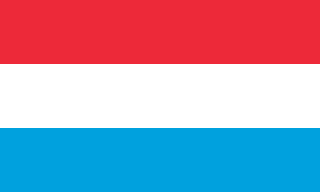
Luxembourg
Grand Duchy of Luxembourg
Population: UN WPP 2024, revision 1, projection for 1 July 2026. Sources and methodology.
Geography and territory
Tucked between Belgium, Germany, and France, the Grand Duchy of Luxembourg is one of Europe’s smallest sovereign states, covering just 2,586 square kilometers. Despite its modest footprint, its position astride some of the continent’s oldest trade and transport corridors has given it an influence far out of proportion to its size, a paradox that runs through much of the country’s history and modern economic life.
The territory splits into two distinct landscapes. In the north, the Oesling forms a southern extension of the Ardennes massif, a rugged tableland of wooded hills and deep river valleys that culminates at Kneiff, the country’s highest point at 560 meters. The south, known as the Gutland, is gentler and more fertile, and it is here that most Luxembourgers live and work. The Moselle River traces the southeastern border with Germany, and the sun-facing slopes above its banks support the vineyards behind Luxembourg’s well-regarded white wines.
The climate is a mild maritime one, with cool winters and temperate summers, and rainfall spread fairly evenly through the year, heavier in the uplands of the Oesling. Roughly a third of the country is forested, and rivers such as the Alzette and the Sûre cut through wooded valleys that give the countryside a pastoral charm quite different from the glass-and-steel skyline of the capital.
With a population of just 686,970, Luxembourg is also one of Europe’s least crowded states in absolute terms, even though density in and around the capital rivals that of much larger cities. Small farming villages, sprawling beech and oak forests, and quiet river valleys occupy most of the national territory, while the capital itself and a handful of secondary towns such as Esch-sur-Alzette concentrate the bulk of the economic activity. This contrast between a busy financial hub and a largely rural hinterland is one of the defining features of the country’s geography.
History
Luxembourg’s recorded history begins in 963, when Count Siegfried acquired a rocky outcrop and the small fortress upon it known as Lucilinburhuc, “little fortress” — the seed from which both the city and the future state would grow. Through the Middle Ages the County of Luxembourg steadily gained standing, becoming a duchy in 1354 and even producing Holy Roman Emperors, including Henry VII and Charles IV.
Its strategic value made Luxembourg one of the most fought-over strongholds in Europe, passing at various times to Burgundian, Spanish, French, Austrian, and Prussian control. Successive rulers reinforced its citadel until it earned the nickname “the Gibraltar of the North.” The Congress of Vienna created the Grand Duchy under Dutch sovereignty in 1815, and the 1839 Treaty of London finally secured Luxembourg’s full independence and guaranteed its neutrality.
That neutrality was violated by Germany in both world wars, and Luxembourg endured harsh occupation during the second, including the forced conscription of its young men into the German army. After liberation in 1944, Luxembourg abandoned neutrality altogether and became a founding member of NATO, the United Nations, the European Coal and Steel Community, and the European Economic Community. Today the city of Luxembourg stands alongside Brussels and Strasbourg as one of the European Union’s three capitals, hosting institutions such as the Court of Justice and the Court of Auditors.
That postwar embrace of European integration transformed a small, historically contested borderland into one of the architects of the modern European project. Successive Grand Dukes and Grand Duchesses, from Jean to Henri, have presided over this transition from fortress town to diplomatic capital, while the country’s small size has allowed it to punch well above its weight in shaping EU policy, particularly on financial regulation and judicial affairs.
Culture and society
Luxembourgish culture sits at a genuine crossroads between Germanic and Romance traditions, and nowhere is that clearer than in its language life. Luxembourgish, a Germanic tongue with heavy French influence, is the national language and the one closest to people’s hearts; French dominates administration, law, and public signage; and German is the language of the press and early schooling. Most residents move comfortably between all three.
The Schueberfouer, a popular fair held since 1340, is the country’s biggest annual celebration and one of the oldest fairs in Europe. National Day, celebrated on June 23, marks the Grand Duke’s official birthday with parades, fireworks, and street festivities nationwide. A lively musical tradition is sustained by the Luxembourg Philharmonic Orchestra and a busy calendar of classical and contemporary festivals.
Few societies in Europe are as cosmopolitan: roughly 47 percent of residents hold foreign nationality, with large communities of Portuguese, French, Italian, Belgian, and German origin. More than 200,000 cross-border commuters also enter the country each day to work. This constant mixing of languages and cultures has produced an unusually open and tolerant society, one where diversity is simply part of everyday life rather than an exception to it.
Economy
Luxembourg has one of the most prosperous economies on earth, with the highest GDP per capita in the European Union and among the highest anywhere. Finance drives that wealth: more than 120 international banks operate in the country, which hosts Europe’s largest investment-fund industry and the world’s second largest after the United States, alongside a substantial insurance and fiduciary-services sector.
Steel was once the backbone of the economy, embodied by the company now known as ArcelorMittal, and while its relative weight has shrunk, industry has diversified into high technology, logistics, biotechnology, and satellite communications — SES, one of the world’s largest satellite operators, is headquartered in Luxembourg, and the European Space Agency also maintains a significant presence there.
The European institutions themselves generate substantial economic activity, employing thousands of officials and drawing in a supporting ecosystem of consultancies, law firms, and international organizations. Luxembourg has been an early mover in fintech regulation and has even pursued initiatives around space-resource exploration, positioning itself in forward-looking industries. The country’s overarching economic challenge is sustaining this diversification while managing international scrutiny of its tax framework, on which its national economy of $101.16 billion partly rests.
Unemployment in Luxembourg has traditionally run lower than the EU average, and the domestic labor market depends heavily on the cross-border workforce commuting in from France, Belgium, and Germany to fill jobs in finance, retail, and construction. Living costs, particularly housing, rank among the highest in Europe, a direct consequence of concentrated wealth and limited land within such a small national territory. Human development indicators mirror this prosperity: with a Human Development Index of 0.922, classified as very high, Luxembourg regularly places among the world’s top-ranked countries for quality of life.
Food and cuisine
Luxembourgish cooking sits at the meeting point of French, German, and Belgian culinary traditions, yet it has forged its own identity. Judd mat gaardebounen — smoked pork collar served with broad beans in a creamy sauce — is considered the national dish, a hearty stew rooted in the Grand Duchy’s rural past. Bounechlupp, a green bean soup made with potatoes, bacon, and cream, is another staple of home cooking.
Gromperekichelcher, crisp fried potato fritters, are a favorite snack at fairs and markets, especially during the Schueberfouer. The Belgian influence shows clearly in frituur-style fries served with an array of dipping sauces, a fixture of everyday eating. Quetschentaart, a seasonal plum tart, and both sweet and savory bretzels round out the local pastry tradition.
Wines from the Luxembourg stretch of the Moselle, mostly whites made from Riesling, Pinot Gris, Auxerrois, and Elbling grapes, enjoy a growing reputation, and Crémant de Luxembourg, a traditional-method sparkling wine, holds its own against French rivals. Craft beers from long-established brewers such as Diekirch, Mousel, and Bofferding, together with fruit liqueurs like plum quetsch, complete a drinks scene that reflects both tradition and terroir.
Tourism and landmarks
The city of Luxembourg, whose old quarter and fortifications are recognized as a World Heritage Site, is the country’s main draw. The Bock Casemates, a 17-kilometer network of defensive tunnels carved into rock, let visitors explore the fortress’s military past underground. The Grund district, tucked into the Alzette valley beneath the cliffs, charms with medieval houses, riverside cafés, and the Neumünster Abbey, now repurposed as a cultural center.
Vianden Castle, one of Europe’s most striking feudal residences, towers over the Ardennes town of the same name. Luxembourg’s “Little Switzerland,” the Müllerthal region, offers dramatic rock formations, beech forests, and hiking trails through unexpectedly beautiful terrain. The Moselle wine route, running between Schengen and Wasserbillig, invites visitors to taste local vintages at family-run cellars while overlooking the river’s steep vineyard slopes.
Echternach, Luxembourg’s oldest town, is known for its Benedictine abbey and its Whit Tuesday dancing procession, recognized by UNESCO as intangible cultural heritage. Clervaux, in the Ardennes, houses Edward Steichen’s celebrated photographic exhibition “The Family of Man,” itself a UNESCO listing. And the small village of Schengen, where the agreement abolishing Europe’s internal borders was signed, holds an outsized symbolic importance and a small museum devoted to that legacy.
Fun facts about Luxembourg
- Luxembourg is the world’s only remaining sovereign Grand Duchy.
- Roughly 47 percent of residents are foreign nationals, the highest share in the European Union.
- More than 200,000 cross-border workers commute in daily from France, Belgium, and Germany.
- The Schengen Agreement, which ended internal border checks across much of Europe, was signed in 1985 in the Luxembourg village bearing its name.
- Luxembourg was a founding member of NATO, the United Nations, the European Coal and Steel Community, and the European Economic Community.
- The Echternach dancing procession, where participants advance with a hopping step, is the last surviving dancing procession in Europe and is inscribed on UNESCO’s cultural heritage list.
Luxembourg in numbers
Latest World Bank and UNDP observations, each with its own year. “World median” is the middle value among the countries that report the same indicator; “#” ranks from the highest value.
Population since 1960
Luxembourg had 313,970 people in 1960 and 686,970 in 2025 — 2.2 times as many.
People
94.9% of people live in towns and cities (world median 63.4%). 15.7% are under 15 and 15.8% are 65 or older — an ageing population. Women have 1.25 children on average, below the replacement level of about 2.1 needed to keep a population stable in the long run without migration.
Economy
The economy grew by 0.6% in real terms in 2025. Consumer prices rose by 2.3% in 2025. Services make up the largest share of output (81.4% of GDP); agriculture contributes 0.2%.
Development and environment
UNDP rates human development in Luxembourg as very high, with an index of 0.922 in 2023 (rank 25 of 193). 99.1% of people use the internet and 100.0% have access to electricity. Forest covers 34.5% of the land (world median 32.8%).
Sources: World Bank, World Development Indicators (CC BY 4.0), most recent observation from 2015 onward; UNDP Human Development Report 2025. Retrieved 2026-10-10. Sector shares need not add up to 100% because taxes and subsidies on products are excluded. Missing values are left blank rather than estimated. Sources and methodology.
Climate of Luxembourg
Averaged across Luxembourg, the warmest month is July (18.6 °C) and the coolest is January (1.8 °C), a seasonal swing of 16.8 °C. The annual mean is 10.0 °C.
About 951 mm of precipitation falls in a typical year. December is the wettest month (108 mm) and April the driest (53 mm).
Show monthly values as a table
| Month | Mean °C | Low °C | High °C | Precipitation, mm |
|---|---|---|---|---|
| January | 1.8 | −0.8 | 4.4 | 93 |
| February | 2.7 | −0.7 | 6.1 | 77 |
| March | 5.9 | 1.6 | 10.2 | 68 |
| April | 9.5 | 4.4 | 14.7 | 53 |
| May | 13.3 | 8.1 | 18.6 | 71 |
| June | 16.5 | 11.2 | 21.8 | 72 |
| July | 18.6 | 13.2 | 24.0 | 83 |
| August | 18.3 | 13.0 | 23.6 | 78 |
| September | 14.6 | 9.8 | 19.5 | 77 |
| October | 10.2 | 6.3 | 14.1 | 81 |
| November | 5.5 | 2.7 | 8.3 | 90 |
| December | 2.9 | 0.0 | 5.8 | 108 |
Figures are 1991–2020 averages across the whole land area of Luxembourg, from the World Bank Climate Change Knowledge Portal, CRU TS 4.08 (CC BY 4.0). They are not readings from one weather station: the capital, the coast and high ground can be much warmer, cooler, wetter or drier.
Travel essentials for Luxembourg
The practical details visitors ask about first. Traffic in Luxembourg drives on the right, like most of the world. Mains electricity is 230 V at 50 Hz, so devices made only for 110–120 V (common in North America) need a converter unless they are dual-voltage — most phone and laptop chargers are.
- Emergency number
- 112
- Driving side
- Right
- Plug types
- Type C, Type FC: two round pins (Europlug); F: two round pins with side earth clips (Schuko)
- Voltage
- 230 V50 Hz
- Dialling code
- +352From abroad: your exit code, then 352 and the number
- Currency
- Euro (EUR)
- Time zone
- CET (UTC+1)Current local time in Luxembourg
Compiled from IEC plug and voltage standards, national emergency-service listings and the UN road-traffic conventions. Emergency numbers and local coverage can change — confirm them locally on arrival. Luxembourg's internet domain is .lu.
Where Luxembourg ranks in the world
Each position counts only the countries with data in that ranking guide. First place is the highest value — for price levels, the most expensive. Select a card to see the full table.
- Population164th of 196687,448UN projection, July 2026
- Land area168th of 1952,574 km²World Bank, 2023
- Population density38th of 194259 per km²World Bank, 2023
- GDP (nominal)72nd of 187$93.3BWorld Bank, 2024, current US$
- GDP per capita3rd of 187$137,782World Bank, 2024, current US$
- Life expectancy14th of 19483.2 yearsWorld Bank, 2024
- Price level8th of 165113 (US = 100)ICP 2021, household consumption
Bordering countries of Luxembourg


Compare Luxembourg with another country
Frequently asked questions about Luxembourg
What is the capital of Luxembourg?
The capital of Luxembourg is Luxembourg.
What is the population of Luxembourg?
The UN World Population Prospects projection for Luxembourg is 687,448 people (687,448) on 1 July 2026. National statistical offices may publish different estimates.
What language is spoken in Luxembourg?
The official language of Luxembourg is Luxembourgish, French, and German.
What currency is used in Luxembourg?
The currency of Luxembourg is the Euro (EUR).
How big is Luxembourg?
Luxembourg covers an area of 2,586 km².
What type of government does Luxembourg have?
Luxembourg is a parliamentary constitutional monarchy (Grand Duchy).
Which countries border Luxembourg?
Luxembourg shares land borders with Belgium, Germany, France.
What is the highest point in Luxembourg?
The highest point in Luxembourg is Kneiff (560 m).


