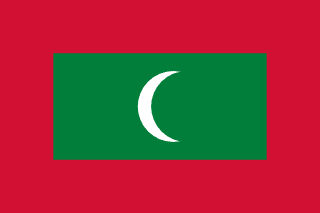
Maldives
Republic of Maldives
Population: UN WPP 2024, revision 1, projection for 1 July 2026. Sources and methodology.
Geography and territory
The Maldives is a scattered nation of coral atolls rising from the Indian Ocean southwest of Sri Lanka and India. The country consists of roughly 1,190 small coral islands arranged into 26 natural atolls that stretch across some 870 kilometers in two parallel chains straddling the equator. Only about 200 of these islands are inhabited, and fewer than a hundred host resort development, yet together they cover a land area of just 298 km², making the Maldives one of the smallest and most geographically fragmented countries on Earth.
What sets the Maldives apart is not its size but its elevation. The highest natural point in the entire country, Mount Villingili, tops out at a mere 5.1 meters above sea level, and the average elevation across all the islands is under two meters. This makes the Maldives the flattest sovereign nation on the planet and, consequently, one of the most exposed to rising seas driven by climate change. The atolls themselves are built on the rims of ancient submerged volcanic peaks, capped by living coral reefs that represent one of the densest concentrations of coral on Earth.
The surrounding waters teem with marine life. Reef systems covering thousands of square kilometers shelter more than 2,000 fish species alongside sea turtles, manta rays, whale sharks, and dolphins. Inside each atoll, sheltered lagoons of impossibly clear turquoise water rest over white coral sand, producing the postcard scenery that has made the Maldives a byword for tropical paradise. Water temperatures stay warm year-round, generally between 26 and 29 degrees Celsius, supporting both the reef ecosystem and the diving industry built around it.
History
Human settlement in the Maldives reaches back at least to the fifth century BCE, when Dravidian peoples from southern India and Sinhalese arrivals from Sri Lanka are believed to have established the earliest communities. These early Maldivians built a Buddhist civilization whose remnants survive in coral-carved stupas and sculptures found across several atolls. That Buddhist heritage endured for more than a thousand years until the archipelago converted to Islam in 1153, a shift traditionally credited to a traveling Moroccan scholar named Abu al-Barakat.
Following the conversion, a succession of sultanates governed the islands, generally preserving Maldivian independence even as foreign powers circled. Portugal held a brief and contested presence between 1558 and 1573, and Britain established a protectorate in 1887 that lasted until 1965. Throughout these centuries, Maldivian rulers balanced outside pressure while sustaining the archipelago’s economy through trade in cowrie shells, coconut fiber, and dried tuna. The islands’ position astride Indian Ocean trade routes drew merchants from Arabia, India, China, and later Europe.
Independence from Britain was achieved on July 26, 1965, and in 1968 the sultanate was abolished in favor of a republic. The modern era has been shaped by the rise of tourism, beginning with the opening of the first resort in 1972, alongside recurring political instability and the mounting threat of climate change. The Maldives has become an outspoken voice for small island nations facing sea-level rise, a role dramatized in 2009 when President Mohamed Nasheed convened an underwater cabinet meeting, delegates in scuba gear, to draw global attention to the country’s plight.
Culture and society
Maldivian culture blends influences from South Asia, the Arab world, and East Africa, shaped by centuries of Indian Ocean seafaring and trade. Sunni Islam forms the backbone of national identity: the country is an Islamic republic where religious observance touches nearly every part of daily life, from the design of coral-stone mosques to the rhythm of the annual calendar. Ramadan and Eid al-Fitr stand out as the most significant periods of communal and spiritual life.
Bodu Beru, meaning “big drum,” is the archipelago’s most vivid artistic tradition. Rooted in African musical heritage, it combines large wooden drums covered in goat skin with chanting that builds gradually into a rhythmic frenzy, drawing onlookers into the dance. Traditional craftsmanship includes lacquered wood carving known as laajehun, the weaving of reed mats, and the construction of the dhoni, an elegant sailing vessel that for centuries served as the only means of travel between islands.
Contemporary Maldivian society sits at the intersection of religious tradition and rapid, tourism-driven modernization. Malé, the capital, ranks among the most densely populated cities in the world, packing well over 200,000 residents into an area of roughly six square kilometers. Life on the smaller inhabited islands moves at a slower pace, centered on fishing, faith, and close-knit community ties. Education and healthcare have expanded considerably in recent decades, lifting the country’s human development indicators well above the regional average.
Economy
Two pillars anchor the Maldivian economy: luxury tourism and fishing. Tourism alone generates roughly a third of national output and is the country’s dominant source of foreign currency. Since the first resort opened in 1972, the Maldives has pioneered a distinctive one-island, one-resort model, in which each property occupies an entire island to guarantee guests near-total privacy. More than 150 resorts now operate across the atolls, drawing well over a million and a half visitors annually, many of them staying in the country’s signature overwater villas.
Fishing, especially for tuna, is the traditional backbone of the economy and its second major pillar. The Maldives is internationally recognized for pole-and-line tuna fishing, an artisanal method that avoids the bycatch problems associated with industrial trawling and has earned international sustainability certification. Maldivian tuna, sold fresh, frozen, and canned, reaches markets around the world. Coconut coir, once a significant export, has faded in economic importance but remains part of the traditional economy.
The country faces serious structural challenges. Heavy reliance on tourism leaves the economy exposed to external shocks such as pandemics and global downturns, while near-total dependence on imports for food, fuel, and consumer goods produces a persistent trade deficit. Climate change poses the most fundamental threat of all: with an average elevation below two meters, even modest sea-level rise could render large parts of the archipelago uninhabitable. This existential risk has spurred ambitious coastal protection projects and the construction of the artificial island of Hulhumalé to accommodate future population growth.
Food and cuisine
Maldivian food is inseparable from the ocean that surrounds every inhabited island, with tuna appearing in nearly every traditional dish. Mas huni, the national breakfast, combines smoked, shredded tuna with grated coconut, onion, chili, and lime, served alongside roshi, an unleavened flatbread similar to Indian chapati. Simple as it is, the dish captures the essence of Maldivian cooking: fish, coconut, and spice in perfect balance.
Garudhiya, a clear, fragrant tuna broth simmered with pandan leaf, chili, and lime and ladled over rice, is arguably the most iconic Maldivian dish, its apparent simplicity masking real depth of flavor. Rihaakuru, a thick, dark paste made by slowly reducing tuna broth for hours, is the country’s most prized seasoning, used to add an intense umami note to countless preparations.
South Asian influence shows up clearly in hedhikaa, the fried snacks eaten throughout the day, including gulha (dumplings stuffed with smoked tuna and coconut), bajiya (savory pastries), and kulhi boakibaa (spiced fish cake). Coconut appears in nearly every form imaginable: as milk in curries, as oil for frying, as grated garnish in sambals, and as refreshing water straight from the shell. Raa, a sweet sap tapped from palm trees, is drunk fresh or, though officially prohibited under the country’s Islamic legal code, fermented.
Tourism and landmarks
The Maldives is globally synonymous with tropical luxury and honeymoon travel, offering scenery that looks almost too perfect to be real: tiny islands ringed by white coral sand, turquoise lagoons, and extraordinarily rich marine life. The one-island resort model delivers experiences found almost nowhere else, from overwater villas with glass floors that reveal fish swimming below, to private dinners on sandbanks that emerge briefly from the ocean, to overwater spas offering treatments drawn from across Asia.
Diving and snorkeling are the archipelago’s signature activities, aided by visibility that frequently exceeds 30 meters. The southern atolls offer close encounters with giant manta rays in Hanifaru Bay, a UNESCO-designated biosphere reserve where hundreds of mantas gather between May and November in one of the ocean’s most spectacular natural events. Whale sharks, vibrant hard and soft coral reefs, and scattered shipwrecks round out a world-class underwater offering.
Malé itself, though tiny, offers a completely different kind of experience: a lively fish market, the golden-domed Grand Friday Mosque, the National Museum, and narrow streets crowded with motorbikes and small shops. Travelers seeking a more authentic, budget-friendly encounter increasingly choose guesthouses on inhabited islands such as Maafushi, Thulusdhoo, and Fulidhoo, where visitors can mix with local communities, sample home cooking, and still access excellent diving and snorkeling.
Fun facts about Maldives
- The Maldives is the flattest country on Earth, with its highest point, Mount Villingili, reaching only 5.1 meters above sea level and an average elevation under two meters.
- In 2009, the Maldivian president held an underwater cabinet meeting, ministers in full scuba gear, to raise global awareness of climate change.
- Cowrie shells gathered in Maldivian waters once circulated as currency across Africa and Asia for centuries.
- The Maldives is the smallest country in Asia by both land area and population.
- Addu Atoll, at the archipelago’s southern tip, straddles the equator, meaning the Maldives extends into both the Northern and Southern Hemispheres.
- With a population of 529,676 spread across about 298 km² of land, the Maldives has one of the highest population densities relative to habitable land of any nation.
The Maldives in numbers
Latest World Bank and UNDP observations, each with its own year. “World median” is the middle value among the countries that report the same indicator; “#” ranks from the highest value.
Population since 1960
The Maldives had 91,189 people in 1960 and 529,676 in 2025 — 5.8 times as many.
People
42.5% of people live in towns and cities (world median 63.4%). 19.0% are under 15 and 5.0% are 65 or older — a middle-aged population. Women have 1.56 children on average, below the replacement level of about 2.1 needed to keep a population stable in the long run without migration.
Economy
The economy grew by 6.3% in real terms in 2025. Consumer prices rose by 4.0% in 2025. Services make up the largest share of output (69.9% of GDP); agriculture contributes 4.6%.
Development and environment
UNDP rates human development in the Maldives as high, with an index of 0.766 in 2023 (rank 93 of 193). 85.2% of people use the internet and 100.0% have access to electricity. Forest covers 12.5% of the land (world median 32.8%).
Sources: World Bank, World Development Indicators (CC BY 4.0), most recent observation from 2015 onward; UNDP Human Development Report 2025. Retrieved 2026-10-10. Sector shares need not add up to 100% because taxes and subsidies on products are excluded. Missing values are left blank rather than estimated. Sources and methodology.
Climate of the Maldives
Averaged across the Maldives, the mean temperature stays between 27.7 °C (October) and 28.9 °C (April) — a swing of only 1.2 °C, so seasons are marked by rainfall rather than by heat.
About 2,190 mm of precipitation falls in a typical year. October is the wettest month (261 mm) and February the driest (98 mm).
Show monthly values as a table
| Month | Mean °C | Low °C | High °C | Precipitation, mm |
|---|---|---|---|---|
| January | 27.9 | 24.8 | 30.9 | 154 |
| February | 28.4 | 25.6 | 31.3 | 98 |
| March | 28.6 | 25.5 | 31.8 | 106 |
| April | 28.9 | 26.0 | 31.9 | 150 |
| May | 28.6 | 25.9 | 31.3 | 223 |
| June | 28.2 | 25.7 | 30.9 | 178 |
| July | 27.9 | 25.2 | 30.7 | 187 |
| August | 27.9 | 25.2 | 30.6 | 192 |
| September | 27.8 | 25.0 | 30.6 | 212 |
| October | 27.7 | 24.9 | 30.5 | 261 |
| November | 27.8 | 24.9 | 30.7 | 209 |
| December | 27.7 | 24.8 | 30.8 | 217 |
Figures are 1991–2020 averages across the whole land area of the Maldives, from the World Bank Climate Change Knowledge Portal, CRU TS 4.08 (CC BY 4.0). They are not readings from one weather station: the capital, the coast and high ground can be much warmer, cooler, wetter or drier.
Travel essentials for the Maldives
The practical details visitors ask about first. Traffic in the Maldives drives on the left, one of 54 of the 196 countries profiled here that do — see the full list. Mains electricity is 230 V at 50 Hz, so devices made only for 110–120 V (common in North America) need a converter unless they are dual-voltage — most phone and laptop chargers are.
- Emergency number
- 119Ambulance 102 · Fire 118
- Driving side
- Left
- Plug types
- Type A, Type C, Type D, Type G, Type J, Type K, Type LA: two flat parallel pins; C: two round pins (Europlug); D: three large round pins in a triangle; G: three rectangular pins (British); J: three round pins (Swiss); K: three round pins (Danish); L: three round pins in a row (Italian)
- Voltage
- 230 V50 Hz
- Dialling code
- +960From abroad: your exit code, then 960 and the number
- Currency
- Maldivian Rufiyaa (MVR)
- Time zone
- UTC+5Current local time in the Maldives
Compiled from IEC plug and voltage standards, national emergency-service listings and the UN road-traffic conventions. Emergency numbers and local coverage can change — confirm them locally on arrival. The Maldives's internet domain is .mv.
Where the Maldives ranks in the world
Each position counts only the countries with data in that ranking guide. First place is the highest value — for price levels, the most expensive. Select a card to see the full table.
- Population168th of 196531,517UN projection, July 2026
- Land area187th of 195298 km²World Bank, 2023
- Population density4th of 1941,765 per km²World Bank, 2023
- GDP (nominal)152nd of 187$7.1BWorld Bank, 2024, current US$
- GDP per capita70th of 187$13,379World Bank, 2024, current US$
- Life expectancy37th of 19481.3 yearsWorld Bank, 2024
- Price level38th of 16567 (US = 100)ICP 2021, household consumption
Compare the Maldives with another country
Frequently asked questions about the Maldives
What is the capital of the Maldives?
The capital of the Maldives is Malé.
What is the population of the Maldives?
The UN World Population Prospects projection for the Maldives is 531,517 people (531,517) on 1 July 2026. National statistical offices may publish different estimates.
What language is spoken in the Maldives?
The official language of the Maldives is Dhivehi.
What currency is used in the Maldives?
The currency of the Maldives is the Maldivian Rufiyaa (MVR).
How big is the Maldives?
The Maldives covers an area of 298 km².
What type of government does the Maldives have?
The Maldives is a presidential republic.
What is the highest point in the Maldives?
The highest point in the Maldives is Mount Villingili (5.1 m).


