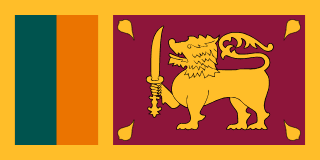
Sri Lanka
Democratic Socialist Republic of Sri Lanka
Population: UN WPP 2024, revision 1, projection for 1 July 2026. Sources and methodology.
Geography and territory
Sri Lanka, poetically known as the Pearl of the Indian Ocean, is a teardrop-shaped island off the southeastern coast of India, separated from the mainland by the narrow Palk Strait, barely 50 kilometers wide. Covering 65,610 square kilometers, this tropical island holds an astonishing range of geography and ecology for its size, from golden-sand beaches and coastal lagoons to rainforest, mountains blanketed in tea plantations, and arid plains in the north.
Sri Lanka’s terrain centers on a mountainous central plateau that rises abruptly from the coastal plains. The central highlands, with Pidurutalagala as the highest point at 2,524 meters, are covered by the famous tea plantations that carpet the hillsides in a mosaic of green and have become one of the country’s most iconic images. The Mahaweli, Kelani, and Kalu rivers rise in these mountains and flow toward the sea, carving fertile valleys and feeding spectacular waterfalls such as Bambarakanda, the tallest in the country at 263 meters.
Sri Lanka’s climate is tropical, shaped by two annual monsoons that bring a wet season and a dry season to each region, though at different times of year, meaning good weather can always be found somewhere in the country. The rains sustain lush vegetation, including UNESCO-listed tropical rainforest in the southwest with an extraordinary rate of endemism. The coast offers coral reefs, mangroves, and marine habitats home to blue whales, dolphins, sea turtles, and a rich array of underwater life.
History
Sri Lanka has a documented history spanning more than 2,500 years, one of the oldest continuous records in Asia. The Mahavamsa chronicle narrates the arrival of Prince Vijaya from India in the sixth century BCE and the founding of the Sinhalese civilization, which developed sophisticated irrigation systems, enormous reservoirs, and monumental cities. Anuradhapura, capital for more than a millennium, and Polonnaruwa became centers of power, culture, and Buddhism that rivaled the great civilizations of the Indian subcontinent.
The arrival of Buddhism in the third century BCE, brought according to tradition by Mahinda, son of the Indian emperor Ashoka, profoundly transformed the island’s civilization. Sri Lanka became a guardian of Theravada Buddhist tradition, preserving the original scriptures in Pali and developing a religious art of extraordinary beauty visible in colossal Buddha statues, the rock paintings of Sigiriya, and monumental stupas known as dagobas. Coexistence with the Hindu Tamils of the north produced both periods of cultural exchange and conflicts that would shape later history.
The colonial era began with the arrival of the Portuguese in 1505, followed by the Dutch in 1658 and the British in 1796, who unified the entire island under their control in 1815 and renamed it Ceylon. British colonization reshaped the economy around tea, coffee, and rubber plantations, and brought Tamil laborers from India. Independence, achieved in 1948, was followed by rising ethnic tensions between Sinhalese and Tamils that erupted into a devastating civil war from 1983 to 2009. The country has since pursued a difficult process of reconciliation and rebuilding.
Culture and society
Sri Lankan culture is a fascinating tapestry woven from Buddhist, Hindu, colonial, and indigenous threads. Theravada Buddhism, practiced by the Sinhalese majority, permeates nearly every aspect of social life, from temple architecture to the calendar of festivals. The Sacred Tooth Relic of the Buddha, housed in the Temple of the Tooth in Kandy, is the country’s most venerated object and the centerpiece of the spectacular Esala Perahera procession, a nighttime parade of decorated elephants, dancers, musicians, and torch bearers held each July or August.
Sri Lanka’s performing arts are exceptionally rich. Kandyan dance, with its elaborate costumes, silver headdresses, and vigorous movements, is the most celebrated form, but southern traditions such as devil-mask dance and the ritual kolam theater offer equally captivating spectacles. Craftsmanship includes the carved masks of Ambalangoda, gemstone jewelry, Sri Lanka being known as the Island of Gems, batik textiles, and Kandyan lacquerware.
Sri Lankan society reflects the complexity of its multiethnic history. Sinhalese and Tamils, alongside Muslim, Burgher, descendants of European settlers, and Vedda, the island’s indigenous people, make up a diverse social mosaic. Religious festivals fill the calendar year-round: the Buddhist Vesak, the Hindu Deepavali, the Muslim observance of Ramadan, and Christmas are all celebrated with enthusiasm, reflecting a religious plurality that, despite past conflict, remains one of the country’s great riches.
Economy
Sri Lanka has a middle-income economy with a level of human development that stands out in South Asia. Services dominate GDP, driven by tourism, telecommunications, and banking. Ceylon tea, celebrated worldwide for its exceptional quality, remains one of the country’s leading exports: Sri Lanka is the world’s fourth-largest producer, and its highland varieties rank among the most prized in international markets.
The textile and garment industry represents the largest manufacturing export sector, with major international brands producing in the country’s free trade zones. Diversified agriculture includes rubber, coconut, cinnamon, of which Sri Lanka is the world’s largest exporter, spices, and rice. Fishing and aquaculture supplement food production on an island surrounded by resource-rich waters. Gemstones, especially sapphires and rubies, sustain a mining and cutting tradition dating back to antiquity.
Sri Lanka’s economy has faced severe recent challenges, including a serious debt crisis in 2022 that led to shortages of fuel, food, and medicine and forced an economic restructuring under IMF supervision. Tourism, which had reached record numbers before the pandemic with more than two million annual visitors, is recovering gradually as a driver of foreign currency and employment. The island’s potential as an Indian Ocean logistics hub and technology services center offers avenues for diversification as the economy stabilizes.
Food and cuisine
Sri Lankan cuisine is an explosion of flavors, aromas, and colors reflecting the island’s historic position at the crossroads of the spice trade. Rice and curry is the foundational dish: a generous serving of rice accompanied by several bowls of fish, meat, lentil, and vegetable curries, spicy sambols, pickles, and papadams. What sets Sri Lankan curries apart is the generous use of coconut milk, fresh curry leaves, Ceylon cinnamon, cardamom, and a blend of roasted spices that gives them a deep, distinctive flavor.
Hoppers, or appam, are among Sri Lanka’s most original preparations: thin, bowl-shaped crepes made from fermented rice flour and coconut milk, cooked in a small round pan. They are served as egg hoppers with an egg cracked into the center, as string hoppers, delicate rice noodle nests, or as a base for curries and sambols. Kottu roti, a street food dish of chopped roti stir-fried with vegetables, egg, and meat to the rhythmic clang of spatulas on a griddle, is the most recognizable sound of a Sri Lankan night market.
Lagoon crab, prepared in a spicy black pepper curry, is the country’s most celebrated culinary treat and has brought restaurants such as Colombo’s Ministry of Crab international fame. Sambols, especially pol sambol, made with grated coconut, chili, and lime, accompany nearly every meal. Tropical fruit is extraordinary here: mangoes, papayas, rambutans, and king coconut, a golden coconut whose sweet water is the quintessential refreshing drink. Ceylon tea, from deep black to delicate white varieties grown in the highlands, is enjoyed at all hours.
Tourism and landmarks
Sri Lanka packs in a density of attractions that is hard to match for its size. Sigiriya Rock, a UNESCO World Heritage site, is a spectacular fifth-century fortress built atop a 200-meter monolith, with frescoes of celestial maidens, water gardens, and a staircase set between the paws of a giant lion that gives the site its name, Lion Rock. The ruins of Anuradhapura and Polonnaruwa offer temples, stupas, and Buddha statues chronicling more than two millennia of civilization.
Kandy, the last capital of the Sinhalese kingdom, charms visitors with its artificial lake, the Temple of the Sacred Tooth Relic, and hills draped in tea plantations. The train ride from Kandy to Ella, considered one of the most beautiful rail journeys in the world, winds through tea plantations, waterfalls, and colonial-era bridges over misty valleys. The southern beaches, from Unawatuna to Mirissa and Tangalle, offer crystal-clear waters, world-class surf, and the chance to spot blue whales, the largest animals ever to have lived.
Yala National Park, in the southeast, holds one of the highest concentrations of leopards in the world, alongside elephants, crocodiles, and hundreds of bird species. Galle, on the south coast, preserves a magnificent seventeenth-century Dutch fort with cobblestone streets, colonial churches, and craft boutiques. The east coast, with Trincomalee and Arugam Bay, offers pristine beaches and colorful Hindu temples. Adam’s Peak (Sri Pada), a sacred mountain of 2,243 meters bearing a footprint revered by Buddhists, Hindus, Muslims, and Christians alike, is climbed overnight in pilgrimage to watch the sunrise from its summit.
Fun facts about Sri Lanka
- Sri Lanka is the world’s largest exporter of cinnamon, a spice Arab traders were already carrying from the island more than 2,000 years ago
- The country has the highest concentration of Asian elephants in the world relative to its land area
- Ceylon tea is renowned worldwide, but the island’s first major cash crop was coffee, wiped out by a plant disease in the nineteenth century
- Sri Lanka was the first country in the world to elect a woman as head of government: Sirimavo Bandaranaike in 1960
- Sigiriya Rock was built by a king who murdered his father and feared his brother’s revenge, raising an impregnable fortress atop a 200-meter monolith
Sri Lanka in numbers
Latest World Bank and UNDP observations, each with its own year. “World median” is the middle value among the countries that report the same indicator; “#” ranks from the highest value.
Population since 1960
Sri Lanka had 9.7 million people in 1960 and 21.8 million in 2025 — 2.3 times as many.
People
20.5% of people live in towns and cities (world median 63.4%). 21.7% are under 15 and 12.5% are 65 or older — a middle-aged population. Women have 1.95 children on average, below the replacement level of about 2.1 needed to keep a population stable in the long run without migration.
Economy
The economy grew by 5.0% in real terms in 2025. Consumer prices fell by 4.8% in 2025. Services make up the largest share of output (54.6% of GDP); agriculture contributes 8.4%.
Development and environment
UNDP rates human development in Sri Lanka as high, with an index of 0.776 in 2023 (rank 89 of 193). 54.6% of people use the internet and 100.0% have access to electricity. Forest covers 34.4% of the land (world median 32.8%).
Sources: World Bank, World Development Indicators (CC BY 4.0), most recent observation from 2015 onward; UNDP Human Development Report 2025. Retrieved 2026-10-10. Sector shares need not add up to 100% because taxes and subsidies on products are excluded. Missing values are left blank rather than estimated. Sources and methodology.
Climate of Sri Lanka
Averaged across Sri Lanka, the mean temperature stays between 25.6 °C (January) and 28.4 °C (May) — a swing of only 2.8 °C, so seasons are marked by rainfall rather than by heat.
About 1,743 mm of precipitation falls in a typical year. November is the wettest month (328 mm) and July the driest (64 mm). The wettest stretch is October to December, with 46% of the year's total.
Show monthly values as a table
| Month | Mean °C | Low °C | High °C | Precipitation, mm |
|---|---|---|---|---|
| January | 25.6 | 21.9 | 29.4 | 115 |
| February | 26.4 | 22.1 | 30.8 | 103 |
| March | 27.5 | 23.1 | 32.1 | 77 |
| April | 28.2 | 24.2 | 32.3 | 147 |
| May | 28.4 | 24.8 | 32.0 | 132 |
| June | 28.1 | 24.9 | 31.4 | 67 |
| July | 28.0 | 24.6 | 31.4 | 64 |
| August | 27.7 | 24.3 | 31.2 | 91 |
| September | 27.6 | 24.0 | 31.3 | 137 |
| October | 27.0 | 23.5 | 30.7 | 242 |
| November | 26.3 | 22.9 | 29.8 | 328 |
| December | 25.8 | 22.6 | 29.0 | 241 |
Figures are 1991–2020 averages across the whole land area of Sri Lanka, from the World Bank Climate Change Knowledge Portal, CRU TS 4.08 (CC BY 4.0). They are not readings from one weather station: the capital, the coast and high ground can be much warmer, cooler, wetter or drier.
Travel essentials for Sri Lanka
The practical details visitors ask about first. Traffic in Sri Lanka drives on the left, one of 54 of the 196 countries profiled here that do — see the full list. Mains electricity is 230 V at 50 Hz, so devices made only for 110–120 V (common in North America) need a converter unless they are dual-voltage — most phone and laptop chargers are.
- Emergency number
- 119Ambulance 1990 · Fire 110
- Driving side
- Left
- Plug types
- Type D, Type G, Type MD: three large round pins in a triangle; G: three rectangular pins (British); M: three large round pins (South African)
- Voltage
- 230 V50 Hz
- Dialling code
- +94From abroad: your exit code, then 94 and the number
- Currency
- Sri Lankan Rupee (LKR)
- Time zone
- UTC+5:30Current local time in Sri Lanka
Compiled from IEC plug and voltage standards, national emergency-service listings and the UN road-traffic conventions. Emergency numbers and local coverage can change — confirm them locally on arrival. Sri Lanka's internet domain is .lk.
Where Sri Lanka ranks in the world
Each position counts only the countries with data in that ranking guide. First place is the highest value — for price levels, the most expensive. Select a card to see the full table.
- Population60th of 19623.3 millionUN projection, July 2026
- Land area122nd of 19561,860 km²World Bank, 2023
- Population density23rd of 194356 per km²World Bank, 2023
- GDP (nominal)70th of 187$99.6BWorld Bank, 2024, current US$
- GDP per capita118th of 187$4,545World Bank, 2024, current US$
- Life expectancy62nd of 19477.7 yearsWorld Bank, 2024
- Price level151st of 16529 (US = 100)ICP 2021, household consumption
Compare Sri Lanka with another country
Frequently asked questions about Sri Lanka
What is the capital of Sri Lanka?
The capital of Sri Lanka is Sri Jayawardenepura Kotte (administrative), Colombo (commercial).
What is the population of Sri Lanka?
The UN World Population Prospects projection for Sri Lanka is 23,348,315 people (23.3 million) on 1 July 2026. National statistical offices may publish different estimates.
What language is spoken in Sri Lanka?
The official language of Sri Lanka is Sinhala, Tamil.
What currency is used in Sri Lanka?
The currency of Sri Lanka is the Sri Lankan Rupee (LKR).
How big is Sri Lanka?
Sri Lanka covers an area of 65,610 km².
What type of government does Sri Lanka have?
Sri Lanka is a semi-presidential republic.
What is the highest point in Sri Lanka?
The highest point in Sri Lanka is Pidurutalagala (2,524 m).


