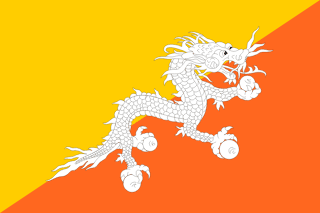
Bhutan
Kingdom of Bhutan
Population: UN WPP 2024, revision 1, projection for 1 July 2026. Sources and methodology.
Geography and territory
Bhutan is a small Himalayan kingdom wedged between two giants, bordered by China to the north and India to the south, east, and west. Covering 38,394 square kilometers, an area only slightly larger than Belgium, this mountainous country contains one of the most dramatic ranges of elevation on Earth, from around 150 meters in the subtropical valleys of the south to 7,570 meters at Gangkhar Puensum, widely regarded as the highest unclimbed mountain in the world; ascents have been prohibited since 2003 for spiritual reasons.
Bhutan’s terrain unfolds in three broad bands, each supporting a radically different ecosystem. The subtropical lowlands of the south, known as the Duars, are covered in dense tropical forest and provide habitat for Asian elephants, Bengal tigers, and rhinoceroses. The central belt holds the great river valleys of Paro, Thimphu, and Punakha, where most of the population and agricultural activity is concentrated, at elevations between roughly 1,100 and 2,600 meters and a temperate climate well suited to rice and orchard crops.
The northern band belongs to the Great Himalaya, a realm of glaciers, high-altitude lakes, and peaks exceeding 7,000 meters. The Mo Chhu, Pho Chhu, and Wang Chhu rivers plunge down from these frozen heights, carving deep valleys and dramatic gorges. Forest cover exceeds 70 percent of Bhutan’s territory, among the highest proportions in the world, the result of an environmental policy that elevates conservation to constitutional mandate: Bhutan’s constitution requires that at least 60 percent of the country remain forested in perpetuity.
History
Bhutan’s history carries a strong air of mysticism and isolation that has helped preserve one of the most intact cultures in the Himalayas. According to tradition, Buddhism arrived in the seventh century through Guru Rinpoche, known as Padmasambhava, Bhutan’s patron saint, who legend says flew to the cliffside where Taktsang monastery now stands on the back of a flying tigress, founding what remains the country’s most recognizable landmark. Since then, Tibetan Vajrayana Buddhism has served as the organizing force of Bhutanese civilization.
Bhutan’s unification as a state is credited to Shabdrung Ngawang Namgyal, a Tibetan lama who in the seventeenth century established a dual system of religious and civil government and built the imposing dzong, fortress-monasteries that still define the country’s built landscape. For centuries, Bhutan maintained near-total isolation from the outside world, repelling Tibetan and British incursions alike while developing a distinct culture that blended Buddhist spirituality, theocratic governance, and rural tradition.
Bhutan’s modernization is a remarkably recent phenomenon. The country’s first road was built in 1961, television did not arrive until 1999, and tourism only opened to the outside world in 1974. The voluntary shift from absolute to constitutional monarchy in 2008, driven by King Jigme Singye Wangchuck against the wishes of much of his own populace, stands as a rare case in modern history: a monarch who ceded power democratically without any popular pressure to do so. His philosophy of Gross National Happiness as an alternative to GDP has since turned Bhutan into something of a global laboratory for sustainable development and well-being.
Culture and society
Bhutanese culture is among the most distinctive and best preserved in the world, deeply rooted in Vajrayana Buddhism, which shapes nearly every aspect of daily life. The dzong, massive fortress-monasteries with sloping whitewashed walls and red-tiled roofs, function simultaneously as administrative and religious centers in every district, embodying the fusion of secular and spiritual authority that defines Bhutan. Traditional architecture is protected by law: all buildings must follow the national style, with carved windows, timber balconies, and painted religious motifs.
The tshechu, religious festivals held at dzong throughout the country, represent Bhutan’s highest cultural expression. Over several days, monks and laypeople perform the cham masked dances, ritual reenactments of episodes from Buddhist lore, wearing elaborate brocade costumes and masks that embody deities, demons, and sacred animals. The climax is the unveiling of the thondrol, a giant embroidered tapestry whose mere sight is believed to grant liberation from suffering. Traditional dress remains mandatory in public buildings: the gho, a knee-length robe for men, and the kira, a wrapped dress for women.
Bhutanese society holds values that stand apart from Western modernity. Gross National Happiness, measured through surveys assessing psychological well-being, health, education, governance, community vitality, cultural diversity, time use, and ecological resilience, guides public policy. The country was a pioneer in banning tobacco sales, plastic bags, and commercial logging. Bhutan is also, notably, the only country in the world with a negative carbon footprint, its forests absorbing more carbon dioxide than its entire economy emits.
Economy
Bhutan’s economy is among the smallest in Asia but stands out for a development model that prioritizes well-being over unlimited growth. Hydroelectric power is the leading economic pillar, generated by the fast-flowing rivers descending from the Himalayas. Hydropower plants, frequently built with Indian assistance, produce a surplus of electricity that is exported to India and represents the government’s largest source of revenue, funding free education, universal health care, and road construction.
Subsistence agriculture employs most of the Bhutanese population, with rice, corn, wheat, and potatoes as the leading crops in the temperate valleys. Bhutan gained international attention as the first country to officially commit to 100 percent organic agriculture, banning chemical pesticides and fertilizers, though full implementation of that goal remains a work in progress. Yak herding in the highlands and small-scale cheese production round out the rural economy.
Tourism forms the other major economic sector, though Bhutan applies a distinctive “high value, low impact” policy that deliberately limits visitor numbers. Tourists must pay a substantial daily fee covering accommodation, meals, a guide, and transportation, a system that helps fund cultural and environmental conservation while generating significant revenue. The policy has preserved the country’s authenticity, though it has also sparked debate over accessibility and fairness within Bhutan’s tourism model.
Food and cuisine
Bhutanese cuisine is defined by its bold use of chili, which functions not as a mere condiment but as a central ingredient in most dishes. Ema datshi, considered the national dish, is a stew of green or red chilies cooked in a creamy sauce of yak cheese, served with red rice, a native variety grown in Bhutanese valleys at altitudes where few other rice strains can survive. The dish’s intense heat often surprises visitors, but for Bhutanese people it is simply the foundation of daily eating.
Variations on datshi, the local cheese, run throughout Bhutanese cooking. Kewa datshi combines potatoes with cheese and chili, shamu datshi swaps in wild mushrooms gathered from mountain forests, and shakam datshi uses dried beef or pork. Phaksha paa, pork simmered with dried red chilies and radish or spinach, and jasha maroo, a spicy chicken and tomato stew, are other essential dishes. Meat is frequently dried in the sun or over smoke, a preservation technique well suited to life in remote mountain communities.
Traditional Bhutanese drinks include suja, butter tea made with whipped yak butter and salt, an energizing staple at high altitude whose salty, buttery flavor often catches Western palates off guard. Ara, a spirit distilled from rice or other grains, accompanies celebrations and social gatherings. Momos, steamed dumplings filled with meat or cheese and inherited from Tibetan tradition, are the country’s most popular snack. Desi, rice sweetened with butter and saffron, is prepared for festivals as both offering and communal treat.
Tourism and landmarks
Bhutan offers a travel experience unlike anywhere else, one where spirituality, pristine nature, and an unbroken culture combine in a country that seems to exist outside of time. Paro Taktsang, known as the Tiger’s Nest, is a Buddhist monastery suspended on a cliffside at 3,120 meters and stands as Bhutan’s most iconic image and one of the most spectacular sacred sites on the planet. The climb to reach it winds through mist-covered pine forest strung with prayer flags before arriving at the white-and-gold facade of the temple, which appears to defy gravity.
Bhutan’s dzong are masterpieces of Himalayan architecture. Punakha Dzong, built at the confluence of two rivers in 1637, is widely considered the most beautiful in the country, framed by jacaranda trees that bloom in spring and connected to the outside world by suspension bridges. Tashichho Dzong in Thimphu, seat of government and the king’s summer residence, and Rinpung Dzong in Paro, with its towering stone walls, complete an unmatched architectural itinerary.
Bhutan’s valleys invite trekking through landscapes of extraordinary purity: terraced rice paddies, traditional villages with painted phallic symbols on their facades believed to ward off evil spirits, remote monasteries, and rhododendron forests that burst into color between March and May. The Bumthang valley, considered Bhutan’s spiritual heartland, holds many of the country’s oldest and most revered temples. For the most adventurous, the Snowman Trek, a 25-day journey across passes above 5,000 meters, is regarded as one of the most demanding and remote treks in the world.
Fun facts about Bhutan
- Bhutan is the only country in the world with a negative carbon footprint; its forests absorb more carbon dioxide than its entire economy produces.
- Gangkhar Puensum, at 7,570 meters, is considered the highest unclimbed mountain on Earth, and climbing it has been banned since 2003 for spiritual reasons.
- Television and the internet did not reach Bhutan until 1999, making it one of the last countries in the world to introduce broadcast TV.
- Bhutan measures its citizens’ well-being through Gross National Happiness rather than relying solely on Gross Domestic Product.
- Many Bhutanese homes are decorated with painted phalluses, a Buddhist tradition believed to protect against evil spirits and envy.
Bhutan in numbers
Latest World Bank and UNDP observations, each with its own year. “World median” is the middle value among the countries that report the same indicator; “#” ranks from the highest value.
Population since 1960
Bhutan had 224,084 people in 1960 and 796,682 in 2025 — 3.6 times as many.
People
43.4% of people live in towns and cities (world median 63.4%). 20.4% are under 15 and 6.6% are 65 or older — a middle-aged population. Women have 1.45 children on average, below the replacement level of about 2.1 needed to keep a population stable in the long run without migration.
Economy
The economy grew by 8.0% in real terms in 2025. Consumer prices rose by 3.6% in 2025. Services make up the largest share of output (53.2% of GDP); agriculture contributes 13.7%.
Development and environment
UNDP rates human development in Bhutan as medium, with an index of 0.698 in 2023 (rank 125 of 193). 91.3% of people use the internet and 100.0% have access to electricity. Forest covers 70.4% of the land (world median 32.8%).
Sources: World Bank, World Development Indicators (CC BY 4.0), most recent observation from 2015 onward; UNDP Human Development Report 2025. Retrieved 2026-10-10. Sector shares need not add up to 100% because taxes and subsidies on products are excluded. Missing values are left blank rather than estimated. Sources and methodology.
Climate of Bhutan
Averaged across Bhutan, the warmest month is July (16.1 °C) and the coolest is January (2.2 °C), a seasonal swing of 13.9 °C. The annual mean is 10.2 °C.
About 1,927 mm of precipitation falls in a typical year. July is the wettest month (468 mm) and December the driest (4 mm). The three wettest consecutive months, June to August, bring 62% of the year's total — a pronounced rainy season.
Show monthly values as a table
| Month | Mean °C | Low °C | High °C | Precipitation, mm |
|---|---|---|---|---|
| January | 2.2 | −5.0 | 9.4 | 10 |
| February | 4.2 | −2.7 | 11.1 | 12 |
| March | 7.8 | 1.3 | 14.4 | 36 |
| April | 10.7 | 5.1 | 16.4 | 109 |
| May | 13.1 | 8.1 | 18.2 | 227 |
| June | 15.7 | 11.3 | 20.1 | 385 |
| July | 16.1 | 12.1 | 20.1 | 468 |
| August | 15.9 | 11.8 | 20.1 | 346 |
| September | 14.7 | 10.2 | 19.3 | 237 |
| October | 11.4 | 5.6 | 17.3 | 85 |
| November | 7.0 | 0.1 | 14.0 | 9 |
| December | 3.7 | −3.7 | 11.1 | 4 |
Figures are 1991–2020 averages across the whole land area of Bhutan, from the World Bank Climate Change Knowledge Portal, CRU TS 4.08 (CC BY 4.0). They are not readings from one weather station: the capital, the coast and high ground can be much warmer, cooler, wetter or drier.
Travel essentials for Bhutan
The practical details visitors ask about first. Traffic in Bhutan drives on the left, one of 54 of the 196 countries profiled here that do — see the full list. Mains electricity is 230 V at 50 Hz, so devices made only for 110–120 V (common in North America) need a converter unless they are dual-voltage — most phone and laptop chargers are.
- Emergency number
- 113Ambulance 112 · Fire 110
- Driving side
- Left
- Plug types
- Type C, Type D, Type F, Type G, Type MC: two round pins (Europlug); D: three large round pins in a triangle; F: two round pins with side earth clips (Schuko); G: three rectangular pins (British); M: three large round pins (South African)
- Voltage
- 230 V50 Hz
- Dialling code
- +975From abroad: your exit code, then 975 and the number
- Currency
- Ngultrum (BTN)
- Time zone
- UTC+6Current local time in Bhutan
Compiled from IEC plug and voltage standards, national emergency-service listings and the UN road-traffic conventions. Emergency numbers and local coverage can change — confirm them locally on arrival. Bhutan's internet domain is .bt.
Where Bhutan ranks in the world
Each position counts only the countries with data in that ranking guide. First place is the highest value — for price levels, the most expensive. Select a card to see the full table.
- Population163rd of 196802,214UN projection, July 2026
- Land area132nd of 19538,140 km²World Bank, 2023
- Population density164th of 19421 per km²World Bank, 2023
- GDP (nominal)160th of 187$3.3BWorld Bank, 2024, current US$
- GDP per capita124th of 187$4,228World Bank, 2024, current US$
- Life expectancy102nd of 19473.3 yearsWorld Bank, 2024
- Price level154th of 16529 (US = 100)ICP 2021, household consumption
Bordering countries of Bhutan


Compare Bhutan with another country
Frequently asked questions about Bhutan
What is the capital of Bhutan?
The capital of Bhutan is Thimphu.
What is the population of Bhutan?
The UN World Population Prospects projection for Bhutan is 802,214 people (802,214) on 1 July 2026. National statistical offices may publish different estimates.
What language is spoken in Bhutan?
The official language of Bhutan is Dzongkha.
What currency is used in Bhutan?
The currency of Bhutan is the Ngultrum (BTN).
How big is Bhutan?
Bhutan covers an area of 38,394 km².
What type of government does Bhutan have?
Bhutan is a constitutional monarchy.
Which countries border Bhutan?
Bhutan shares land borders with China, India.
What is the highest point in Bhutan?
The highest point in Bhutan is Gangkhar Puensum (7,570 m).


