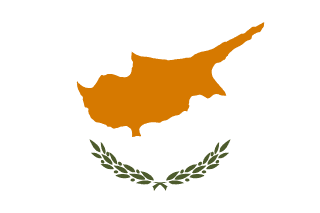
Cyprus
Republic of Cyprus
Population: UN WPP 2024, revision 1, projection for 1 July 2026. Sources and methodology.
Geography and territory
Cyprus is the third-largest island in the Mediterranean, after Sicily and Sardinia, covering 9,251 square kilometers. Set at the eastern edge of the Mediterranean, roughly 75 kilometers from the Turkish coast, 105 kilometers from Syria, and 380 kilometers from Egypt, the island sits at a genuine crossroads of continents. Although geographically closer to Asia, Cyprus has long maintained deep cultural and political ties with Europe, and it has been a member of the European Union since 2004.
The island’s geography is shaped by two mountain ranges: the Troodos range in the center-west, topped by Mount Olympus at 1,952 meters, and the narrower, more rugged Kyrenia range, also called the Pentadaktylos, in the north. Between them lies the Mesaoria plain, the island’s most important agricultural region. Cyprus’s roughly 650-kilometer coastline offers a striking mix of golden beaches, rocky coves, and sheer cliffs.
The climate is classically Mediterranean, with long, hot, dry summers running from May through October and mild, moderately rainy winters. Cyprus enjoys more than 300 days of sunshine a year, making it one of the sunniest parts of Europe. The Troodos mountains receive enough snow in winter to support skiing, while coastal temperatures rarely dip below 10 degrees Celsius even in the coldest months. Vegetation ranges from pine, cypress, and cedar forests in the highlands to Mediterranean scrubland across the lowland plains.
History
Cyprus’s history reads like a palimpsest of civilizations. The island has been inhabited since the Neolithic period, and the roughly 9,000-year-old settlement of Khirokitia is a UNESCO World Heritage site. Cyprus was a major center of copper production during the Bronze Age, and many scholars believe the island’s name is linked to the Latin word for copper, cuprum, or vice versa. Phoenicians, Assyrians, Egyptians, Persians, Greeks, and Romans all left their mark on the island over the centuries.
In Greek mythology, Cyprus is the birthplace of Aphrodite, the goddess of love, said to have emerged from the sea foam near Petra tou Romiou, the Rock of Aphrodite. The island was part of the Byzantine Empire for centuries, was seized by Richard the Lionheart during the Third Crusade, and was later ruled by the French Lusignan dynasty and then Venice, before falling under Ottoman rule in 1571. British colonial administration followed from 1878 until independence was achieved on 16 August 1960.
Cyprus’s modern history has been shaped profoundly by ethnic division between Greek Cypriots and Turkish Cypriots. Following a coup backed by the Greek military junta in 1974, Turkish forces moved into the northern part of the island, which has remained divided ever since. A UN-patrolled buffer zone, commonly called the Green Line, separates the internationally recognized Republic of Cyprus in the south from the Turkish Cypriot administration in the north. Nicosia remains the last divided capital city in Europe, a distinction that continues to shape both daily life and international diplomacy on the island.
Culture and society
Cypriot culture is a fascinating mosaic of Greek, Turkish, British, and broader Levantine influences that together give the island a distinct identity. The Greek Cypriot community, the majority in the south, maintains close ties to Hellenic culture, with Greek as the principal language and the Orthodox Church as a central pillar of identity. The Turkish Cypriot community in the north shares many traditions with Turkey, with Turkish as the main language and Islam as the predominant faith.
Traditional Cypriot craftsmanship includes the delicate lace of Lefkara, a centuries-old technique local legend credits to the influence of Leonardo da Vinci, said to have visited the village. Pottery, basket weaving, and silverwork remain significant traditional crafts as well. Cypriot music blends Greek melodies with Eastern rhythms, and folk dances enliven festivals across the island. Wine festivals, particularly the one held in Limassol, celebrate a winemaking tradition that stretches back more than 5,000 years.
Cypriot society places great value on family, community, and life lived largely outdoors. Cafés and taverns serve as social hubs where people linger for hours, talking, playing tavli (backgammon), and sharing local food. Cypriot hospitality is famously generous, and visitors are almost always invited to share food and drink. A relaxed Mediterranean pace, marked by long lunches and evening strolls, defines the island’s character.
Economy
Cyprus’s economy, with a GDP of roughly $41.23 billion, is overwhelmingly services-based. Tourism is a pillar of the economy, drawing millions of visitors each year to its beaches, historical sites, and sunny climate. Financial and business services, supported by a competitive tax regime and Cyprus’s membership in both the EU and the eurozone, form another key sector that has positioned the island as a business hub for international companies.
Cyprus’s shipping sector is one of the most significant in the world: the country controls one of the largest merchant fleets in the European Union and ranks among the largest ship registries globally. Manufacturing includes food processing, textiles, chemicals, and cement. Agriculture, while a smaller share of output, produces citrus fruit, potatoes, grapes, olives, and halloumi cheese, whose EU-protected designation of origin is a source of considerable national pride.
The discovery of significant natural gas reserves within Cyprus’s exclusive economic zone in the eastern Mediterranean has opened prospects for further economic transformation, although development has been complicated by territorial disputes with Turkey. The 2013 financial crisis, which required an international bailout, was a severe setback, but the economy has since recovered solidly. Technology, professional services, and higher education, which draws a growing number of international students, are among the sectors now expanding.
Food and cuisine
Cypriot food is a delicious fusion of Greek, Turkish, and Levantine cooking, elevated by exceptional Mediterranean ingredients. The Cypriot meze is the island’s defining culinary experience: a long procession of twenty to thirty small dishes that might include grilled halloumi, tahini, hummus, koupepia (stuffed grape leaves), sheftalia (pork sausages wrapped in caul fat), loukaniko (smoked sausage), grilled octopus, and kleftiko, among many others.
Halloumi is Cyprus’s most emblematic food product: a semi-hard cheese made from goat’s and sheep’s milk with the unusual property of holding its shape when grilled or fried, developing a crisp exterior around a soft, warm center. Kleftiko, lamb slow-cooked for hours in a sealed clay oven until the meat falls apart, is the island’s classic celebratory dish. Cypriot moussaka, souvlaki, koupes (bulgur croquettes with a meat filling), and afelia, pork stewed in red wine and coriander seed, are other staples of the table.
Cypriot wine has a history stretching back more than 5,000 years, possibly the oldest continuous winemaking tradition in the world. Commandaria, a sweet wine produced in the Troodos region, is considered the oldest named wine still in production, mentioned even by medieval crusaders. Local sweets include the loukoumia (Turkish delight) of Geroskipou, daktyla, or “finger” almond pastries, baklava, and galaktoboureko. Cypriot coffee, similar to Turkish coffee, is traditionally served with a glass of cold water and often a piece of loukoumi on the side.
Tourism and landmarks
Cyprus draws visitors with a combination of spectacular beaches and world-class archaeological and historical sites. The archaeological sites of Paphos, a UNESCO World Heritage listing, include the Tombs of the Kings, extraordinarily well-preserved Roman mosaics in the House of Dionysos and the House of Theseus, and the pillar where, according to tradition, Saint Paul was scourged. Nearby, the Rock of Aphrodite marks the legendary birthplace of the goddess of love.
The Troodos mountains shelter Byzantine churches with medieval frescoes recognized by UNESCO, the Kykkos Monastery with its icon of the Virgin Mary attributed to Saint Luke, and picturesque mountain villages such as Omodos and Kakopetria. Limassol, the island’s second city, offers a lively seafront promenade, a medieval castle where Richard the Lionheart is said to have married, and wineries that still produce ancestral Commandaria.
Ayia Napa and Protaras, in the southeast, are internationally known beach destinations prized for crystal-clear turquoise water, with Nissi Beach ranking among the most photographed stretches of coast in the Mediterranean. Larnaca offers the Church of Saint Lazarus, a salt lake where flamingos winter, and the Hala Sultan Tekke mosque. In the north, the ruins of ancient Salamis and the walled city of Famagusta preserve an impressive layered heritage, including the Gothic cathedral of Saint Nicholas, later converted into a mosque.
Fun facts about Cyprus
- According to Greek mythology, Cyprus is the birthplace of Aphrodite, the goddess of love and beauty, said to have risen from the sea foam near Paphos.
- Nicosia is the last divided capital city in the world, split by a UN-patrolled buffer zone since 1974.
- Commandaria, a sweet wine from the Troodos region, is considered the world’s oldest named wine still produced today, with a documented history spanning many centuries.
- Halloumi is one of the only cheeses in the world that can be grilled or fried without melting, and it now carries EU-protected designation of origin status.
- Cats are said to have been introduced to Cyprus in the fourth century by Saint Helena, mother of Emperor Constantine, to control a snake infestation, and the island remains famous for its large cat population today.
Cyprus in numbers
Latest World Bank and UNDP observations, each with its own year. “World median” is the middle value among the countries that report the same indicator; “#” ranks from the highest value.
Population since 1960
Cyprus had 586,490 people in 1960 and 1.4 million in 2025 — 2.3 times as many.
People
66.7% of people live in towns and cities (world median 63.4%). 16.1% are under 15 and 14.9% are 65 or older — an ageing population. Women have 1.38 children on average, below the replacement level of about 2.1 needed to keep a population stable in the long run without migration.
Economy
The economy grew by 3.8% in real terms in 2025. Consumer prices rose by 0.1% in 2025. Services make up the largest share of output (76.8% of GDP); agriculture contributes 1.1%.
Development and environment
UNDP rates human development in Cyprus as very high, with an index of 0.913 in 2023 (rank 32 of 193). 89.6% of people use the internet and 100.0% have access to electricity. Forest covers 18.6% of the land (world median 32.8%).
Sources: World Bank, World Development Indicators (CC BY 4.0), most recent observation from 2015 onward; UNDP Human Development Report 2025. Retrieved 2026-10-10. Sector shares need not add up to 100% because taxes and subsidies on products are excluded. Missing values are left blank rather than estimated. Sources and methodology.
Climate of Cyprus
Averaged across Cyprus, the warmest month is August (27.7 °C) and the coolest is January (10.4 °C), a seasonal swing of 17.3 °C. The annual mean is 18.7 °C.
About 475 mm of precipitation falls in a typical year. December is the wettest month (109 mm) and July the driest (1 mm). The three wettest consecutive months, December to February, bring 60% of the year's total — a pronounced rainy season.
Show monthly values as a table
| Month | Mean °C | Low °C | High °C | Precipitation, mm |
|---|---|---|---|---|
| January | 10.4 | 6.3 | 14.5 | 107 |
| February | 10.8 | 6.4 | 15.3 | 69 |
| March | 13.0 | 8.2 | 17.9 | 47 |
| April | 16.4 | 11.2 | 21.7 | 25 |
| May | 20.4 | 15.1 | 25.9 | 19 |
| June | 24.5 | 19.1 | 30.0 | 7 |
| July | 27.4 | 22.0 | 32.8 | 1 |
| August | 27.7 | 22.4 | 33.0 | 2 |
| September | 25.0 | 19.8 | 30.4 | 6 |
| October | 21.3 | 16.2 | 26.4 | 27 |
| November | 16.0 | 11.2 | 20.9 | 55 |
| December | 12.0 | 7.8 | 16.3 | 109 |
Figures are 1991–2020 averages across the whole land area of Cyprus, from the World Bank Climate Change Knowledge Portal, CRU TS 4.08 (CC BY 4.0). They are not readings from one weather station: the capital, the coast and high ground can be much warmer, cooler, wetter or drier.
Travel essentials for Cyprus
The practical details visitors ask about first. Traffic in Cyprus drives on the left, one of 54 of the 196 countries profiled here that do — see the full list. Mains electricity is 230 V at 50 Hz, so devices made only for 110–120 V (common in North America) need a converter unless they are dual-voltage — most phone and laptop chargers are.
- Emergency number
- 112
- Driving side
- Left
- Plug types
- Type GG: three rectangular pins (British)
- Voltage
- 230 V50 Hz
- Dialling code
- +357From abroad: your exit code, then 357 and the number
- Currency
- Euro (EUR)
- Time zone
- EET (UTC+2)Current local time in Cyprus
Compiled from IEC plug and voltage standards, national emergency-service listings and the UN road-traffic conventions. Emergency numbers and local coverage can change — confirm them locally on arrival. Cyprus's internet domain is .cy.
Where Cyprus ranks in the world
Each position counts only the countries with data in that ranking guide. First place is the highest value — for price levels, the most expensive. Select a card to see the full table.
- Population154th of 1961.4 millionUN projection, July 2026
- Land area162nd of 1959,240 km²World Bank, 2023
- Population density64th of 194146 per km²World Bank, 2023
- GDP (nominal)101st of 187$37.6BWorld Bank, 2024, current US$
- GDP per capita29th of 187$38,674World Bank, 2024, current US$
- Life expectancy33rd of 19481.8 yearsWorld Bank, 2024
- Price level29th of 16574 (US = 100)ICP 2021, household consumption
Compare Cyprus with another country
Frequently asked questions about Cyprus
What is the capital of Cyprus?
The capital of Cyprus is Nicosia.
What is the population of Cyprus?
The UN World Population Prospects projection for Cyprus is 1,382,334 people (1.4 million) on 1 July 2026. National statistical offices may publish different estimates.
What language is spoken in Cyprus?
The official language of Cyprus is Greek, Turkish.
What currency is used in Cyprus?
The currency of Cyprus is the Euro (EUR).
How big is Cyprus?
Cyprus covers an area of 9,251 km².
What type of government does Cyprus have?
Cyprus is a presidential republic.
What is the highest point in Cyprus?
The highest point in Cyprus is Mount Olympus (1,952 m).


