Flag of Uruguay
Oriental Republic of Uruguay
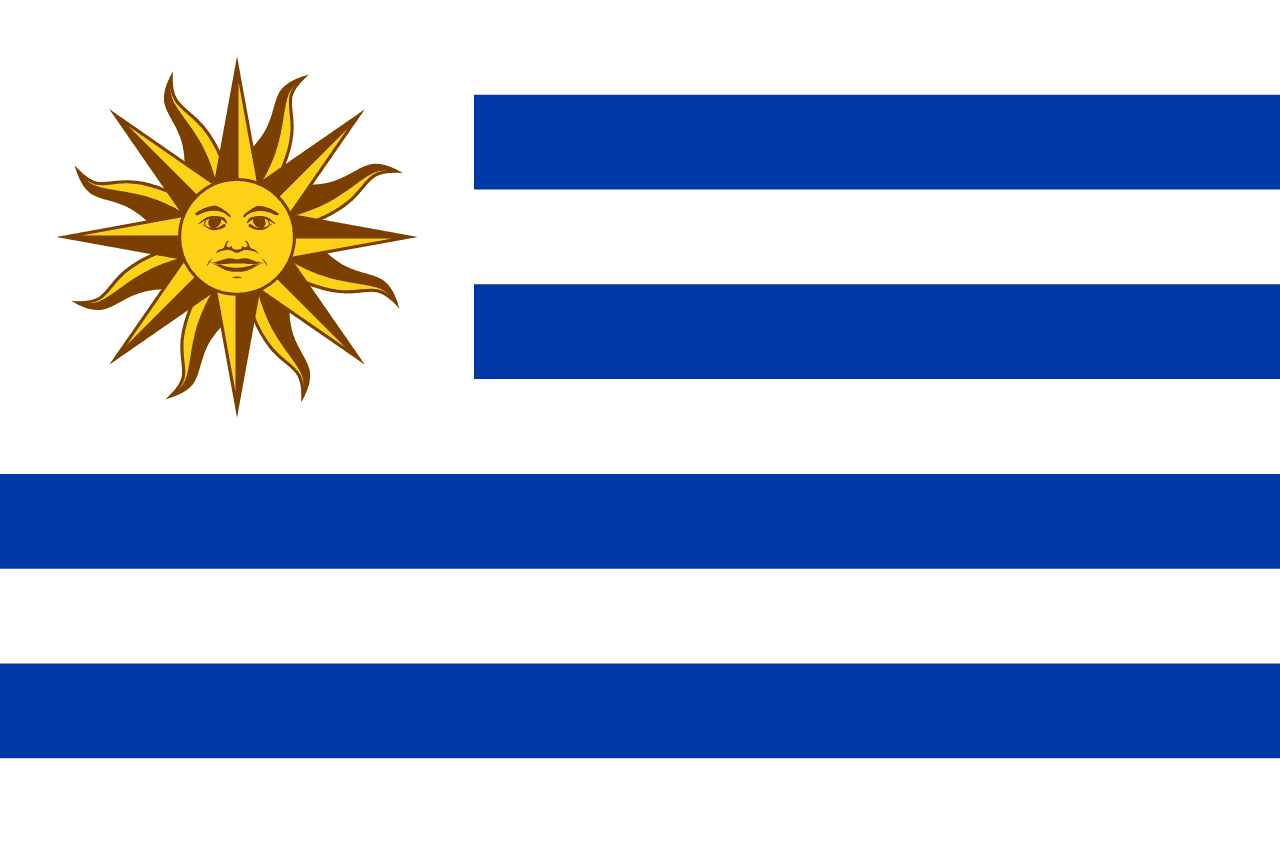
Flag details
- Country
- Uruguay
- Official name
- Oriental Republic of Uruguay
- Capital
- Montevideo
- ISO code
- UY / URY
- Region
- South America
Flag colors
- #ffffff56%
- #0038a833%
Share of the flag's surface, measured from the image.
Download the flag
Meaning and history of the flag of Uruguay
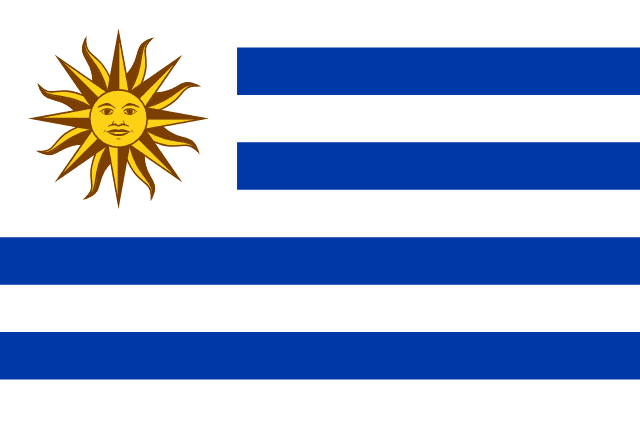
Uruguay's flag, known as the "National Pavilion," was officially adopted on July 11, 1830. It features nine alternating horizontal stripes of white and blue (five white, four blue), with a white canton in the upper hoist corner containing a golden sun with a human face, known as the Sun of May, radiating sixteen alternating straight and wavy rays.
The nine stripes represent the nine original departments into which the country was divided when its first constitution was promulgated. Blue and white are the traditional colors of the Río de la Plata region, inherited from the wars for South American independence. The Sun of May, an element shared with Argentina's flag, commemorates the May Revolution of 1810, considered the starting point of the Río de la Plata's path to independence, and represents the Inca sun god Inti.
Uruguay's flag bears clear similarities to Argentina's through its use of the Sun of May and the sky-blue-and-white color scheme, though Uruguay's flag uses a darker shade of blue and a greater number of stripes. Its structure also recalls Greece's flag, with multiple horizontal stripes and a canton. The influence of the United States flag is evident in the overall design of stripes and canton. Uruguay's Sun of May has a human face with defined features, unlike other solar depictions on flags, making it one of the most distinctive elements in South American vexillology.
You can view the flag of Uruguay in high resolution above and download it in several sizes for personal, educational or reference use. To explore more, visit the full Uruguay profile, its map, or the current local time in Montevideo.