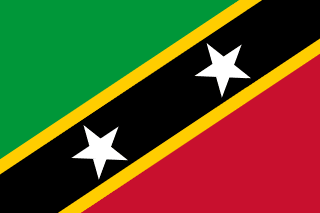
Saint Kitts and Nevis
Federation of Saint Kitts and Nevis
Population: UN WPP 2024, revision 1, projection for 1 July 2026. Sources and methodology.
Geography and territory
Saint Kitts and Nevis is the smallest sovereign country in the Americas, both by land area and by population. This twin-island federation covers just 261 square kilometers in the northern Leeward Islands of the eastern Caribbean, separated by a narrow channel barely 3 kilometers wide known as The Narrows. Saint Kitts, the larger island at 168 square kilometers, holds the capital of Basseterre, while Nevis, at 93 square kilometers, forms an almost perfectly circular island dominated by a single volcanic peak.
Both islands share a volcanic origin and boast dramatically mountainous terrain for their size. Mount Liamuiga, a dormant volcano on Saint Kitts, rises to 1,156 meters and holds a crater lake 240 meters deep, reachable via a demanding hike through tropical forest. Nevis Peak, at 985 meters, dominates its namesake island and is frequently wreathed in clouds, giving it a moody, almost mystical presence. Rainforest blankets the slopes of both volcanoes, tumbling down toward the coastline.
The coasts alternate between black volcanic sand in some stretches and pale golden sand in others, all fringed by clear Caribbean waters. Coral reefs encircling the islands support abundant marine life, and The Narrows between Saint Kitts and Nevis is a favorite spot for diving and snorkeling. Tropical trade winds moderate the climate, keeping temperatures pleasant year-round, with a wetter season running from May through November. With a population of just 46,922 across both islands, the federation combines an outsized sense of history with an intimate, close-knit scale.
History
Saint Kitts was the first island in the Caribbean colonized by both the English and the French, earning it the historic nickname “Mother Colony of the West Indies.” English settlers under Thomas Warner arrived in 1623, followed by the French in 1625. The two powers shared the island uneasily for more than a century, even as they jointly massacred the local Kalinago population in 1626, an episode that effectively erased the islands’ indigenous presence. Anglo-French rivalry over control of Saint Kitts was finally settled in Britain’s favor in 1783.
The colonial economy revolved around sugar, which generated immense fortunes for European planters while inflicting enormous suffering on enslaved Africans. Brimstone Hill Fortress, built by enslaved laborers atop a 230-meter promontory, became one of the most formidable fortifications in the Caribbean and today holds UNESCO World Heritage status. Nevis carries its own singular historical claim as the birthplace of Alexander Hamilton, one of the founding fathers of the United States.
Saint Kitts and Nevis gained independence from Britain on September 19, 1983, making it the last Caribbean nation to break from the crown. The federation has maintained a stable democracy ever since, though relations between the two islands have occasionally been strained, most notably when Nevis held a 1998 secession referendum that fell just short of the required majority. In the decades since independence, the country has shifted decisively from a sugar-based economy toward one built on tourism and financial services.
Culture and society
The culture of Saint Kitts and Nevis reflects the African heritage of most of its population, layered with British colonial and broader Caribbean influences. The Saint Kitts Carnival, held between Christmas and New Year rather than in the run-up to Lent like most Caribbean carnivals, is the most important cultural celebration of the year. Costumed troupe parades, calypso and soca competitions, clowns, and masquerade dancers in elaborate fabric costumes fill the streets of Basseterre for two lively weeks.
Calypso and soca dominate the musical landscape, complemented by string band music, a homegrown tradition built around guitar, banjo, cuatro, and percussion. The legacy of sugar, which shaped island life for more than three centuries, still permeates local traditions, architecture, and national identity, with many former sugar estates now reborn as boutique hotels and restaurants.
Cricket is the national sport, played on fields found in nearly every village and community across both islands. Kittitian and Nevisian society is close-knit, religious, and proud of its heritage. Nevis hosts its own signature event each August, Culturama, a cultural festival featuring calypso competitions, costumed parades, art exhibitions, and the crowning of Miss Culturama, making it the smaller island’s most important cultural showcase. Bull fights, in which bulls compete against one another rather than against humans, remain a popular festive tradition.
Economy
The economy of Saint Kitts and Nevis has been transformed in recent decades, moving from total dependence on sugar to a diversified, services-driven model. The sugar industry, which had shaped island life for 350 years, shut down for good in 2005 when the last remaining sugar factory ceased operations. Tourism has since become the dominant economic engine, with cruise ships calling at Basseterre and overnight visitors drawn by Caribbean beaches, colonial history, and lush natural scenery.
The country’s citizenship-by-investment program, established in 1984, was the first of its kind in the world and remains one of the best known and most widely used programs of its type today. It has generated significant revenue for the federation, helping fund infrastructure, education, and social services. Offshore financial services, light manufacturing such as electronics components and apparel, and construction round out the economic base.
Saint Kitts and Nevis boasts one of the higher per capita incomes in the Caribbean, a reflection of how effectively its diversification strategy has played out. Even so, the country faces familiar small-island challenges: vulnerability to hurricanes, heavy reliance on tourism and citizenship revenues, and the ongoing need to create opportunities for a young population. Renewable energy, particularly geothermal potential on Nevis and solar power on both islands, represents a promising avenue for future growth.
Food and cuisine
The cuisine of Saint Kitts and Nevis blends Caribbean staples with African, British, and Indian influences. Stewed saltfish with flour dumplings, boiled plantain, and breadfruit is a traditional breakfast that fuels a busy day. Goat water, a rich stew of goat meat simmered with potatoes, onion, tomato, spices, and a splash of rum, is widely considered the national dish and appears at celebrations and festive gatherings throughout the year.
Pelau, rice cooked with chicken browned in caramelized sugar, pigeon peas, carrots, and Caribbean spices, is a festive one-pot dish served at family gatherings and community events. Conch fritters, fried saltfish cakes, and grilled lobster with garlic butter are classics of the coastal kitchen. Roti stuffed with curried chicken or goat can be found at street stalls on both islands, a legacy of Indian immigration to the wider Caribbean.
Tropical fruits such as mango, guava, passion fruit, soursop, and sugar apple grow abundantly and are enjoyed fresh or turned into juices, shakes, and desserts. Black cake, a dark, dense dessert saturated with rum and fruit steeped for months in advance, is the essential Christmas treat. Popular drinks include ting, a grapefruit soda, sorrel, a hibiscus drink spiced for the holiday season, and local rum, notably Brinley Gold, distilled on Saint Kitts with island spice and fruit flavors.
Tourism and landmarks
Brimstone Hill Fortress National Park, a UNESCO World Heritage Site, is the most striking fortification in the eastern Caribbean. Built between the seventeenth and nineteenth centuries by enslaved Africans under British direction, this volcanic-stone stronghold rises 230 meters above sea level and offers sweeping views that stretch, on clear days, across six neighboring islands. An on-site museum traces the region’s military and colonial history through original artifacts.
Saint Kitts’s beaches include the popular Frigate Bay, split between the calm Caribbean waters of North Frigate Bay and the lively beach-bar strip of South Frigate Bay. Cockleshell Beach, at the island’s southern tip, offers relaxed views across the channel to Nevis. On Nevis itself, Pinney’s Beach is the island’s crown jewel, four kilometers of golden sand lined with palm trees beneath the towering backdrop of Nevis Peak.
The St. Kitts Scenic Railway travels the island aboard a train running on former sugar-industry tracks, revealing panoramic views of abandoned cane fields, volcanic mountains, and Caribbean coastline. Former Nevis sugar estates, including the Hermitage Plantation Inn and Golden Rock Plantation, have been converted into boutique hotels offering a distinctive stay steeped in history. Hiking to the crater of Mount Liamuiga is a rewarding, if strenuous, adventure that ends with extraordinary views over a forest-ringed crater lake.
Fun facts about Saint Kitts and Nevis
- Saint Kitts and Nevis is the smallest sovereign country in the Americas by both area and population, covering just 261 square kilometers.
- Saint Kitts was the first Caribbean island colonized by the English (1623) and the French (1625), earning it the nickname “Mother Colony of the West Indies.”
- Alexander Hamilton, a founding father of the United States and the subject of a hit Broadway musical, was born on Nevis in 1755.
- The federation’s citizenship-by-investment program, launched in 1984, was the first of its kind anywhere in the world.
- Brimstone Hill Fortress was once known as “the Gibraltar of the Caribbean” for its commanding strategic position and imposing defenses.
- Saint Kitts operated a sugar industry continuously for 350 years, one of the longest unbroken sugar economies on record, before its final factory closed in 2005.
Saint Kitts and Nevis in numbers
Latest World Bank and UNDP observations, each with its own year. “World median” is the middle value among the countries that report the same indicator; “#” ranks from the highest value.
Population since 1960
Saint Kitts and Nevis had 55,810 people in 1960 and 46,922 in 2025 — 16% fewer.
The population peaked at 55,810 in 1960 and has since declined.
People
31.9% of people live in towns and cities (world median 63.4%). 18.3% are under 15 and 11.7% are 65 or older — a middle-aged population. Women have 1.53 children on average, below the replacement level of about 2.1 needed to keep a population stable in the long run without migration.
Economy
The economy grew by 2.7% in real terms in 2025. Consumer prices rose by 3.6% in 2023. Services make up the largest share of output (66.2% of GDP); agriculture contributes 1.3%.
Development and environment
UNDP rates human development in Saint Kitts and Nevis as very high, with an index of 0.840 in 2023 (rank 58 of 193). 76.9% of people use the internet and 100.0% have access to electricity. Forest covers 42.1% of the land (world median 32.8%).
Sources: World Bank, World Development Indicators (CC BY 4.0), most recent observation from 2015 onward; UNDP Human Development Report 2025. Retrieved 2026-10-10. Sector shares need not add up to 100% because taxes and subsidies on products are excluded. Missing values are left blank rather than estimated. Sources and methodology.
Climate of Saint Kitts and Nevis
Averaged across Saint Kitts and Nevis, the mean temperature stays between 26.0 °C (January) and 29.1 °C (August) — a swing of only 3.1 °C, so seasons are marked by rainfall rather than by heat.
About 1,097 mm of precipitation falls in a typical year. November is the wettest month (130 mm) and March the driest (35 mm).
Show monthly values as a table
| Month | Mean °C | Low °C | High °C | Precipitation, mm |
|---|---|---|---|---|
| January | 26.0 | 23.1 | 29.0 | 88 |
| February | 26.0 | 22.9 | 29.2 | 44 |
| March | 26.4 | 23.2 | 29.7 | 35 |
| April | 27.1 | 24.0 | 30.3 | 60 |
| May | 27.9 | 24.9 | 31.0 | 85 |
| June | 28.8 | 26.0 | 31.6 | 72 |
| July | 28.9 | 25.9 | 32.0 | 105 |
| August | 29.1 | 26.0 | 32.1 | 121 |
| September | 29.0 | 25.9 | 32.1 | 125 |
| October | 28.5 | 25.5 | 31.6 | 126 |
| November | 27.6 | 24.7 | 30.5 | 130 |
| December | 26.5 | 23.7 | 29.4 | 105 |
Figures are 1991–2020 averages across the whole land area of Saint Kitts and Nevis, from the World Bank Climate Change Knowledge Portal, CRU TS 4.08 (CC BY 4.0). They are not readings from one weather station: the capital, the coast and high ground can be much warmer, cooler, wetter or drier.
Travel essentials for Saint Kitts and Nevis
The practical details visitors ask about first. Traffic in Saint Kitts and Nevis drives on the left, one of 54 of the 196 countries profiled here that do — see the full list. Mains electricity is 230 V at 60 Hz, so devices made only for 110–120 V (common in North America) need a converter unless they are dual-voltage — most phone and laptop chargers are.
- Emergency number
- 911
- Driving side
- Left
- Plug types
- Type A, Type B, Type D, Type GA: two flat parallel pins; B: two flat pins plus a round earth pin; D: three large round pins in a triangle; G: three rectangular pins (British)
- Voltage
- 230 V60 Hz
- Dialling code
- +1-869From abroad: your exit code, then 1-869 and the number
- Currency
- Eastern Caribbean Dollar (XCD)
- Time zone
- AST (UTC-4)Current local time in Saint Kitts and Nevis
Compiled from IEC plug and voltage standards, national emergency-service listings and the UN road-traffic conventions. Emergency numbers and local coverage can change — confirm them locally on arrival. Saint Kitts and Nevis's internet domain is .kn.
Where Saint Kitts and Nevis ranks in the world
Each position counts only the countries with data in that ranking guide. First place is the highest value — for price levels, the most expensive. Select a card to see the full table.
- Population188th of 19646,992UN projection, July 2026
- Land area188th of 195260 km²World Bank, 2023
- Population density53rd of 194180 per km²World Bank, 2023
- GDP (nominal)178th of 187$1.1BWorld Bank, 2024, current US$
- GDP per capita49th of 187$23,961World Bank, 2024, current US$
- Life expectancy114th of 19472.3 yearsWorld Bank, 2024
- Price level21st of 16584 (US = 100)ICP 2021, household consumption
Compare Saint Kitts and Nevis with another country
Frequently asked questions about Saint Kitts and Nevis
What is the capital of Saint Kitts and Nevis?
The capital of Saint Kitts and Nevis is Basseterre.
What is the population of Saint Kitts and Nevis?
The UN World Population Prospects projection for Saint Kitts and Nevis is 46,992 people (46,992) on 1 July 2026. National statistical offices may publish different estimates.
What language is spoken in Saint Kitts and Nevis?
The official language of Saint Kitts and Nevis is English.
What currency is used in Saint Kitts and Nevis?
The currency of Saint Kitts and Nevis is the Eastern Caribbean Dollar (XCD).
How big is Saint Kitts and Nevis?
Saint Kitts and Nevis covers an area of 261 km².
What type of government does Saint Kitts and Nevis have?
Saint Kitts and Nevis is a federal constitutional parliamentary monarchy.
What is the highest point in Saint Kitts and Nevis?
The highest point in Saint Kitts and Nevis is Mount Liamuiga (1,156 m).


