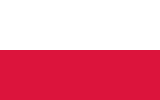
Flag of Poland
Republic of Poland

Flag details
- Proportions
- 5:8 height : width
- ISO code
- PL / POL
- Emoji
- Unicode
- U+1F1F5 U+1F1F1
Flag colors
- white#ffffff50%
- red#dc143c50%
Share of the flag's surface, measured from the image. Names describe the measured shade.
Download the flag
Meaning and history of the flag of Poland
Poland's flag is one of the simplest in the world: two equal horizontal stripes, white on top and red on the bottom. These colors come from the country's coat of arms, which depicts a white eagle on a red field and dates back to the 13th century. White symbolizes peace and morality, while red represents the courage and sacrifice of those who fought for the nation's independence.
It was officially adopted on August 1, 1919, shortly after Poland regained its independence following World War I, though white and red had been recognized as the national colors since 1831. The Polish flag is identical to Indonesia's and very similar to Monaco's, except that those flags have the order reversed, with red on top and white below; Indonesia's and Monaco's flags differ from one another only in proportions. Poland's state version adds the crowned white eagle emblem to the white stripe, clearly distinguishing it from the others.
Colours and shape
Measured from the image, the main colours of the flag of Poland are white and red; white alone covers about 50% of the surface. Its official proportions are 5:8 (height to width), a shape it shares with only 4 other national flags: Argentina, Guatemala, Palau, Sweden.
The flag emoji 🇵🇱 is built from the two regional indicator letters P and L (U+1F1F5 U+1F1F1). Most phones and Macs draw it as a flag; Windows shows the two letters instead.