Flag of Dominica
Commonwealth of Dominica
Flag details
- Proportions
- 1:2 height : width
- ISO code
- DM / DMA
- Emoji
- Unicode
- U+1F1E9 U+1F1F2
Flag colors
- green#046a3865%
- yellow#ffcd008%
- white#ffffff8%
- black#0000008%
- red#d500327%
Share of the flag's surface, measured from the image. Names describe the measured shade.
Download the flag
Meaning and history of the flag of Dominica
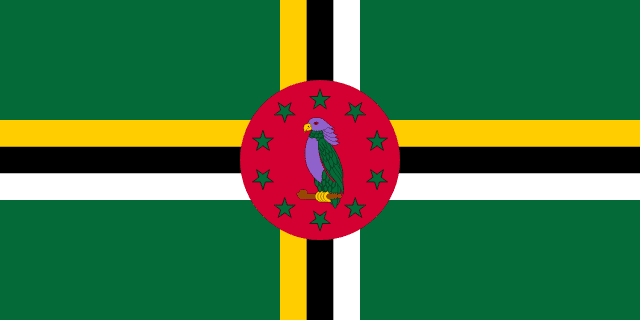
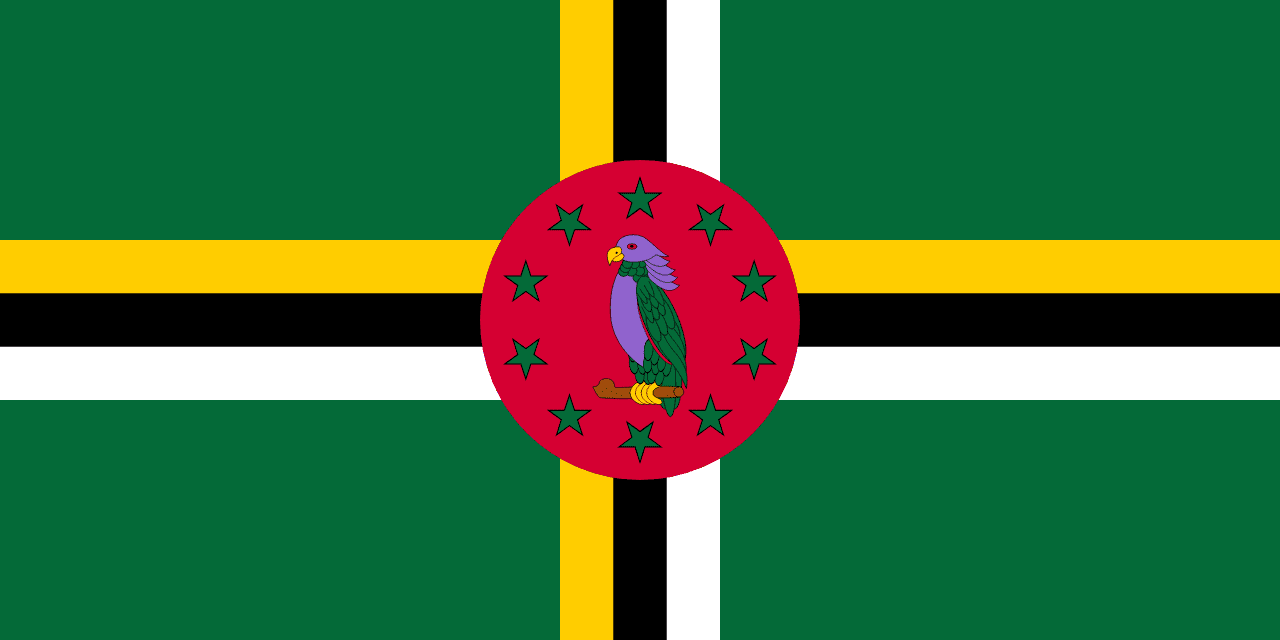
Dominica's flag was adopted on November 3, 1978, when the country gained independence from the United Kingdom. It shows a green field symbolizing the island's lush tropical vegetation. Overlaid on this field is a cross made of three stripes, yellow, black, and white, representing the island's Carib indigenous people, its fertile soil, and its pure waters, respectively.
At the center of the flag sits a red disc containing an imperial parrot, the sisserou (Amazona imperialis), a bird found only on Dominica and the country's national symbol. The parrot is surrounded by ten green five-pointed stars arranged in a circle, representing the nation's ten parishes. The sisserou is an endangered species, and its presence on the flag reflects the country's commitment to protecting its biodiversity.
Dominica is one of the few countries in the world whose flag includes the color purple, found in the plumage of the imperial parrot, a detail that makes it especially unusual among national flags. The design has undergone slight modifications over the years, with the current version dating to 1990.
Colours and shape
Measured from the image, the main colours of the flag of Dominica are green, yellow, white, black and red; green alone covers about 65% of the surface. Its official proportions are 1:2 (height to width), the same shape as at least 51 other national flags.
The flag emoji 🇩🇲 is built from the two regional indicator letters D and M (U+1F1E9 U+1F1F2). Most phones and Macs draw it as a flag; Windows shows the two letters instead.