
Flag of Tuvalu
Tuvalu
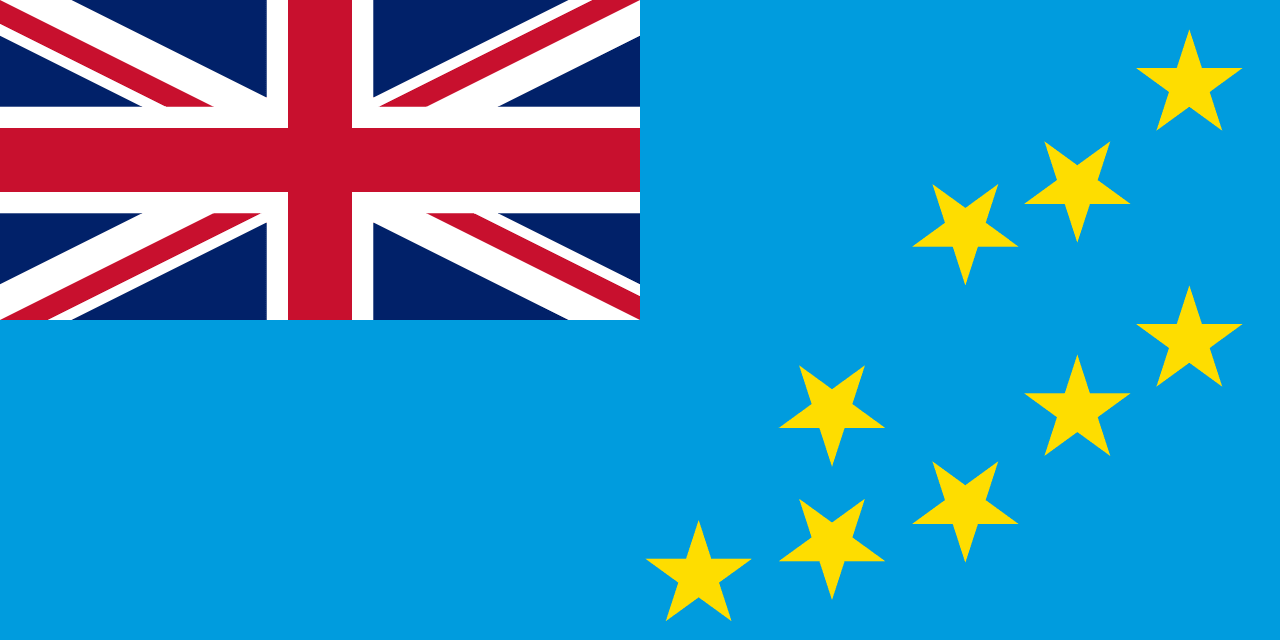
Flag details
- Country
- Tuvalu
- Official name
- Tuvalu
- Capital
- Funafuti
- ISO code
- TV / TUV
- Region
- Polynesia
Flag colors
- #009cde70%
- #c8102e9%
Share of the flag's surface, measured from the image.
Download the flag
Meaning and history of the flag of Tuvalu
Tuvalu's flag was adopted on October 1, 1978, when the country gained independence from the United Kingdom. It features a light blue field with the Union Jack in the upper hoist canton and nine yellow five-pointed stars scattered across the right half of the flag, arranged to represent the geographic positions of the archipelago's nine islands.
The light blue field symbolizes the Pacific Ocean surrounding this tiny island nation, one of the smallest countries in the world by both land area and population. The nine stars correspond to the nine inhabited islands that make up Tuvalu: Funafuti, Nanumea, Nanumaga, Niutao, Nui, Vaitupu, Nukufetau, Nukulaelae, and Niulakita. Their placement on the flag roughly mirrors each island's actual location in the Pacific, a cartographic feature rarely seen on national flags.
The flag has undergone several changes over its history. Between 1996 and 1997 a version without the Union Jack was briefly used, but the original design was restored by popular decision, reflecting the country's ties to the Commonwealth. Tuvalu shares the presence of the Union Jack in its canton with other Pacific states such as Fiji, Australia, and New Zealand, though Tuvalu's light blue field sets it apart from the darker blue used by those other nations.
You can view the flag of Tuvalu in high resolution above and download it in several sizes for personal, educational or reference use. To explore more, visit the full Tuvalu profile, its map, or the current local time in Funafuti.