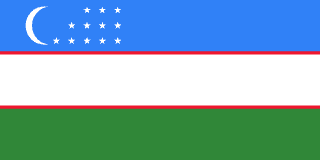
Uzbekistan
Republic of Uzbekistan
Population: UN WPP 2024, revision 1, projection for 1 July 2026. Sources and methodology.
Geography and territory
Uzbekistan sits at the heart of Central Asia and is the only country in the region bordering all four of its neighbors as well as Afghanistan. Covering 447,400 square kilometers, its territory ranges from the arid expanses of the Kyzylkum Desert, which occupies nearly a third of the country, to the western foothills of the Tian Shan and Pamir mountain systems in the east, with the fertile Fergana Valley in between standing as one of the most productive agricultural oases anywhere in Central Asia.
Broad desert and semi-arid plains dominate the landscape, but the valleys of the Amu Darya and Syr Darya, the region’s two great rivers, have sustained corridors of life and farming for thousands of years. The climate is sharply continental and dry, with scorching summers that can top 45 degrees Celsius in desert areas and cold winters that drop well below freezing. Rainfall is sparse overall, concentrated mainly in the mountainous east.
The ecological catastrophe of the Aral Sea stands as one of the most sobering chapters in recent environmental history. Once the fourth-largest lake in the world, it shrank dramatically after Soviet-era irrigation schemes diverted massive volumes of water toward cotton cultivation, leaving behind a desolate landscape of stranded ships in the desert and serious public health consequences for nearby communities. Restoration efforts continue today, though the Uzbek portion of the former seabed has suffered the most severe damage.
History
Uzbekistan inherits one of the richest and most fascinating histories in all of Asia, a land that served as a crossroads of civilizations and the beating heart of the legendary Silk Road. The cities of Samarkand, Bukhara, and Khiva, continuously inhabited for more than two thousand years, grew into centers of trade, science, and culture that rivaled the great metropolises of the ancient and medieval worlds. Alexander the Great conquered the region in the fourth century BC, and in the centuries that followed, Persians, Arabs, Turks, and Mongols each left their mark on this land of oases and caravan routes.
The region reached its greatest splendor under Timur, known in the West as Tamerlane, who in the fourteenth century built an empire stretching from Anatolia to India from his capital at Samarkand. Timur and his successors, the Timurid dynasty, turned Samarkand into one of the most dazzling cities on Earth, drawing artists, architects, scientists, and poets from across the Islamic world. His grandson Ulugh Beg built an astronomical observatory whose calculations of the length of the sidereal year were the most precise achieved anywhere up to that time.
Russian conquest in the nineteenth century and subsequent absorption into the Soviet Union radically reshaped Uzbek society. Forced industrialization, agricultural collectivization centered on cotton monoculture, and the suppression of Islamic tradition marked the Soviet era. Uzbekistan declared independence on September 1, 1991, and after decades under an authoritarian government, has in recent years embarked on a program of economic and touristic opening that is now revealing its extraordinary heritage to the wider world.
Culture and society
Uzbek culture forms an extraordinary mosaic reflecting the country’s historic role as a Silk Road crossroads. With more than 4,000 catalogued historical and cultural monuments, Uzbekistan holds one of the richest heritages anywhere in Asia. Islamic architecture reaches sublime heights here in madrasas, mosques, and mausoleums decorated with glazed ceramic mosaics in brilliant blues and turquoises that have captivated travelers for centuries.
Uzbek decorative arts enjoy worldwide renown. The ceramics of Rishtan, distinguished by their cobalt-blue motifs, handwoven ikat silk with its vivid patterns, and miniature paintings on mulberry paper represent artisan traditions passed down through generations. Uzbek classical music, known as shashmaqam, has been recognized by UNESCO as Intangible Cultural Heritage of Humanity, blending lyric poetry with intricate melodic structures performed on traditional instruments such as the dutar and the doira.
Uzbek society is predominantly Sunni Muslim, practicing a moderate form of Islam infused with strong Sufi influences interwoven with pre-Islamic traditions. Nauryz, the Persian New Year celebration marking the spring equinox, is the most important holiday, bringing entire families together around tables laden with traditional dishes. The mahalla, the traditional Uzbek neighborhood, functions as the basic unit of social life, where neighbors share celebrations, resolve disputes, and keep communal identity alive.
Economy
The Uzbek economy has undergone a significant transformation over the past few decades, shifting from the centrally planned Soviet model toward a market economy with growing international openness. Cotton, which dominated agricultural production during the Soviet era to the point of triggering the Aral Sea disaster, remains an important crop, but the country has diversified its productive base toward textiles, mining, and services.
Uzbekistan holds substantial natural resources that underpin its economy. It ranks among the world’s leading gold producers, with the Muruntau mine counting among the largest open-pit gold mines on the planet, and it holds significant reserves of natural gas, uranium, and copper. The energy sector is modernizing through investment in renewable power, capitalizing on the enormous solar potential of a country that enjoys more than 300 sunny days a year.
Tourism has emerged as a strategic sector following the reform program launched in 2016. Simplified visa requirements and improved infrastructure have driven a surge in international arrivals drawn to the architectural jewels of the Silk Road. Agriculture continues to employ a substantial share of the population, producing fruit, vegetables, and natural silk alongside cotton, a legacy of the region’s ancient tradition of silk cultivation.
Food and cuisine
Uzbek cuisine is widely regarded as the richest and most varied in Central Asia, the product of centuries of cultural exchange along the Silk Road. Plov, the national dish, is far more than a simple rice preparation — it is a social ritual that brings entire communities together. Cooked in a large cauldron called a kazan with rice, lamb, carrots, onions, chickpeas, and spices such as cumin and coriander, plov takes on distinct regional variations across the country, and in 2016 the tradition was inscribed on UNESCO’s Intangible Cultural Heritage list.
Uzbek breads, baked in cylindrical clay ovens called tandyrs, are edible works of art stamped with intricate decorative patterns. Known as non, bread holds an almost sacred status in Uzbek culture: it is never placed upside down and never thrown away. Manti, large steamed dumplings filled with minced meat and onion, and shashlik, skewers of marinated meat grilled over charcoal, round out the essential dishes found on any Uzbek table.
Samsa, a pastry filled with meat, pumpkin, or vegetables and baked in the tandyr, is the country’s most popular street snack. Fresh salads of tomato and cucumber, seasoned with aromatic herbs, accompany nearly every meal. Green tea is the social drink of choice in Samarkand and the west of the country, while black tea dominates in Tashkent and the east. Dried fruits, fresh produce from the Fergana Valley, and sweets made with honey and walnuts round out any generous Uzbek feast.
Tourism and landmarks
Uzbekistan holds some of the most spectacular architectural ensembles in the Islamic world, Silk Road treasures that have been meticulously restored. Samarkand, often called the Pearl of the East, dazzles with the majestic Registan square, flanked by three monumental madrasas whose turquoise tilework gleams under the Central Asian sun. The Gur-e-Amir mausoleum, resting place of Timur, and the Bibi-Khanym Mosque, once the largest in the Islamic world, complete an urban landscape of overwhelming beauty.
Bukhara, known as “the Noble,” preserves a historic center recognized as a UNESCO World Heritage Site that feels frozen in time. The Ark fortress, home to the region’s emirs for a thousand years, the towering Kalyan Minaret, so imposing that Genghis Khan reportedly spared it from destruction, and covered bazaars still trading in silk and ceramics offer visitors an authentic immersion in Central Asia’s past. Khiva, the walled city of Itchan Kala, functions as an open-air museum where every corner reveals a mosque, minaret, or palace adorned with glazed tilework.
Tashkent, the capital, blends the modernity of a metropolis of roughly three million people with treasures such as the Kukeldash Madrasa, the domed Chorsu Bazaar, and the Museum of Applied Arts. Adventurous travelers can head into the western Tian Shan mountains for hiking, or to the Ustyurt Plateau in the far northwest, whose lunar landscapes sit alongside the ghostly remnants of the Aral Sea.
Fun facts about Uzbekistan
- Uzbekistan is one of only two countries in the world that are doubly landlocked, meaning every neighboring country is itself landlocked.
- The fifteenth-century observatory built by Ulugh Beg in Samarkand calculated the length of the sidereal year with an error of just 25 seconds compared to modern measurements.
- Bukhara holds the tomb of the legendary physician and philosopher Avicenna, one of the most influential scholars in human history.
- The Tashkent Metro, opened in 1977, features stations decorated with opulent mosaics and chandeliers, and photography inside the system was banned until 2018.
- Uzbek cotton was so prized in ancient Rome that it was known there as “tree wool.”
Uzbekistan in numbers
Latest World Bank and UNDP observations, each with its own year. “World median” is the middle value among the countries that report the same indicator; “#” ranks from the highest value.
Population since 1960
Uzbekistan had 8.2 million people in 1960 and 37.1 million in 2025 — 4.5 times as many.
People
51.0% of people live in towns and cities (world median 63.4%). 31.3% are under 15 and 6.1% are 65 or older — a young population. Women have 3.49 children on average, above the replacement level of about 2.1.
Economy
The economy grew by 7.7% in real terms in 2025. Consumer prices rose by 8.8% in 2025. Services make up the largest share of output (46.5% of GDP); agriculture contributes 16.6%.
Development and environment
UNDP rates human development in Uzbekistan as high, with an index of 0.740 in 2023 (rank 107 of 193). 89.5% of people use the internet and 100.0% have access to electricity. Forest covers 8.8% of the land (world median 32.8%).
Sources: World Bank, World Development Indicators (CC BY 4.0), most recent observation from 2015 onward; UNDP Human Development Report 2025. Retrieved 2026-10-10. Sector shares need not add up to 100% because taxes and subsidies on products are excluded. Missing values are left blank rather than estimated. Sources and methodology.
Climate of Uzbekistan
Averaged across Uzbekistan, the warmest month is July (28.5 °C) and the coolest is January (−1.5 °C), a seasonal swing of 30.0 °C. The annual mean is 13.6 °C.
1 month has a national mean temperature below freezing.
About 213 mm of precipitation falls in a typical year. March is the wettest month (34 mm) and August the driest (3 mm). What little rain there is falls mostly from February to April (44% of the total).
Less than 250 mm a year is typical of desert climates.
Show monthly values as a table
| Month | Mean °C | Low °C | High °C | Precipitation, mm |
|---|---|---|---|---|
| January | −1.5 | −5.8 | 2.8 | 23 |
| February | 0.4 | −4.5 | 5.4 | 26 |
| March | 7.5 | 1.9 | 13.2 | 34 |
| April | 15.2 | 8.7 | 21.8 | 33 |
| May | 21.5 | 14.5 | 28.6 | 24 |
| June | 26.5 | 19.1 | 34.0 | 8 |
| July | 28.5 | 21.1 | 35.9 | 4 |
| August | 26.5 | 18.8 | 34.3 | 3 |
| September | 20.4 | 12.6 | 28.3 | 3 |
| October | 13.1 | 5.8 | 20.4 | 11 |
| November | 5.6 | 0.3 | 10.9 | 22 |
| December | 0.1 | −4.1 | 4.4 | 23 |
Figures are 1991–2020 averages across the whole land area of Uzbekistan, from the World Bank Climate Change Knowledge Portal, CRU TS 4.08 (CC BY 4.0). They are not readings from one weather station: the capital, the coast and high ground can be much warmer, cooler, wetter or drier.
Travel essentials for Uzbekistan
The practical details visitors ask about first. Traffic in Uzbekistan drives on the right, like most of the world. Mains electricity is 220 V at 50 Hz, so devices made only for 110–120 V (common in North America) need a converter unless they are dual-voltage — most phone and laptop chargers are.
- Emergency number
- 112Police 102 · Ambulance 103 · Fire 101
- Driving side
- Right
- Plug types
- Type C, Type F, Type IC: two round pins (Europlug); F: two round pins with side earth clips (Schuko); I: two angled flat pins plus earth
- Voltage
- 220 V50 Hz
- Dialling code
- +998From abroad: your exit code, then 998 and the number
- Currency
- Uzbekistani Som (UZS)
- Time zone
- UTC+5Current local time in Uzbekistan
Compiled from IEC plug and voltage standards, national emergency-service listings and the UN road-traffic conventions. Emergency numbers and local coverage can change — confirm them locally on arrival. Uzbekistan's internet domain is .uz.
Where Uzbekistan ranks in the world
Each position counts only the countries with data in that ranking guide. First place is the highest value — for price levels, the most expensive. Select a card to see the full table.
- Population43rd of 19637.7 millionUN projection, July 2026
- Land area56th of 195440,650 km²World Bank, 2023
- Population density103rd of 19481 per km²World Bank, 2023
- GDP (nominal)63rd of 187$121.4BWorld Bank, 2024, current US$
- GDP per capita134th of 187$3,337World Bank, 2024, current US$
- Life expectancy109th of 19472.5 yearsWorld Bank, 2024
- Price level160th of 16527 (US = 100)ICP 2021, household consumption
Bordering countries of Uzbekistan


Compare Uzbekistan with another country
Frequently asked questions about Uzbekistan
What is the capital of Uzbekistan?
The capital of Uzbekistan is Tashkent.
What is the population of Uzbekistan?
The UN World Population Prospects projection for Uzbekistan is 37,724,223 people (37.7 million) on 1 July 2026. National statistical offices may publish different estimates.
What language is spoken in Uzbekistan?
The official language of Uzbekistan is Uzbek.
What currency is used in Uzbekistan?
The currency of Uzbekistan is the Uzbekistani Som (UZS).
How big is Uzbekistan?
Uzbekistan covers an area of 447,400 km².
What type of government does Uzbekistan have?
Uzbekistan is a presidential republic.
Which countries border Uzbekistan?
Uzbekistan shares land borders with Kazakhstan, Kyrgyzstan, Tajikistan, Afghanistan, Turkmenistan.
What is the highest point in Uzbekistan?
The highest point in Uzbekistan is Khazret Sultan Peak (4,643 m).