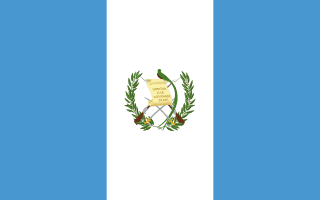
Guatemala
Republic of Guatemala
Population: UN WPP 2024, revision 1, projection for 1 July 2026. Sources and methodology.
Geography and territory
Guatemala sits at the northern end of Central America, bordered by Mexico to the north and west, Belize to the northeast, Honduras to the east, and El Salvador to the southeast. Covering 108,889 square kilometers and home to about 19.0 million people, it is a country of striking geographic contrast, ranging from tropical coastal lowlands to volcanic highlands that climb past 4,000 meters. Its territory touches two coasts: the Pacific to the south and a narrow strip of Caribbean shoreline to the east.
The landscape is dominated by the Sierra Madre, a volcanic mountain chain running from west to east across the country and home to more than 30 volcanoes, several of them active, including Fuego, Pacaya, and Santiaguito. Volcán Tajumulco, at 4,220 meters, is the highest point in all of Central America. Fertile valleys and highland plateaus lie between the volcanic peaks and have served as the country’s agricultural and demographic heartland since pre-Hispanic times.
The northern region, known as the Petén, forms a vast lowland jungle that is part of the Maya Forest, one of the largest expanses of tropical forest remaining in the Americas. Guatemala is also rich in water resources, with rivers such as the Motagua, the Usumacinta, and the Polochic, along with Lake Atitlán, often ranked among the most beautiful lakes in the world for its setting amid volcanoes and traditional indigenous villages.
History
Guatemala’s history is deeply shaped by Maya civilization, one of the most advanced of the ancient world. Between the third and ninth centuries AD, cities such as Tikal, El Mirador, and Quiriguá flourished as centers of political, scientific, and artistic power. The Maya developed a sophisticated hieroglyphic writing system, a calendar of remarkable precision, and notable advances in mathematics and astronomy, including an early concept of zero.
The Spanish conquest, led by Pedro de Alvarado beginning in 1524, transformed the territory dramatically. Guatemala became the seat of the Captaincy General of Guatemala, which administered all of Central America during the colonial period. Independence arrived on September 15, 1821, and after a brief period of annexation to the Mexican Empire, Guatemala joined the United Provinces of Central America before establishing itself as an independent republic in 1847.
The twentieth century brought periods of political instability, including an internal armed conflict that lasted 36 years, from 1960 until the signing of the Peace Accords in 1996. That conflict left deep scars on Guatemalan society, particularly within indigenous communities. Since then, the country has pursued an ongoing process of reconciliation and democratic strengthening that continues to this day.
Culture and society
Guatemala is an extraordinarily rich cultural mosaic, home to 22 distinct Maya peoples alongside the Xinca, the Garífuna, and a mestizo and ladino population. This diversity is reflected in the coexistence of 21 Mayan languages alongside Spanish, making Guatemala one of the most linguistically diverse countries in the Americas. Traditional indigenous dress, with its elaborately woven textiles in vivid colors and ancestral symbolism, remains a living tradition across many highland communities.
Guatemalan literature has earned worldwide recognition through Miguel Ángel Asturias, awarded the Nobel Prize in Literature in 1967 for work that fuses Maya oral tradition with modern narrative technique. The Popol Vuh, the sacred book of the Kʼicheʼ Maya, stands as one of the most important literary works to survive from pre-Hispanic America. The marimba, the national instrument, is the soul of Guatemalan popular music, accompanying religious, civic, and family celebrations across the country.
Religious celebrations, above all Holy Week in Antigua Guatemala, are cultural events of worldwide renown. The elaborate carpets of colored sawdust and fresh flowers laid across the streets for the processions represent a strikingly beautiful and fleeting art form. The Day of the Dead, observed on November 1, blends Catholic tradition with ancestral Maya ritual, including the preparation of fiambre, a singular ceremonial dish found nowhere else in the world.
Economy
Guatemala has the largest economy in Central America. Agriculture remains fundamental, with the country ranked among the world’s leading exporters of coffee, sugar, cardamom, and bananas. Guatemalan coffee, grown at high altitude in volcanic soil across regions such as Antigua and Huehuetenango, is especially prized by roasters for its bright acidity and complex flavor. Guatemalan cardamom is likewise highly regarded, and the country stands as the world’s top exporter of the spice, a crop introduced from Asia in the early twentieth century that found ideal growing conditions in the northern highlands. Textile and manufacturing industries, including garment assembly for export, have grown significantly over recent decades, adding a further layer to the economy.
Remittances sent home from abroad, mainly from the United States, form one of the most important sources of national income, amounting to a substantial share of GDP. The services sector, including tourism, telecommunications, and financial services, has seen sustained growth. Guatemala is a member of the Dominican Republic-Central America Free Trade Agreement, known as CAFTA-DR.
The country faces significant economic challenges, including income inequality and high rates of poverty in rural and indigenous areas. Even so, Guatemala has shown notable macroeconomic resilience, with relatively stable inflation and sustained growth that position it as an emerging market with real potential within the Central American region.
Food and cuisine
Guatemalan cuisine reflects a direct blend of Maya heritage and Spanish colonial influence. Corn is the sacred, foundational ingredient, appearing in tortillas, tamales, atol drinks, and a nearly endless range of preparations dating back thousands of years. Guatemalan tamales, wrapped in banana or corn leaves, vary from region to region and take center stage at Christmas and family celebrations.
Pepián, considered one of the national dishes, is a thick pre-Hispanic stew made from pumpkin seeds, sesame seeds, tomato, chili, and spices, served with chicken, pork, or beef. Kak’ik, a turkey soup with red chili from the Alta Verapaz region, is another culinary treasure, formally recognized as part of the nation’s intangible cultural heritage. Cacao, used by the Maya as both a ceremonial drink and a form of currency, remains a fixture of local cuisine to this day.
Street food culture thrives in Guatemalan cities and towns, with vendors selling elotes locos (corn on the cob dressed with mayonnaise, cheese, and chili), chuchitos (small tamales wrapped in corn husks), and garnachas, crisp fried tortillas topped with shredded cabbage and salsa. Traditional drinks include atol de elote, made with tender young corn and cinnamon, and Guatemalan horchata, prepared from morro seeds rather than the rice-based versions found elsewhere in Latin America. Traditional sweets such as canillitas de leche, plantain rellenitos, and buñuelos round out a culinary landscape where every dish carries centuries of tradition, and Sunday markets across the highlands often double as informal food fairs showcasing regional specialties.
Tourism and landmarks
Tikal, deep in the jungle of the Petén, is Guatemala’s most striking archaeological site and one of the most important in the entire Maya world. Its towering pyramids rise above the forest canopy, and its ceremonial plazas and carved stelae offer a direct window into the grandeur of Classic Maya civilization. Designated a UNESCO World Heritage Site, Tikal draws visitors from around the globe captivated by its fusion of archaeology and tropical wilderness.
Antigua Guatemala, the former colonial capital, is an architectural gem ringed by volcanoes. Its cobblestone streets, ruined baroque churches, restored convents, and cosmopolitan atmosphere make it one of the most enchanting destinations in Latin America. Lake Atitlán, described by Aldous Huxley as the most beautiful lake in the world, offers a landscape of volcanoes mirrored in crystalline water, surrounded by Tzʼutujil and Kaqchikel villages that keep their ancestral traditions alive.
Semuc Champey, in the department of Alta Verapaz, features a natural limestone bridge over the Cahabón River with stepped, turquoise pools set amid dense tropical forest. Quetzaltenango, the country’s second city, serves as the gateway to the western highlands, where indigenous markets such as the one in Chichicastenango dazzle with color, textiles, and syncretic rituals that blend Maya and Catholic traditions. Guatemala City, the capital and the largest urban center in Central America, adds a contrasting big-city dimension, with archaeological museums housing extensive Maya artifact collections and access to nearby volcanoes such as Pacaya, where visitors can hike to steaming vents and cooled lava fields. Along the Pacific coast, black volcanic-sand beaches offer sportfishing and wildlife-watching, while the Caribbean town of Livingston, reachable only by boat, showcases the distinct Garífuna culture, cuisine, and music that set it apart from the rest of the country.
Fun facts about Guatemala
- The quetzal, Guatemala’s national bird and a symbol of freedom, cannot survive in captivity, which is why it represents liberty in Maya culture.
- Guatemala is the world’s leading exporter of cardamom, surpassing even India, the spice’s country of origin.
- Lake Atitlán is one of the deepest lakes in Central America, reaching an estimated maximum depth of around 340 meters.
- At its peak, the city of Tikal may have housed between 100,000 and 200,000 people, making it one of the largest cities in the ancient world.
- Chocolate traces its origins to Guatemala and the wider Maya region, where it was consumed as a sacred drink mixed with chili and spices more than 2,000 years ago.
- Guatemala is one of the world’s 19 recognized megadiverse countries, home to more than 10,000 plant species and an extraordinary range of wildlife.
Guatemala in numbers
Latest World Bank and UNDP observations, each with its own year. “World median” is the middle value among the countries that report the same indicator; “#” ranks from the highest value.
Population since 1960
Guatemala had 4.1 million people in 1960 and 18.7 million in 2025 — 4.6 times as many.
People
56.3% of people live in towns and cities (world median 63.4%). 31.0% are under 15 and 5.0% are 65 or older — a young population. Women have 2.29 children on average, close to the replacement level of about 2.1.
Economy
The economy grew by 4.3% in real terms in 2025. Consumer prices rose by 1.5% in 2025. Services make up the largest share of output (62.1% of GDP); agriculture contributes 9.6%.
Development and environment
UNDP rates human development in Guatemala as medium, with an index of 0.662 in 2023 (rank 137 of 193). 60.2% of people use the internet and 90.9% have access to electricity. Forest covers 33.1% of the land (world median 32.8%).
Sources: World Bank, World Development Indicators (CC BY 4.0), most recent observation from 2015 onward; UNDP Human Development Report 2025. Retrieved 2026-10-10. Sector shares need not add up to 100% because taxes and subsidies on products are excluded. Missing values are left blank rather than estimated. Sources and methodology.
Climate of Guatemala
Averaged across Guatemala, the mean temperature stays between 21.5 °C (January) and 25.4 °C (May) — a swing of only 3.9 °C, so seasons are marked by rainfall rather than by heat.
About 2,182 mm of precipitation falls in a typical year. September is the wettest month (328 mm) and February the driest (44 mm). The wettest stretch is August to October, with 42% of the year's total.
Show monthly values as a table
| Month | Mean °C | Low °C | High °C | Precipitation, mm |
|---|---|---|---|---|
| January | 21.5 | 15.8 | 27.1 | 65 |
| February | 22.2 | 16.0 | 28.5 | 44 |
| March | 23.5 | 17.0 | 30.1 | 47 |
| April | 25.0 | 18.7 | 31.3 | 68 |
| May | 25.4 | 19.7 | 31.1 | 221 |
| June | 25.1 | 20.1 | 30.2 | 318 |
| July | 24.5 | 19.6 | 29.5 | 271 |
| August | 24.5 | 19.3 | 29.8 | 291 |
| September | 24.3 | 19.3 | 29.3 | 328 |
| October | 23.7 | 18.9 | 28.5 | 303 |
| November | 22.4 | 17.4 | 27.4 | 144 |
| December | 21.8 | 16.5 | 27.0 | 83 |
Figures are 1991–2020 averages across the whole land area of Guatemala, from the World Bank Climate Change Knowledge Portal, CRU TS 4.08 (CC BY 4.0). They are not readings from one weather station: the capital, the coast and high ground can be much warmer, cooler, wetter or drier.
Travel essentials for Guatemala
The practical details visitors ask about first. Traffic in Guatemala drives on the right, like most of the world. Mains electricity is 120 V at 60 Hz, so appliances built only for 220–240 V need a voltage converter.
- Emergency number
- 110Ambulance 123 · Fire 122
- Driving side
- Right
- Plug types
- Type A, Type B, Type G, Type IA: two flat parallel pins; B: two flat pins plus a round earth pin; G: three rectangular pins (British); I: two angled flat pins plus earth
- Voltage
- 120 V60 Hz
- Dialling code
- +502From abroad: your exit code, then 502 and the number
- Currency
- Quetzal (GTQ)
- Time zone
- CST (UTC-6)Current local time in Guatemala
Compiled from IEC plug and voltage standards, national emergency-service listings and the UN road-traffic conventions. Emergency numbers and local coverage can change — confirm them locally on arrival. Guatemala's internet domain is .gt.
Where Guatemala ranks in the world
Each position counts only the countries with data in that ranking guide. First place is the highest value — for price levels, the most expensive. Select a card to see the full table.
- Population69th of 19619.0 millionUN projection, July 2026
- Land area102nd of 195107,160 km²World Bank, 2023
- Population density55th of 194169 per km²World Bank, 2023
- GDP (nominal)67th of 187$113.2BWorld Bank, 2024, current US$
- GDP per capita105th of 187$6,151World Bank, 2024, current US$
- Life expectancy106th of 19472.7 yearsWorld Bank, 2024
- Price level94th of 16544 (US = 100)ICP 2021, household consumption
Bordering countries of Guatemala


Compare Guatemala with another country
Frequently asked questions about Guatemala
What is the capital of Guatemala?
The capital of Guatemala is Guatemala City.
What is the population of Guatemala?
The UN World Population Prospects projection for Guatemala is 18,967,978 people (19.0 million) on 1 July 2026. National statistical offices may publish different estimates.
What language is spoken in Guatemala?
The official language of Guatemala is Spanish.
What currency is used in Guatemala?
The currency of Guatemala is the Quetzal (GTQ).
How big is Guatemala?
Guatemala covers an area of 108,889 km².
What type of government does Guatemala have?
Guatemala is a presidential republic.
Which countries border Guatemala?
Guatemala shares land borders with Mexico, Belize, Honduras, El Salvador.
What is the highest point in Guatemala?
The highest point in Guatemala is Tajumulco Volcano (4,220 m).


