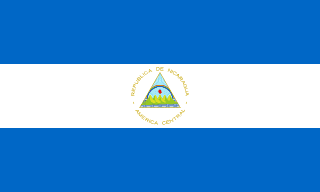
Nicaragua
Republic of Nicaragua
Population: UN WPP 2024, revision 1, projection for 1 July 2026. Sources and methodology.
Geography and territory
Nicaragua is the largest country in Central America, spanning 130,373 square kilometers between Honduras to the north and Costa Rica to the south. Its territory touches two oceans, the Pacific to the west and the Caribbean Sea to the east, giving the country an unusually wide range of landscapes packed into a single nation: tropical beaches, untouched rainforest, and an active volcanic chain. The Pacific lowlands hold the bulk of the population and economic activity, while the Caribbean coast remains a vast, sparsely settled expanse of dense jungle.
Lake Nicaragua, also known as Cocibolca, is the largest lake in Central America and the only tropical lake in the world known to host freshwater bull sharks, a genuinely rare biological phenomenon. Within its waters sits Ometepe Island, formed by two volcanoes rising dramatically from the lake and now recognized as a UNESCO Biosphere Reserve. The Pacific volcanic chain includes active peaks such as Masaya, Cerro Negro, and Momotombo, which together define much of the country’s dramatic skyline.
Nicaragua’s Caribbean coast, historically known as the Mosquito Coast, consists of rainforest, coastal lagoons, and coral cays, and is home to the Indio Maiz Biological Reserve, one of the most biodiverse ecosystems in Central America. The Corn Islands, located about 70 kilometers off the Caribbean coast, offer pristine white-sand beaches and clear water that evoke an unspoiled, classic Caribbean atmosphere far removed from mass tourism.
Nicaragua sits squarely within the Central American Volcanic Arc, part of the wider Pacific Ring of Fire, which explains both the fertility of its western soils and the persistent seismic and volcanic risk the country faces. Tropical rainforest, cloud forest, and dry forest ecosystems coexist within relatively short distances of one another, supporting a wealth of biodiversity that includes howler monkeys, jaguars, and hundreds of bird species. This ecological richness, combined with a warm tropical climate tempered by trade winds, has made conservation and ecotourism increasingly central to how the country presents itself to the world.
History
Nicaraguan territory was originally home to various indigenous peoples, including the Chorotega and the Nicarao, from whom the country’s name is derived. The arrival of the Spanish in the sixteenth century, led by figures including Francisco Hernandez de Cordoba, founder of the cities of Granada and Leon, transformed the region permanently. These two colonial cities became historic rivals whose competing political traditions, conservative Granada versus liberal Leon, shaped Nicaraguan politics for centuries.
Nicaragua declared independence from Spain on September 15, 1821, and after a period as part of the Federal Republic of Central America, became a fully independent republic in 1838. The nineteenth and early twentieth centuries were marked by repeated foreign intervention, including the brief and bizarre episode of American filibuster William Walker, who declared himself president in 1856, and later United States military occupations that provoked armed resistance led by General Augusto Cesar Sandino.
The Sandinista Revolution of 1979 overthrew the Somoza family dictatorship, which had ruled the country for more than four decades. The revolution reshaped Nicaraguan society and reverberated across Central American geopolitics. Following a bloody civil conflict with the American-backed Contras and a severe economic crisis, the 1990 elections opened a new democratic chapter, and the political transformations set in motion during that era continue to define the country’s direction today.
Culture and society
Nicaraguan culture blends indigenous tradition, Spanish colonial heritage, and Caribbean African influences into something distinctly its own. Poetry occupies a central place in national identity, so much so that Nicaragua is often called the land of poets. Ruben Dario, father of Spanish-American literary modernism and widely considered the most influential poet in the Spanish language after Cervantes, was born in the country in 1867, and his legacy remains a deep source of national pride.
Popular festivals showcase extraordinary cultural vitality. La Griteria, celebrated on December 7 in honor of the Immaculate Conception, is Nicaragua’s most emblematic holiday, with crowds singing through the streets and receiving sweets and fruit at neighborhood altars. Patron saint festivals held in cities and towns throughout the year combine religious processions, marimba music, and traditional dances that reinforce strong community bonds.
El Guegüense, recognized by UNESCO as Intangible Cultural Heritage of Humanity, is a seventeenth-century satirical street theater work combining dance, music, and dialogue that represents indigenous cultural resistance to colonial rule. Baseball is the undisputed national sport, followed with genuine passion nationwide, and Nicaragua has produced players who went on to star in Major League Baseball in the United States.
Family and community remain central pillars of Nicaraguan life, with extended households, godparent relationships, and neighborhood networks providing social support that formal institutions do not always supply. Catholicism remains the dominant faith, though evangelical Protestant congregations have grown substantially in recent decades, and religious observance still shapes the rhythm of daily and seasonal life across both rural and urban communities. Handicrafts also carry deep cultural weight, from the balsa-wood carvings and hammocks of Masaya to the pottery traditions preserved among the country’s indigenous communities.
Economy
Nicaragua’s economy of roughly $22.2 billion rests on agriculture, manufacturing, and services. Coffee, grown in the mountainous north and center of the country, ranks as the leading export and is prized in specialty coffee markets worldwide. Nicaraguan tobacco has likewise achieved international acclaim, with cigars rivaling Cuban quality produced primarily around the city of Esteli, often described as the premium tobacco capital of the world.
Cattle ranching, sugarcane, peanuts, and gold production round out the country’s productive base. Free-trade-zone factories, focused largely on textile manufacturing, employ tens of thousands of workers. Remittances sent home from Nicaraguans working abroad, particularly in Costa Rica and the United States, represent a significant source of household income that fuels domestic consumption.
Tourism has grown substantially in recent years, positioning Nicaragua as an emerging destination offering cultural, natural, and adventure attractions at competitive prices. Foreign investment in hotels and tourism services has transformed cities such as Granada, San Juan del Sur, and Leon into established travel destinations. The country’s renewable energy potential, especially geothermal and wind resources tied to its volcanic geography, represents a promising avenue for future development.
Food and cuisine
Corn stands at the heart of Nicaraguan cuisine, a direct inheritance from pre-Hispanic Mesoamerican cultures. Gallo pinto, a mix of rice and red beans fried with onion and garlic, functions as the national breakfast that unites Nicaraguans across the country. The nacatamal, the quintessential ceremonial dish, is a generous corn-dough tamale filled with pork, rice, potatoes, olives, raisins, and spices, wrapped in plantain leaves and slow-cooked for hours, traditionally reserved for weekends and celebrations.
Vigoron, which originated in Granada, layers boiled yuca, crispy pork rind, and a cabbage-and-tomato salad atop a plantain leaf, striking a balance of flavor and texture that captures the essence of Nicaraguan street food. Indio viejo, a thick stew of shredded corn masa with meat, tomato, onion, and herbs, is another pre-Hispanic culinary treasure. Mondongo soup and baho, prepared with meat, plantain, and yuca steamed together, round out the country’s repertoire of substantial dishes.
Traditional Nicaraguan drinks include pinolillo, made from toasted corn, cacao, and cinnamon, widely considered the national beverage. Tiste, made with cacao, corn, and achiote, along with fermented corn chicha, are pre-Hispanic legacies that persist in everyday diets. Typical desserts such as tres leches cake, cajeta, and various milk-based sweets complete a food culture rich in both flavor and history.
Tourism and landmarks
Granada, founded in 1524, is one of the oldest and best-preserved colonial cities in the Americas. Its colorful colonial streets, the cathedral overlooking the central plaza, the small islets scattered across Lake Nicaragua, and the nearby Mombacho Volcano cloud forest reserve together make it a premier travel destination. Leon, Granada’s historic rival, offers a UNESCO World Heritage cathedral, a lively university atmosphere, and access to the Cerro Negro volcano, where visitors practice volcano boarding, a unique sport that involves sliding down slopes of volcanic ash.
Ometepe Island, with its twin volcanoes rising from Lake Nicaragua, is a Biosphere Reserve offering hiking, kayaking, cycling, and encounters with rural communities amid stunning scenery. San Juan del Sur, once a modest fishing village and now a hub for surfing and nightlife, serves as a base for exploring pristine Pacific beaches such as Playa Maderas and Playa Marsella.
The Indio Maiz Biological Reserve protects one of the most pristine rainforests remaining in Central America, reached via the San Juan River in a journey reminiscent of nineteenth-century exploration. The Corn Islands, with their turquoise waters and relaxed Caribbean atmosphere, offer diving, snorkeling, and a tropical island experience far from mass tourism. The Solentiname archipelago on Lake Nicaragua is celebrated for its community of primitivist artists, a tradition fostered by the poet Ernesto Cardenal.
Fun facts about Nicaragua
- Nicaragua is the largest country in Central America by land area
- Lake Nicaragua is the only tropical lake in the world known to be home to freshwater bull sharks
- Poet Ruben Dario, father of literary modernism, is regarded by many as the most influential Spanish-language poet after Cervantes
- Spanish conquistadors nicknamed Masaya Volcano “the mouth of hell,” believing its glowing lava was molten gold
- El Guegüense, a satirical seventeenth-century theatrical work, was one of the first colonial-era literary works from Central America to receive UNESCO recognition
- Volcano boarding down the ash slopes of Cerro Negro is one of the more unusual adventure sports found anywhere in the world
Nicaragua in numbers
Latest World Bank and UNDP observations, each with its own year. “World median” is the middle value among the countries that report the same indicator; “#” ranks from the highest value.
Population since 1960
Nicaragua had 1.8 million people in 1960 and 7.0 million in 2025 — 3.9 times as many.
People
59.4% of people live in towns and cities (world median 63.4%). 28.3% are under 15 and 5.7% are 65 or older — a middle-aged population. Women have 2.21 children on average, close to the replacement level of about 2.1.
Economy
The economy grew by 4.9% in real terms in 2025. Consumer prices rose by 2.1% in 2025. Services make up the largest share of output (45.2% of GDP); agriculture contributes 14.5%.
Development and environment
UNDP rates human development in Nicaragua as high, with an index of 0.706 in 2023 (rank 123 of 193). 61.4% of people use the internet and 88.7% have access to electricity. Forest covers 25.8% of the land (world median 32.8%).
Sources: World Bank, World Development Indicators (CC BY 4.0), most recent observation from 2015 onward; UNDP Human Development Report 2025. Retrieved 2026-10-10. Sector shares need not add up to 100% because taxes and subsidies on products are excluded. Missing values are left blank rather than estimated. Sources and methodology.
Climate of Nicaragua
Averaged across Nicaragua, the mean temperature stays between 24.7 °C (December) and 27.2 °C (April) — a swing of only 2.5 °C, so seasons are marked by rainfall rather than by heat.
About 2,303 mm of precipitation falls in a typical year. June is the wettest month (335 mm) and March the driest (40 mm). The wettest stretch is June to August, with 42% of the year's total.
Show monthly values as a table
| Month | Mean °C | Low °C | High °C | Precipitation, mm |
|---|---|---|---|---|
| January | 24.8 | 20.6 | 29.0 | 100 |
| February | 25.1 | 20.4 | 29.8 | 56 |
| March | 26.3 | 21.3 | 31.4 | 40 |
| April | 27.2 | 22.4 | 32.1 | 50 |
| May | 27.2 | 22.8 | 31.7 | 206 |
| June | 26.4 | 22.4 | 30.3 | 335 |
| July | 26.2 | 22.4 | 30.1 | 334 |
| August | 26.0 | 22.0 | 30.1 | 292 |
| September | 25.9 | 22.0 | 30.0 | 274 |
| October | 25.7 | 21.7 | 29.8 | 294 |
| November | 25.0 | 20.9 | 29.1 | 186 |
| December | 24.7 | 20.7 | 28.9 | 137 |
Figures are 1991–2020 averages across the whole land area of Nicaragua, from the World Bank Climate Change Knowledge Portal, CRU TS 4.08 (CC BY 4.0). They are not readings from one weather station: the capital, the coast and high ground can be much warmer, cooler, wetter or drier.
Travel essentials for Nicaragua
The practical details visitors ask about first. Traffic in Nicaragua drives on the right, like most of the world. Mains electricity is 120 V at 60 Hz, so appliances built only for 220–240 V need a voltage converter.
- Emergency number
- 118
- Driving side
- Right
- Plug types
- Type A, Type BA: two flat parallel pins; B: two flat pins plus a round earth pin
- Voltage
- 120 V60 Hz
- Dialling code
- +505From abroad: your exit code, then 505 and the number
- Currency
- Nicaraguan Córdoba (NIO)
- Time zone
- CST (UTC-6)Current local time in Nicaragua
Compiled from IEC plug and voltage standards, national emergency-service listings and the UN road-traffic conventions. Emergency numbers and local coverage can change — confirm them locally on arrival. Nicaragua's internet domain is .ni.
Where Nicaragua ranks in the world
Each position counts only the countries with data in that ranking guide. First place is the highest value — for price levels, the most expensive. Select a card to see the full table.
- Population107th of 1967.1 millionUN projection, July 2026
- Land area98th of 195120,340 km²World Bank, 2023
- Population density129th of 19457 per km²World Bank, 2023
- GDP (nominal)127th of 187$19.7BWorld Bank, 2024, current US$
- GDP per capita137th of 187$2,848World Bank, 2024, current US$
- Life expectancy85th of 19475.1 yearsWorld Bank, 2024
- Price level125th of 16536 (US = 100)ICP 2021, household consumption
Bordering countries of Nicaragua


Compare Nicaragua with another country
Frequently asked questions about Nicaragua
What is the capital of Nicaragua?
The capital of Nicaragua is Managua.
What is the population of Nicaragua?
The UN World Population Prospects projection for Nicaragua is 7,097,329 people (7.1 million) on 1 July 2026. National statistical offices may publish different estimates.
What language is spoken in Nicaragua?
The official language of Nicaragua is Spanish.
What currency is used in Nicaragua?
The currency of Nicaragua is the Nicaraguan Córdoba (NIO).
How big is Nicaragua?
Nicaragua covers an area of 130,373 km².
What type of government does Nicaragua have?
Nicaragua is a presidential republic.
Which countries border Nicaragua?
Nicaragua shares land borders with Honduras, Costa Rica.
What is the highest point in Nicaragua?
The highest point in Nicaragua is Mogotón (2,107 m).


