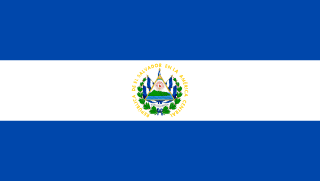
El Salvador
Republic of El Salvador
Population: UN WPP 2024, revision 1, projection for 1 July 2026. Sources and methodology.
Geography and territory
El Salvador is the smallest country in Central America, covering just 21,041 km², a compact footprint that has earned it the affectionate nickname “the thumbnail of the Americas.” Despite its size, it packs in remarkable geographic variety. It is the only Central American country without a Caribbean coastline, facing the Pacific Ocean exclusively along more than 300 kilometers of shore. It borders Honduras to the north and east and Guatemala to the west.
Salvadoran territory is dominated by a volcanic chain running from west to east across the country, with 23 recognized volcanoes, several of them active. Santa Ana Volcano (Ilamatepec), San Salvador Volcano, and Izalco — historically nicknamed the “Lighthouse of the Pacific” for its once-constant activity — define a dramatic landscape of cones and calderas. Between these volcanoes lie fertile valleys and plateaus that hold most of the country’s population and agricultural activity.
Cerro El Pital, at 2,730 meters on the border with Honduras, is the country’s highest point, its cloud forests offering a cool, temperate contrast to the hot coastal lowlands. El Salvador holds several notable bodies of water, including Lake Coatepeque, formed inside a volcanic caldera, Lake Ilopango, and the Alegría lagoon, nicknamed the “emerald of the Americas” for the intense green color of its sulfurous waters. Because so many volcanoes and lakes sit close together within such a small territory, it is possible to travel from misty highland forest to warm Pacific shoreline within a single day.
History
Salvadoran territory was home to the Pipil, a people of Nahua origin who developed a sophisticated culture tied to broader Mesoamerican traditions. Joya de Cerén, a Pipil village buried by a volcanic eruption around 600 CE, is now a UNESCO World Heritage Site known as the “Pompeii of the Americas” for the extraordinary preservation of its everyday structures, which offer a rare window into the daily life of the region’s pre-Hispanic peoples.
The Spanish conquest, led by Pedro de Alvarado in 1524, met fierce resistance from the Pipil prince Atlacatl, a heroic figure in national history. During the colonial period, El Salvador was part of the Captaincy General of Guatemala. Independence arrived on September 15, 1821, and after brief periods of union with Mexico and the Central American Federation, the country became a fully independent republic in 1841.
The twentieth century was marked by deep social tensions that erupted into a civil war lasting from 1980 to 1992, one of the most devastating conflicts in Latin American history, claiming tens of thousands of lives and displacing large segments of the population. The Chapultepec Peace Accords, signed in Mexico in January 1992, ended the fighting and laid the groundwork for the country’s democratic reconstruction. In the decades since, El Salvador has pursued a path of institutional transformation and national reconciliation, while a large share of the population emigrated abroad in search of opportunity, forging deep and lasting ties with communities in the United States.
Culture and society
Salvadoran culture blends indigenous and Spanish heritage into an identity defined by resilience and creativity. Salvadoran literature has produced significant figures such as Roque Dalton, a revolutionary poet whose work combines social commitment with powerful lyricism, and Claudia Lars, regarded as one of Central America’s most important poetic voices. Salarrué, a master of the short story, captured rural life and popular tradition with rare sensitivity.
Religious and popular festivities occupy a central place in Salvadoran social life. The Fiestas Agostinas, held in honor of the Divine Savior of the World, patron of San Salvador, are the country’s largest celebrations, filling the month of August with parades, music, dance, and cultural events. Los Historiantes, dramatic dances of colonial origin depicting the struggle between Moors and Christians, survive in many towns across the interior.
Salvadoran craftsmanship is known for its textiles, ceramics, and woodwork. The town of La Palma, in the department of Chalatenango, is famous for a distinctive naïve painting style built around motifs of nature and rural life, launched by the artist Fernando Llort and now recognized internationally, appearing on everything from small wooden trinkets to church murals. Salvadoran identity also has a strong surf culture, built on the powerful Pacific waves that have turned beaches such as El Tunco and Punta Roca into world-class destinations that draw professional competitions and traveling surfers from around the globe.
Economy
El Salvador’s economy rests on services, manufacturing, agriculture, and family remittances. The country adopted the US dollar as legal tender in 2001, a move that eliminated exchange-rate risk but also constrained national monetary policy. Remittances sent by the large Salvadoran diaspora in the United States, estimated at more than two million people, account for close to a quarter of GDP and are the principal driver of domestic consumption.
Salvadoran coffee, grown on volcanic slopes above 1,200 meters, enjoys strong international standing, with varieties such as bourbon and pacamara competing at the top end of the specialty coffee market. Textile maquiladora manufacturing, concentrated in free-trade zones, provides significant employment. In recent years El Salvador drew worldwide attention for adopting Bitcoin as legal tender in 2021, a pioneering move that sparked considerable international debate.
The tourism sector has shown notable growth, driven by surf tourism, gastronomy, archaeological sites, and the country’s natural beauty. El Salvador’s strategic location, served by regional air connectivity through El Salvador International Airport, along with its compact size — which allows visitors to cross the country in just a few hours — gives it real competitive advantages for further economic and tourism development. Government efforts to improve public security in recent years have also encouraged renewed interest from foreign investors and travelers alike, helping the country shed a reputation for violence that once overshadowed its economic potential.
Food and cuisine
The pupusa is El Salvador’s national dish and the heart of its culinary identity. This thick corn or rice masa flatbread, stuffed with cheese, beans, pork cracklings, loroco flower, or a combination of these, is cooked on a griddle and served with curtido, a fermented cabbage relish, and tomato salsa. National Pupusa Day is celebrated on the second Sunday of November, and the tradition has spread worldwide thanks to the Salvadoran diaspora.
Salvadoran tamales come in distinctive local varieties, including tamales pisques, made with firm masa and beans, and sweet tamales de elote, made with tender fresh corn. Fried cassava with pork cracklings and curtido is another popular staple found in markets and eateries across the country. Atol de elote, atol shuco (made from fermented black corn and served with beans and chili), and horchata made from morro seeds are traditional drinks central to everyday meals.
The izote flower, El Salvador’s national flower, has the unusual distinction of being edible and appears in several forms: battered in egg, pickled as curtido, or as a filling in pupusas. Nuégados de yuca drizzled with panela syrup, riguas (sweet corn cakes grilled in plantain leaves), and meat-filled pastelitos round out a tradition of street snacks that turns every Salvadoran market into a small feast, with vendors often specializing in a single dish perfected over generations of family recipes.
Tourism and landmarks
Joya de Cerén, a UNESCO World Heritage Site, is one of the most unusual archaeological sites in the Americas. Unlike sites that preserve temples and monuments, Joya de Cerén preserves the remains of an ordinary village, offering a rare glimpse into how pre-Hispanic Mesoamerican people actually lived, cooked, and farmed. The ruins of Tazumal, in Chalchuapa, add to the archaeological offering with pyramids and ceremonial structures showing Maya influence.
The Ruta de las Flores, a 36-kilometer route through picturesque western towns such as Juayúa, Apaneca, Ataco, and Nahuizalco, combines volcanic scenery, coffee plantations, local food, crafts, and weekend food festivals. El Imposible National Park, the country’s largest protected area, safeguards dry and humid tropical forest with exceptional biodiversity, including endemic and endangered species.
El Salvador’s Pacific beaches have earned worldwide recognition in the surfing community. El Tunco, El Sunzal, and Punta Roca offer consistent year-round breaks that draw international surfers. Lake Coatepeque, set inside a volcanic caldera with crystalline waters, and the Puerta del Diablo rock formation, with sweeping views over the San Salvador valley, round out a compact but remarkably varied travel destination.
Fun facts about El Salvador
- El Salvador is the smallest country in continental Central America and one of the most densely populated in the region.
- It became the first country in the world to adopt Bitcoin as legal tender, in September 2021.
- Joya de Cerén is known as the “Pompeii of the Americas” for its exceptional preservation beneath layers of volcanic ash.
- The izote flower, the national flower, is one of the few national flowers in the world that is regularly eaten.
- Izalco Volcano erupted almost continuously for nearly 200 years, from 1770 to 1958, and was once visible to ships far out in the Pacific.
- El Salvador packs 23 volcanoes into such a small territory that none sits more than about 50 kilometers from another.
El Salvador in numbers
Latest World Bank and UNDP observations, each with its own year. “World median” is the middle value among the countries that report the same indicator; “#” ranks from the highest value.
Population since 1960
El Salvador had 2.8 million people in 1960 and 6.4 million in 2025 — 2.3 times as many.
People
75.5% of people live in towns and cities (world median 63.4%). 24.4% are under 15 and 8.3% are 65 or older — a middle-aged population. Women have 1.77 children on average, below the replacement level of about 2.1 needed to keep a population stable in the long run without migration.
Economy
The economy grew by 3.9% in real terms in 2025. Consumer prices rose by 0.3% in 2025. Services make up the largest share of output (58.9% of GDP); agriculture contributes 4.4%.
Development and environment
UNDP rates human development in El Salvador as medium, with an index of 0.678 in 2023 (rank 132 of 193). 66.5% of people use the internet and 98.7% have access to electricity. Forest covers 33.0% of the land (world median 32.8%).
Sources: World Bank, World Development Indicators (CC BY 4.0), most recent observation from 2015 onward; UNDP Human Development Report 2025. Retrieved 2026-10-10. Sector shares need not add up to 100% because taxes and subsidies on products are excluded. Missing values are left blank rather than estimated. Sources and methodology.
Climate of El Salvador
Averaged across El Salvador, the mean temperature stays between 24.1 °C (November) and 26.8 °C (April) — a swing of only 2.7 °C, so seasons are marked by rainfall rather than by heat.
About 1,710 mm of precipitation falls in a typical year. September is the wettest month (339 mm) and February the driest (4 mm). The three wettest consecutive months, July to September, bring 50% of the year's total — a pronounced rainy season.
Show monthly values as a table
| Month | Mean °C | Low °C | High °C | Precipitation, mm |
|---|---|---|---|---|
| January | 24.4 | 17.2 | 31.8 | 6 |
| February | 24.9 | 17.5 | 32.4 | 4 |
| March | 26.1 | 18.5 | 33.7 | 13 |
| April | 26.8 | 19.9 | 33.7 | 45 |
| May | 26.2 | 20.3 | 32.2 | 196 |
| June | 25.4 | 19.9 | 30.9 | 305 |
| July | 25.7 | 20.0 | 31.5 | 246 |
| August | 25.4 | 19.7 | 31.1 | 278 |
| September | 24.8 | 19.7 | 29.9 | 339 |
| October | 24.7 | 19.4 | 29.9 | 226 |
| November | 24.1 | 18.1 | 30.1 | 44 |
| December | 24.1 | 17.5 | 30.7 | 9 |
Figures are 1991–2020 averages across the whole land area of El Salvador, from the World Bank Climate Change Knowledge Portal, CRU TS 4.08 (CC BY 4.0). They are not readings from one weather station: the capital, the coast and high ground can be much warmer, cooler, wetter or drier.
Travel essentials for El Salvador
The practical details visitors ask about first. Traffic in El Salvador drives on the right, like most of the world. Mains electricity is 115 V at 60 Hz, so appliances built only for 220–240 V need a voltage converter.
- Emergency number
- 911
- Driving side
- Right
- Plug types
- Type A, Type BA: two flat parallel pins; B: two flat pins plus a round earth pin
- Voltage
- 115 V60 Hz
- Dialling code
- +503From abroad: your exit code, then 503 and the number
- Currency
- US Dollar (USD)
- Time zone
- CST (UTC-6)Current local time in El Salvador
Compiled from IEC plug and voltage standards, national emergency-service listings and the UN road-traffic conventions. Emergency numbers and local coverage can change — confirm them locally on arrival. El Salvador's internet domain is .sv.
Where El Salvador ranks in the world
Each position counts only the countries with data in that ranking guide. First place is the highest value — for price levels, the most expensive. Select a card to see the full table.
- Population112th of 1966.4 millionUN projection, July 2026
- Land area149th of 19520,720 km²World Bank, 2023
- Population density29th of 194305 per km²World Bank, 2023
- GDP (nominal)103rd of 187$34.9BWorld Bank, 2024, current US$
- GDP per capita110th of 187$5,503World Bank, 2024, current US$
- Life expectancy113th of 19472.3 yearsWorld Bank, 2024
- Price level72nd of 16549 (US = 100)ICP 2021, household consumption
Bordering countries of El Salvador


Compare El Salvador with another country
Frequently asked questions about El Salvador
What is the capital of El Salvador?
The capital of El Salvador is San Salvador.
What is the population of El Salvador?
The UN World Population Prospects projection for El Salvador is 6,391,253 people (6.4 million) on 1 July 2026. National statistical offices may publish different estimates.
What language is spoken in El Salvador?
The official language of El Salvador is Spanish.
What currency is used in El Salvador?
The currency of El Salvador is the US Dollar (USD).
How big is El Salvador?
El Salvador covers an area of 21,041 km².
What type of government does El Salvador have?
El Salvador is a presidential republic.
Which countries border El Salvador?
El Salvador shares land borders with Guatemala, Honduras.
What is the highest point in El Salvador?
The highest point in El Salvador is Cerro El Pital (2,730 m).


