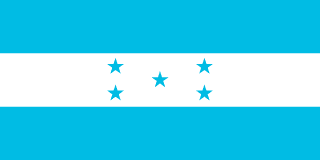
Honduras
Republic of Honduras
Population: UN WPP 2024, revision 1, projection for 1 July 2026. Sources and methodology.
Geography and territory
Honduras sits at the heart of Central America, covering 112,492 square kilometers and home to a population of about 11.2 million, making it the region’s second-largest country by area after Nicaragua. It borders the Caribbean Sea to the north, the Gulf of Fonseca and El Salvador to the south, Nicaragua to the east, and Guatemala to the west. Its extensive Caribbean coastline stretches more than 600 kilometers, while its outlet to the Pacific through the Gulf of Fonseca gives the country a strategic position between two oceans.
The Honduran landscape is overwhelmingly mountainous, with more than 65 percent of the territory covered by ranges that reach their highest point at Cerro Las Minas, standing 2,870 meters tall. Intermontane valleys, including Sula, Comayagua, and Aguan, form the country’s main agricultural and population centers. La Mosquitia, in the far east, is one of the largest and best-preserved rainforest regions in Central America and has been designated a UNESCO Biosphere Reserve.
The Bay Islands, made up of Roatan, Utila, and Guanaja, rise from the Caribbean Sea as tropical gems ringed by the Mesoamerican Reef, the world’s second-largest coral reef system. This underwater world supports extraordinary marine biodiversity, including whale sharks, manta rays, sea turtles, and hundreds of species of fish and coral, making Honduras one of the premier international diving destinations.
History
Honduran territory was home to one of the most sophisticated expressions of Maya civilization: the city of Copan. Between the fifth and ninth centuries AD, Copan flourished as a major political, astronomical, and artistic center, renowned for its carved stelae, its Hieroglyphic Stairway, the longest known Maya inscription, and its advanced astronomical observatory. Designated a UNESCO World Heritage Site, Copan continues to reveal new insights into Maya grandeur.
Christopher Columbus reached the Honduran coast in 1502 during his fourth voyage, naming the region Honduras, meaning “depths,” after the deep Caribbean waters near the shore. Spanish colonization reshaped the territory, establishing mining towns such as Tegucigalpa and Comayagua. Honduras won independence from Spain on September 15, 1821, and after a brief period as part of the Mexican Empire and then the Federal Republic of Central America, it became a fully independent nation in 1838.
The twentieth century in Honduras was shaped heavily by American banana companies, which turned the country into the archetype of the so-called “banana republic.” The United Fruit Company and the Standard Fruit Company controlled vast tracts of land and wielded considerable political influence. In recent decades, Honduras has faced significant challenges related to governance, security, and social development, alongside notable progress in democratization and economic growth.
Culture and society
Honduran culture is a vibrant weave of Indigenous, Spanish, and African influences. The Lenca, Miskito, Garifuna, Pech, Tolupan, Tawahka, and Ch’orti’ peoples keep their own languages, traditions, and worldviews alive across the country. The Garifuna, descendants of Africans and Indigenous Caribs settled along the northern coast, have a distinctive culture recognized by UNESCO as Intangible Cultural Heritage of Humanity, expressed through punta music, ritual dance, and a singular cuisine.
Honduran music ranges from garifuna punta, an infectious rhythm of drums and maracas, to ranchera and Caribbean sounds heard throughout the country. Popular festivals such as the Feria Juniana in San Pedro Sula, one of the largest celebrations in Central America, combine parades, live music, food, and cultural activities across a full week. Holy Week in Comayagua is especially notable for its elaborate carpets of colored sawdust and flowers laid across the streets.
Honduran primitivist painting, particularly the school associated with Jose Antonio Velasquez, has won international recognition for its colorful depictions of rural life and landscape. Soccer is a national passion that unites Honduran society across regional and social lines, with the national team’s World Cup appearances stirring fervent devotion throughout the country. Family and community ties remain central to daily life, with extended households, patron saint festivals, and local marimba and mariachi traditions anchoring social gatherings in towns both large and small.
Economy
The Honduran economy rests on a combination of agriculture, manufacturing, services, and family remittances. Honduran coffee has established itself as among the finest in the world, with the country ranking as a leading global producer and exporter, its high-altitude varieties competing in the most demanding specialty markets. Bananas, African palm, shrimp, and tilapia round out a diversified agro-export basket.
The maquiladora industry, concentrated mainly around San Pedro Sula, is a pillar of the manufacturing sector, employing hundreds of thousands of Hondurans in textile and component production for export. Family remittances, sent primarily from the United States, are a vital income source that exceeds 25 percent of GDP and sustains consumption for millions of households. Small and medium-sized businesses, many operating informally, also make up a substantial share of employment, particularly in urban centers where formal job creation has struggled to keep pace with a young and growing workforce.
Tourism has emerged as a strategic growth sector, driven by the natural appeal of the Bay Islands, Maya archaeological sites, national parks, and a growing ecotourism offering. Honduras is a member of the CAFTA-DR trade agreement and has sought to diversify its economy by attracting foreign investment into special economic zones and expanding renewable energy. Hydroelectric and, increasingly, solar and wind projects have expanded the country’s power generation capacity, part of a broader push to reduce dependence on imported fuel and build a more resilient national grid.
Food and cuisine
Honduran cuisine reflects the country’s cultural diversity through generous portions and bold flavors. The baleada, widely regarded as the national dish, consists of a thick flour tortilla filled with refried beans, grated cheese, and butter, often enriched with avocado, egg, sausage, or meat. This simple but satisfying dish is eaten throughout the country at any hour and captures the essence of everyday Honduran cooking.
Honduran tamales, known as nacatamales, are hearty parcels wrapped in banana leaves containing corn dough, pork or chicken, rice, potatoes, olives, and raisins, steamed for hours. Sopa de caracol, a conch soup originating on the Garifuna coast, is a creamy blend of sea snail, coconut milk, plantain, cassava, and spices that has become a beloved national icon, even celebrated in popular song.
Garifuna machuca, made with mashed green plantain and a coconut-milk seafood broth, and tapado, a fish stew with coconut and root vegetables, showcase the culinary richness of the Caribbean coast. Catrachitas (fried tortillas topped with beans and cheese), chicken served with fried plantain chips, and a strong tradition of tropical fruit smoothies round out a cuisine that has something for every palate. Street stalls and family-run comedores serve most of these dishes, and sharing a baleada or a plate of nacatamales remains as much a social ritual as a meal.
Tourism and landmarks
The ruins of Copan are Honduras’s most valuable archaeological treasure and one of the most important Maya sites in the world. The Hieroglyphic Stairway, carved with more than 2,000 glyphs, is the longest Maya inscription ever discovered. The Copan Archaeological Park, together with the nearby site of Las Sepulturas, offers an immersive encounter with Maya civilization, complemented by the Museum of Maya Sculpture, which houses full-scale replicas of the brightly painted Rosalila Temple.
The Bay Islands are a tropical paradise that draws divers from around the world. Roatan combines spectacular coral reefs, white-sand beaches, and steadily growing tourist infrastructure. Utila is known as one of the most affordable places on Earth to earn a scuba diving certification, and its waters offer regular encounters with the whale shark, the largest fish in the world, drawing backpackers and serious divers alike to its laid-back shores.
The Rio Platano Biosphere Reserve, a World Heritage Site, protects one of the last pristine rainforests in Central America, home to Miskito and Pech communities that maintain traditional ways of life. La Tigra National Park, a short distance from Tegucigalpa, offers trails through strikingly beautiful cloud forest. Lake Yojoa, the country’s only natural lake, is a haven for bird-watchers, with hundreds of species recorded in the surrounding area. Colonial towns such as Gracias and Comayagua, with their cobblestone streets, colorful facades, and centuries-old churches, offer a quieter counterpoint to the coast and the reef, rounding out a country whose landscapes range from misty cloud forest peaks to warm turquoise water.
Fun facts about Honduras
- Honduras hosts the world’s second-largest barrier reef system as part of the Mesoamerican Reef.
- Copan was designated a UNESCO World Heritage Site in 1980 and contains the longest hieroglyphic inscription in the Maya world.
- The country’s name comes from Christopher Columbus, who reportedly exclaimed thanks for escaping the “depths” (honduras) of the deep Caribbean waters off the coast in 1502.
- The town of Yoro holds an annual festival celebrating the legendary “Rain of Fish,” a phenomenon locals say sends fish falling from the sky during violent storms.
- Lake Yojoa’s surrounding area has recorded hundreds of bird species, ranking it among Central America’s premier bird-watching sites.
- The national currency, the lempira, is named after the Lenca Indigenous leader who resisted Spanish conquest in the sixteenth century.
Honduras in numbers
Latest World Bank and UNDP observations, each with its own year. “World median” is the middle value among the countries that report the same indicator; “#” ranks from the highest value.
Population since 1960
Honduras had 2.1 million people in 1960 and 11.0 million in 2025 — 5.3 times as many.
People
59.3% of people live in towns and cities (world median 63.4%). 30.3% are under 15 and 4.5% are 65 or older — a young population. Women have 2.48 children on average, close to the replacement level of about 2.1.
Economy
The economy grew by 3.8% in real terms in 2025. Consumer prices rose by 4.6% in 2025. Services make up the largest share of output (57.6% of GDP); agriculture contributes 13.3%.
Development and environment
UNDP rates human development in Honduras as medium, with an index of 0.645 in 2023 (rank 139 of 193). 58.6% of people use the internet and 95.5% have access to electricity. Forest covers 52.8% of the land (world median 32.8%).
Sources: World Bank, World Development Indicators (CC BY 4.0), most recent observation from 2015 onward; UNDP Human Development Report 2025. Retrieved 2026-10-10. Sector shares need not add up to 100% because taxes and subsidies on products are excluded. Missing values are left blank rather than estimated. Sources and methodology.
Climate of Honduras
Averaged across Honduras, the mean temperature stays between 22.7 °C (January) and 26.3 °C (May) — a swing of only 3.6 °C, so seasons are marked by rainfall rather than by heat.
About 1,859 mm of precipitation falls in a typical year. June is the wettest month (258 mm) and March the driest (38 mm). The wettest stretch is August to October, with 38% of the year's total.
Show monthly values as a table
| Month | Mean °C | Low °C | High °C | Precipitation, mm |
|---|---|---|---|---|
| January | 22.7 | 18.1 | 27.5 | 84 |
| February | 23.4 | 18.1 | 28.8 | 49 |
| March | 24.7 | 18.8 | 30.6 | 38 |
| April | 25.8 | 20.2 | 31.4 | 49 |
| May | 26.3 | 21.1 | 31.4 | 176 |
| June | 25.8 | 21.3 | 30.2 | 258 |
| July | 25.3 | 21.0 | 29.7 | 220 |
| August | 25.5 | 21.0 | 30.1 | 215 |
| September | 25.4 | 20.9 | 30.0 | 246 |
| October | 24.8 | 20.4 | 29.2 | 252 |
| November | 23.6 | 19.3 | 28.0 | 163 |
| December | 23.2 | 18.8 | 27.6 | 109 |
Figures are 1991–2020 averages across the whole land area of Honduras, from the World Bank Climate Change Knowledge Portal, CRU TS 4.08 (CC BY 4.0). They are not readings from one weather station: the capital, the coast and high ground can be much warmer, cooler, wetter or drier.
Travel essentials for Honduras
The practical details visitors ask about first. Traffic in Honduras drives on the right, like most of the world. Mains electricity is 110 V at 60 Hz, so appliances built only for 220–240 V need a voltage converter.
- Emergency number
- 911
- Driving side
- Right
- Plug types
- Type A, Type BA: two flat parallel pins; B: two flat pins plus a round earth pin
- Voltage
- 110 V60 Hz
- Dialling code
- +504From abroad: your exit code, then 504 and the number
- Currency
- Lempira (HNL)
- Time zone
- CST (UTC-6)Current local time in Honduras
Compiled from IEC plug and voltage standards, national emergency-service listings and the UN road-traffic conventions. Emergency numbers and local coverage can change — confirm them locally on arrival. Honduras's internet domain is .hn.
Where Honduras ranks in the world
Each position counts only the countries with data in that ranking guide. First place is the highest value — for price levels, the most expensive. Select a card to see the full table.
- Population87th of 19611.2 millionUN projection, July 2026
- Land area100th of 195111,890 km²World Bank, 2023
- Population density93rd of 19495 per km²World Bank, 2023
- GDP (nominal)102nd of 187$37.0BWorld Bank, 2024, current US$
- GDP per capita132nd of 187$3,416World Bank, 2024, current US$
- Life expectancy104th of 19473.0 yearsWorld Bank, 2024
- Price level75th of 16549 (US = 100)ICP 2021, household consumption
Bordering countries of Honduras


Compare Honduras with another country
Frequently asked questions about Honduras
What is the capital of Honduras?
The capital of Honduras is Tegucigalpa.
What is the population of Honduras?
The UN World Population Prospects projection for Honduras is 11,184,760 people (11.2 million) on 1 July 2026. National statistical offices may publish different estimates.
What language is spoken in Honduras?
The official language of Honduras is Spanish.
What currency is used in Honduras?
The currency of Honduras is the Lempira (HNL).
How big is Honduras?
Honduras covers an area of 112,492 km².
What type of government does Honduras have?
Honduras is a presidential republic.
Which countries border Honduras?
Honduras shares land borders with Guatemala, El Salvador, Nicaragua.
What is the highest point in Honduras?
The highest point in Honduras is Cerro Las Minas (2,870 m).


