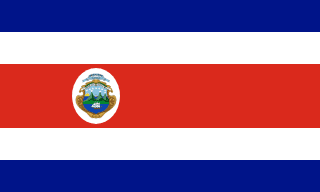
Costa Rica
Republic of Costa Rica
Population: UN WPP 2024, revision 1, projection for 1 July 2026. Sources and methodology.
Geography and territory
Costa Rica sits on the Central American isthmus, covering 51,100 square kilometers between Nicaragua to the north and Panama to the south. Despite its modest size, it ranks among the most biologically diverse countries on Earth, and it borders two oceans at once — the Pacific to the west and the Caribbean to the east — with barely 320 kilometers separating the two coasts at the narrowest point of the country. This compact geography compresses an unusual variety of landscapes and microclimates into a nation smaller than many single provinces elsewhere in the Americas.
A chain of volcanoes runs from the northwest to the southeast, shaping the country’s dramatic topography and including active peaks such as Arenal, Poas, Irazu, and Rincon de la Vieja. Cerro Chirripo, at 3,821 meters, is the nation’s highest point and the second-highest peak in Central America; on exceptionally clear days, hikers who reach its summit can glimpse both the Pacific and the Caribbean at once. Nestled among the mountains, the temperate Central Valley holds the bulk of the country’s population, including the capital, San Jose, and has long served as the agricultural and cultural heartland of the nation.
Costa Rica’s coastline stretches for more than 1,200 kilometers and encompasses an extraordinary range of beaches, from the black volcanic sands of Playa Hermosa to the pale expanses of Manuel Antonio. A protected-lands system covering more than a quarter of the national territory, including some thirty national parks, eight biological reserves, and numerous wildlife refuges, has made Costa Rica one of the world’s foremost models of environmental conservation. Rainforest, cloud forest, dry tropical forest, mangrove, and wetland ecosystems all coexist within this single, small country.
History
Spanish colonization began in the sixteenth century, but the scarcity of precious metals and persistent resistance from indigenous peoples left Costa Rica one of the poorest and most isolated provinces in Spain’s American empire. That relative neglect fostered a society of small, largely self-sufficient farmers, a pattern that Costa Rican historical tradition credits with laying the groundwork for a more democratic and egalitarian culture than emerged elsewhere in the region.
Independence from Spain arrived on 15 September 1821, and Costa Rica broke away from the Central American Federation in 1838 to become a fully independent republic. Coffee cultivation, introduced in the early nineteenth century, reshaped both the economy and society, giving rise to an agro-export elite that invested heavily in education, infrastructure, and democratic institutions. The construction of a railroad to the Caribbean coast to move coffee to market later brought Jamaican immigration and the rise of the banana industry, permanently reshaping the demographics and culture of Costa Rica’s Caribbean province of Limon.
The defining event of the twentieth century was the abolition of the armed forces in 1949, following a brief civil war led by Jose Figueres Ferrer. That decision, unique in the region, freed up resources for education and public health and laid the foundation for Costa Rica’s welfare state. In the decades since, the country has remained one of Latin America’s most stable democracies, earning international recognition for its commitment to peace and human rights, and it has hosted the United Nations-mandated University for Peace since the 1980s as a further expression of that legacy.
Culture and society
Costa Rican culture places a premium on peace, democracy, and respect for the environment, values distilled into the famous phrase “pura vida” — literally “pure life” — which functions less as a simple expression than as an entire outlook on living optimistically and without excess stress. Costa Ricans, affectionately called “ticos,” are known for their hospitality, their strong educational tradition, and their sense of community, and the country maintains one of the highest literacy rates in Latin America.
Cultural traditions include the ornately painted oxcart, a form of agricultural transport originating in the town of Sarchi and recognized by UNESCO as an Intangible Cultural Heritage of Humanity. Traditional music fuses Spanish, indigenous, and Caribbean influences, evident in genres such as the punto guanacasteco and Limon’s calypso. Popular festivities like the Zapote fair, Costa Rican-style bullfighting events, and the religious celebrations honoring the Virgin of the Angels in Cartago all remain central to national identity.
Costa Rica has repeatedly ranked among the happiest nations on Earth according to the Happy Planet Index, and its model of sustainable development draws admiration and study from around the world. The country generates the great majority of its electricity from renewable sources and has committed to fully decarbonizing its economy, positioning itself as a global leader in the fight against climate change. Family and community ties remain strong throughout Costa Rican society, reinforced by a robust public education system and a national health service that provides broad access to care.
Economy
Costa Rica’s economy, with a gross domestic product of about $102.91 billion, is one of the most diversified and dynamic in Central America. The services sector dominates, driven by tourism, technology, and financial services. The country has become an important hub for multinational technology operations, with companies such as Intel, Amazon, and Microsoft establishing service centers and advanced manufacturing operations within its borders.
Export agriculture remains significant, with Costa Rica ranking among the world’s leading exporters of bananas, pineapples, coffee, and ornamental plants. Costa Rican coffee, particularly the beans grown in Tarrazu, the Central Valley, and the Los Santos zone, enjoys a worldwide reputation for exceptional quality and complex flavor. The medical device industry has also expanded substantially, making the country one of Latin America’s leading exporters of these products, alongside a growing base of business process outsourcing and software development firms drawn by the country’s educated, largely bilingual workforce.
Tourism is the most visible engine of the economy, drawing more than three million international visitors a year and generating billions of dollars in annual revenue. Costa Rica’s pioneering ecotourism model pairs biodiversity conservation with sustainable economic development, attracting travelers in search of nature, adventure, and wellness experiences found in few other destinations. Small and medium-sized, locally owned lodges and tour operators make up a significant share of the industry, helping to spread tourism income into rural communities near national parks.
Food and cuisine
Costa Rican cooking rests on simple, satisfying staples: rice, beans, plantain, and corn form the backbone of the national diet. Gallo pinto, a savory blend of rice and black beans sauteed with onion, sweet pepper, and Salsa Lizano, is the classic breakfast that fuels daily life across the country. Casado, the quintessential lunch plate, brings together rice, beans, salad, fried sweet plantain, and a protein — beef, chicken, fish, or pork.
Regional cooking varies considerably. In Guanacaste, corn tortillas, tamales, and corn-based rice dishes reflect Chorotega indigenous heritage. Along the Caribbean coast, Afro-Caribbean influence shows up in rice and beans cooked with coconut milk, rondon, a hearty seafood-and-tuber stew, and pati, a spicy meat-filled pastry. Olla de carne, a substantial beef broth loaded with vegetables and root crops, remains a beloved comfort dish for Costa Rican families.
Costa Rican coffee deserves special mention for its exceptional quality: the Central Valley’s high elevation, volcanic soil, and favorable climate combine to produce arabica beans prized in the world’s most discerning markets. Chorreadas, sweet fresh-corn griddle cakes, prestinos, honey-drizzled fritters, and tres leches cake round out a repertoire of traditional flavors woven into everyday Costa Rican life.
Tourism and landmarks
Manuel Antonio National Park, on the central Pacific coast, is Costa Rica’s most visited park, where white-sand beaches ringed by rainforest host abundant wildlife, including capuchin monkeys, sloths, toucans, and iguanas that wander close to visitors. Arenal Volcano, with its once-perfect cone and natural hot springs, is another national icon, offering hiking, zip-lining, whitewater rafting, and the chance to observe one of Central America’s most active volcanoes.
Corcovado National Park, on the Osa Peninsula, has been described by National Geographic as one of the most biologically intense places on the planet. Jaguars, tapirs, scarlet macaws, and four species of monkeys inhabit this stretch of primary rainforest, which shelters an outsized share of the world’s biodiversity relative to its modest size. Tortuguero, on the Caribbean coast, is one of the most important nesting sites in the world for green sea turtles, and its network of navigable jungle canals offers a singular way to explore the rainforest.
Monteverde, its cloud forest perpetually wrapped in mist, is a haven for the resplendent quetzal and hundreds of species of orchids, ferns, and birds, with hanging bridges and canopy tours allowing visitors to explore the forest from the treetops. Guanacaste province offers striking beaches such as Tamarindo, Flamingo, and Conchal, while the Caribbean coast charms visitors with Puerto Viejo and Cahuita, where rainforest, coral reef, and Afro-Caribbean culture meet in a distinctive combination.
Fun facts about Costa Rica
- Costa Rica abolished its army in 1949 and remains one of the few countries in the world without a standing military.
- The country generates the vast majority of its electricity from renewable sources, including hydroelectric, geothermal, wind, and solar power.
- The phrase “pura vida” is used by Costa Ricans as a greeting, a farewell, an expression of thanks, and a general statement of well-being.
- Costa Rica has repeatedly been ranked the happiest country in the world according to the Happy Planet Index.
- The resplendent quetzal, considered one of the most beautiful birds on Earth, lives in Costa Rica’s cloud forests and was revered by pre-Columbian cultures.
- More than a quarter of Costa Rica’s national territory is under formal environmental protection, spread across roughly thirty national parks.
Costa Rica in numbers
Latest World Bank and UNDP observations, each with its own year. “World median” is the middle value among the countries that report the same indicator; “#” ranks from the highest value.
Population since 1960
Costa Rica had 1.3 million people in 1960 and 5.2 million in 2025 — 3.9 times as many.
People
79.7% of people live in towns and cities (world median 63.4%). 18.3% are under 15 and 12.8% are 65 or older — a middle-aged population. Women have 1.32 children on average, below the replacement level of about 2.1 needed to keep a population stable in the long run without migration.
Economy
The economy grew by 4.6% in real terms in 2025. Consumer prices fell by 0.1% in 2025. Services make up the largest share of output (69.2% of GDP); agriculture contributes 3.4%.
Development and environment
UNDP rates human development in Costa Rica as very high, with an index of 0.833 in 2023 (rank 62 of 193). 87.2% of people use the internet and 99.8% have access to electricity. Forest covers 59.1% of the land (world median 32.8%).
Sources: World Bank, World Development Indicators (CC BY 4.0), most recent observation from 2015 onward; UNDP Human Development Report 2025. Retrieved 2026-10-10. Sector shares need not add up to 100% because taxes and subsidies on products are excluded. Missing values are left blank rather than estimated. Sources and methodology.
Climate of Costa Rica
Averaged across Costa Rica, the mean temperature stays between 23.9 °C (November) and 26.0 °C (April) — a swing of only 2.1 °C, so seasons are marked by rainfall rather than by heat.
About 2,964 mm of precipitation falls in a typical year. October is the wettest month (445 mm) and March the driest (84 mm). The wettest stretch is September to November, with 37% of the year's total.
Show monthly values as a table
| Month | Mean °C | Low °C | High °C | Precipitation, mm |
|---|---|---|---|---|
| January | 24.3 | 20.4 | 28.2 | 122 |
| February | 24.7 | 20.5 | 28.9 | 88 |
| March | 25.5 | 21.2 | 29.8 | 84 |
| April | 26.0 | 21.9 | 30.2 | 140 |
| May | 25.5 | 21.7 | 29.3 | 327 |
| June | 25.0 | 21.4 | 28.6 | 319 |
| July | 25.1 | 21.6 | 28.6 | 308 |
| August | 24.9 | 21.3 | 28.4 | 304 |
| September | 24.7 | 21.2 | 28.1 | 334 |
| October | 24.4 | 20.8 | 28.1 | 445 |
| November | 23.9 | 20.3 | 27.6 | 312 |
| December | 24.0 | 20.3 | 27.7 | 182 |
Figures are 1991–2020 averages across the whole land area of Costa Rica, from the World Bank Climate Change Knowledge Portal, CRU TS 4.08 (CC BY 4.0). They are not readings from one weather station: the capital, the coast and high ground can be much warmer, cooler, wetter or drier.
Travel essentials for Costa Rica
The practical details visitors ask about first. Traffic in Costa Rica drives on the right, like most of the world. Mains electricity is 120 V at 60 Hz, so appliances built only for 220–240 V need a voltage converter.
- Emergency number
- 911
- Driving side
- Right
- Plug types
- Type A, Type BA: two flat parallel pins; B: two flat pins plus a round earth pin
- Voltage
- 120 V60 Hz
- Dialling code
- +506From abroad: your exit code, then 506 and the number
- Currency
- Costa Rican Colon (CRC)
- Time zone
- CST (UTC-6)Current local time in Costa Rica
Compiled from IEC plug and voltage standards, national emergency-service listings and the UN road-traffic conventions. Emergency numbers and local coverage can change — confirm them locally on arrival. Costa Rica's internet domain is .cr.
Where Costa Rica ranks in the world
Each position counts only the countries with data in that ranking guide. First place is the highest value — for price levels, the most expensive. Select a card to see the full table.
- Population126th of 1965.2 millionUN projection, July 2026
- Land area126th of 19551,060 km²World Bank, 2023
- Population density88th of 194100 per km²World Bank, 2023
- GDP (nominal)71st of 187$96.7BWorld Bank, 2024, current US$
- GDP per capita56th of 187$18,853World Bank, 2024, current US$
- Life expectancy38th of 19481.0 yearsWorld Bank, 2024
- Price level51st of 16559 (US = 100)ICP 2021, household consumption
Bordering countries of Costa Rica


Compare Costa Rica with another country
Frequently asked questions about Costa Rica
What is the capital of Costa Rica?
The capital of Costa Rica is San Jose.
What is the population of Costa Rica?
The UN World Population Prospects projection for Costa Rica is 5,174,789 people (5.2 million) on 1 July 2026. National statistical offices may publish different estimates.
What language is spoken in Costa Rica?
The official language of Costa Rica is Spanish.
What currency is used in Costa Rica?
The currency of Costa Rica is the Costa Rican Colon (CRC).
How big is Costa Rica?
Costa Rica covers an area of 51,100 km².
What type of government does Costa Rica have?
Costa Rica is a presidential republic.
Which countries border Costa Rica?
Costa Rica shares land borders with Nicaragua, Panama.
What is the highest point in Costa Rica?
The highest point in Costa Rica is Cerro Chirripo (3,821 m).


