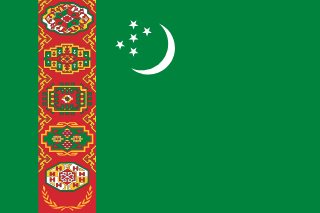
Turkmenistan
Republic of Turkmenistan
Population: UN WPP 2024, revision 1, projection for 1 July 2026. Sources and methodology.
Geography and territory
Turkmenistan spans 491,210 square kilometers in southwestern Central Asia, bordered by the Caspian Sea to the west and sharing land frontiers with Kazakhstan, Uzbekistan, Afghanistan, and Iran. The country’s defining feature is the Karakum Desert, which blankets roughly seventy percent of the national territory and ranks among the largest sand deserts on Earth, its dunes rolling unbroken toward every horizon.
Mountains gather along the southern and southeastern edges of the country. The Kopet Dag range forms a natural boundary with Iran, rising to elevations above 2,900 meters, while the Kugitang system in the far east contains the nation’s highest summit, Ayrybaba, at 3,139 meters. The Amu Darya River traces the northeastern border, delivering irrigation water to a landscape that is otherwise among the driest on the planet.
The climate is harshly continental and arid, with Karakum summers routinely climbing past 50 degrees Celsius and annual rainfall rarely exceeding 200 millimeters. To compensate, Soviet engineers built the Karakum Canal, a channel stretching more than 1,300 kilometers that draws water from the Amu Darya toward farmland in the south. It remains one of the world’s most ambitious irrigation projects, though vast losses to evaporation and seepage along its unlined banks have long drawn criticism from water experts. Most of the country’s roughly 7.7 million residents cluster in the oases and irrigated valleys that ring the Karakum, leaving the desert interior almost entirely uninhabited. Ashgabat, the capital, sits at the foot of the Kopet Dag near the Iranian border, while smaller cities such as Turkmenabat and Mary anchor the river valleys and old caravan routes that have sustained settlement here for centuries.
History
Human settlement in this region stretches back millennia, and few sites capture that depth better than ancient Merv, an oasis city that by the twelfth century ranked among the largest urban centers on Earth and a crucial waypoint on the Silk Road. Armies of Alexander the Great passed through these lands, Arab conquerors introduced Islam in the seventh century, and Mongol forces under Genghis Khan razed Merv in 1221 in one of the deadliest sacks of the medieval world.
Turkic-speaking Turkmen tribes coalesced into a distinct people from around the tenth century onward, building a culture centered on horse breeding, carpet weaving, and tribal confederation. Fierce resistance to Russian imperial expansion collapsed at the Battle of Geok Tepe in 1881, a crushing defeat that brought Turkmen territory under Russian control. The Soviet era that followed reshaped the region into a cotton- and gas-producing republic, even as its nomadic traditions were steadily suppressed.
Independence arrived on October 27, 1991, following the Soviet collapse, but self-rule soon gave way to one of the most closed and idiosyncratic governments in the world under Saparmurat Niyazov, who styled himself Turkmenbashi, or “father of the Turkmen.” Niyazov built an extraordinary personality cult, complete with a mandatory spiritual text, bans on ballet and opera, and gilded statues erected in his own honor. Since his death in 2006, successive leadership has preserved a tightly controlled political system while allowing modest economic openings, and Turkmenistan today operates as a presidential republic in which political life remains closely managed from Ashgabat.
Culture and society
Turkmen identity remains firmly rooted in the nomadic traditions of the steppe and desert. Turkmen carpets, prized worldwide for their exceptional craftsmanship and intricate geometric patterns in deep reds and burgundies, stand as the country’s most recognizable cultural symbol. The carpet’s importance is so profound that it appears on the national flag, a design unique in the world, featuring five gul motifs representing the five principal Turkmen tribes.
The Akhal-Teke horse, one of the oldest and most refined breeds on Earth, forms another pillar of national identity. Prized for a metallic golden coat and remarkable stamina in harsh desert conditions, these horses were historically the most treasured possession a nomadic family could own. Their image pervades Turkmen poetry, music, and folklore, and the breed features prominently on the national emblem, while traditional festivals still showcase horse racing and equestrian displays.
Hospitality is legendary throughout Turkmen society, expressed through elaborate tea ceremonies and the offering of a household’s finest food to any guest. Extended family and tribal bonds remain powerful, and weddings can stretch across several days, drawing hundreds of relatives and neighbors. Traditional music, played on the two-stringed dutar and accompanied by throat singing, recounts the exploits of nomadic heroes and epic desert romances passed down through generations. Turkmen, the official language spoken by the vast majority of the population, belongs to the Oghuz branch of the Turkic language family and shares deep roots with Turkish and Azerbaijani. Russian remains widely understood among older generations as a legacy of the Soviet period, and religious life centers on Sunni Islam, practiced alongside older folk customs tied to ancestor veneration and the natural landscape.
Economy
Turkmenistan’s economy rests overwhelmingly on its vast natural gas reserves, among the largest anywhere in the world. The Galkynysh field, the second-largest gas deposit on the planet, anchors an export sector dominated by sales to China through the Central Asia-China pipeline, an engineering feat that crosses more than 1,800 kilometers of desert and mountain terrain. Oil extraction along the Caspian coast supplements the country’s energy income, and the national economy, valued at roughly $49.8 billion, along with a high Human Development Index score of 0.764, reflects gas-driven prosperity that remains unevenly distributed.
Cotton forms the second economic pillar, grown across extensive irrigated farmland and placing Turkmenistan among the world’s ten largest cotton producers. The crop has drawn international criticism, however, over allegations of forced labor during the harvest season. A growing domestic textile industry has sought to add value locally rather than exporting raw fiber, part of a broader push toward economic diversification.
Despite its natural wealth, Turkmenistan faces real structural challenges tied to international isolation, limited transparency, and a narrow productive base. The government supplies electricity, gas, water, and salt free or at token prices, a legacy policy funded by gas revenue that nonetheless discourages energy efficiency. Efforts to attract foreign investment and cultivate tourism continue, but progress remains slow within a political environment defined by tight state control. The manat, the national currency, trades under a managed exchange regime that further reflects the state’s firm grip on economic affairs.
Food and cuisine
Turkmen cuisine reflects a nomadic heritage adapted to desert life, favoring hearty, substantial dishes built around lamb. The meat appears grilled as shashlik skewers over charcoal, simmered slowly in cauldrons, or cooked in its own juices within underground clay ovens called tamdyr. Plov, a festive dish of rice, meat, carrots, and spices, holds pride of place at family gatherings and celebrations alike.
Bread carries near-sacred status at the Turkmen table, baked in the same tamdyr ovens that crisp the outside of chorek loaves while keeping the interior soft. Gutap, pan-fried pastries filled with meat, pumpkin, or greens, rank among the most popular snacks, sold everywhere from home kitchens to street markets. Dairy products round out the diet, including thick agaran cream, fermented camel’s milk known as chal, and an assortment of dried cheeses that speak to the country’s pastoral roots.
Desert fruit holds a special place in Turkmen life, none more so than the country’s famously sweet melons, celebrated so widely that the second Sunday of August is officially observed as Melon Day. Grapes, pomegranates, and apricots grown in fertile oases round out the produce, while green tea remains the constant companion to every meal and conversation, poured generously as a fundamental gesture of hospitality.
Tourism and landmarks
Strict visa policies keep Turkmenistan among the least-visited countries on Earth, yet those who do reach it encounter sights found nowhere else. The most spectacular is the Darvaza gas crater, popularly known as the Door to Hell, a roughly 70-meter-wide pit that has burned continuously since 1971, when Soviet engineers reportedly set it alight expecting the gas to burn out within days. After dark, the flames cast an otherworldly glow across the surrounding desert.
The ruins of ancient Merv, inscribed as a UNESCO World Heritage site, preserve centuries of Silk Road history layered across a sprawling site that ranges from an Achaemenid-era citadel to twelfth-century Seljuk monuments, including the striking turquoise-domed Mausoleum of Sultan Sanjar. Nearby, the ruins of Nisa, once capital of the Parthian Empire, offer another window into the region’s pre-Islamic past.
Ashgabat, the capital, presents a surreal cityscape sheathed almost entirely in white marble, a feat that earned it a Guinness World Record. Gilded statues, monumental fountains, and government buildings of outsized scale combine into an urban environment that visitors often describe as both mesmerizing and disorienting. For a livelier contrast, the sprawling Tolkuchka Market offers a chaotic, colorful trade in authentic Turkmen carpets, silver jewelry, and traditional handicrafts.
Fun facts about Turkmenistan
- The Darvaza gas crater, known as the Door to Hell, has burned continuously in the Karakum Desert for more than five decades.
- Turkmenistan is the only country whose national flag incorporates carpet-pattern motifs, representing its five principal tribes.
- Ashgabat holds a Guinness World Record for the highest concentration of white marble-clad buildings anywhere on Earth.
- The golden-coated Akhal-Teke horse, a national icon, is renowned for exceptional endurance across long desert distances.
- In 2024, the government officially renamed months and days of the week using Turkmen terms, replacing older Russian-derived names.
- The second Sunday of August is celebrated nationally as Melon Day, honoring the country’s prized desert fruit.
Turkmenistan in numbers
Latest World Bank and UNDP observations, each with its own year. “World median” is the middle value among the countries that report the same indicator; “#” ranks from the highest value.
Population since 1960
Turkmenistan had 1.6 million people in 1960 and 7.6 million in 2025 — 4.6 times as many.
People
47.1% of people live in towns and cities (world median 63.4%). 31.2% are under 15 and 4.8% are 65 or older — a young population. Women have 2.66 children on average, above the replacement level of about 2.1.
Economy
The economy grew by 6.3% in real terms in 2025. Services make up the largest share of output (48.9% of GDP); agriculture contributes 12.4%.
Development and environment
UNDP rates human development in Turkmenistan as high, with an index of 0.764 in 2023 (rank 95 of 193). 18.0% of people use the internet and 100.0% have access to electricity. Forest covers 5.0% of the land (world median 32.8%).
Sources: World Bank, World Development Indicators (CC BY 4.0), most recent observation from 2015 onward; UNDP Human Development Report 2025. Retrieved 2026-10-10. Sector shares need not add up to 100% because taxes and subsidies on products are excluded. Missing values are left blank rather than estimated. Sources and methodology.
Climate of Turkmenistan
Averaged across Turkmenistan, the warmest month is July (30.6 °C) and the coolest is January (2.7 °C), a seasonal swing of 27.9 °C. The annual mean is 16.5 °C.
About 150 mm of precipitation falls in a typical year. March is the wettest month (29 mm) and August the driest (1 mm). What little rain there is falls mostly from February to April (50% of the total).
Less than 250 mm a year is typical of desert climates.
Show monthly values as a table
| Month | Mean °C | Low °C | High °C | Precipitation, mm |
|---|---|---|---|---|
| January | 2.7 | −1.9 | 7.2 | 18 |
| February | 4.4 | −0.6 | 9.4 | 23 |
| March | 10.4 | 4.7 | 16.2 | 29 |
| April | 17.2 | 10.8 | 23.7 | 23 |
| May | 23.3 | 16.2 | 30.5 | 14 |
| June | 28.4 | 21.0 | 35.9 | 3 |
| July | 30.6 | 23.3 | 37.9 | 2 |
| August | 28.9 | 21.3 | 36.5 | 1 |
| September | 23.1 | 15.4 | 30.9 | 2 |
| October | 16.0 | 8.8 | 23.3 | 6 |
| November | 8.9 | 3.4 | 14.5 | 14 |
| December | 4.0 | −0.5 | 8.5 | 15 |
Figures are 1991–2020 averages across the whole land area of Turkmenistan, from the World Bank Climate Change Knowledge Portal, CRU TS 4.08 (CC BY 4.0). They are not readings from one weather station: the capital, the coast and high ground can be much warmer, cooler, wetter or drier.
Travel essentials for Turkmenistan
The practical details visitors ask about first. Traffic in Turkmenistan drives on the right, like most of the world. Mains electricity is 220 V at 50 Hz, so devices made only for 110–120 V (common in North America) need a converter unless they are dual-voltage — most phone and laptop chargers are.
- Emergency number
- 112Police 102 · Ambulance 103 · Fire 101
- Driving side
- Right
- Plug types
- Type B, Type C, Type FB: two flat pins plus a round earth pin; C: two round pins (Europlug); F: two round pins with side earth clips (Schuko)
- Voltage
- 220 V50 Hz
- Dialling code
- +993From abroad: your exit code, then 993 and the number
- Currency
- Turkmenistani Manat (TMT)
- Time zone
- UTC+5Current local time in Turkmenistan
Compiled from IEC plug and voltage standards, national emergency-service listings and the UN road-traffic conventions. Emergency numbers and local coverage can change — confirm them locally on arrival. Turkmenistan's internet domain is .tm.
Where Turkmenistan ranks in the world
Each position counts only the countries with data in that ranking guide. First place is the highest value — for price levels, the most expensive. Select a card to see the full table.
- Population104th of 1967.7 millionUN projection, July 2026
- Land area53rd of 195469,930 km²World Bank, 2023
- Population density177th of 19416 per km²World Bank, 2023
- GDP (nominal)96th of 187$44.2BWorld Bank, 2024, current US$
- GDP per capita107th of 187$5,904World Bank, 2024, current US$
- Life expectancy130th of 19470.2 yearsWorld Bank, 2024
Bordering countries of Turkmenistan


Compare Turkmenistan with another country
Frequently asked questions about Turkmenistan
What is the capital of Turkmenistan?
The capital of Turkmenistan is Ashgabat.
What is the population of Turkmenistan?
The UN World Population Prospects projection for Turkmenistan is 7,736,632 people (7.7 million) on 1 July 2026. National statistical offices may publish different estimates.
What language is spoken in Turkmenistan?
The official language of Turkmenistan is Turkmen.
What currency is used in Turkmenistan?
The currency of Turkmenistan is the Turkmenistani Manat (TMT).
How big is Turkmenistan?
Turkmenistan covers an area of 491,210 km².
What type of government does Turkmenistan have?
Turkmenistan is a presidential republic.
Which countries border Turkmenistan?
Turkmenistan shares land borders with Kazakhstan, Uzbekistan, Afghanistan, Iran.
What is the highest point in Turkmenistan?
The highest point in Turkmenistan is Ayrybaba (3,139 m).

