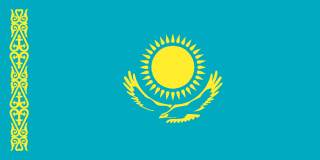
Kazakhstan
Republic of Kazakhstan
Population: UN WPP 2024, revision 1, projection for 1 July 2026. Sources and methodology.
Geography and territory
Kazakhstan is the ninth-largest country on Earth and the largest in Central Asia, spanning 2,724,900 square kilometers from the Caspian Sea in the west to the Altai Mountains in the east. Its immense territory holds an extraordinary range of landscapes: seemingly endless steppes, deserts such as the Kyzylkum and Betpak-Dala, mountain ranges topping 7,000 meters, and singular lakes like Balkhash, whose western half is freshwater and eastern half salt water.
The terrain rises steadily from west to east. The Caspian lowlands, in places below sea level, give way to the central steppes and finally to the towering Tien Shan and Altai ranges along the borders with China and Kyrgyzstan. Khan Tengri, at 7,010 meters, crowns the country’s mountainous landscape. The Irtysh, Syr Darya, and Ili rivers form the main arteries of a river system that sustains unique ecosystems in an otherwise arid region.
Kazakhstan’s climate is sharply continental, with brutally cold winters that can plunge to -40°C in the north and scorching summers exceeding 40°C in the southern deserts, one of the widest temperature swings on the planet, shaping daily life and the economy alike. The Kazakh portion of the Aral Sea, once the world’s fourth-largest lake, stands as one of the great ecological disasters of the modern era, though restoration efforts have partially revived its northern section.
History
Kazakhstan’s history is deeply rooted in the nomadic traditions of the Eurasian steppe. For millennia, nomadic peoples including the Scythians, Huns, and Turkic tribes crossed these vast plains, developing an equestrian, pastoral culture that would come to define the region’s identity. In the 13th century, the Mongol invasions under Genghis Khan absorbed the territory into history’s largest contiguous land empire, a legacy still visible in the ethnic makeup and traditions of the Kazakh people.
The Kazakh Khanate emerged in the 15th century as a distinct political entity, unifying the Turkic nomadic tribes of the region. From the 18th century onward, however, the expanding Russian Empire steadily absorbed Kazakh lands. The Soviet era brought radical upheaval: forced collectivization in the 1930s caused a famine that killed more than a million Kazakhs, the Virgin Lands campaign drastically reshaped the agricultural landscape, and the Semipalatinsk Test Site hosted more than 450 nuclear detonations between 1949 and 1989.
Kazakhstan declared independence on December 16, 1991, the last Soviet republic to do so. Under the leadership of Nursultan Nazarbayev, who governed until 2019, the country underwent rapid economic modernization fueled by its vast hydrocarbon wealth. The capital moved from Almaty to Astana in 1997, a city renamed Nursultan in 2019 that has become a showcase of futuristic architecture rising from the open steppe.
Culture and society
Kazakh culture is a fascinating weave of ancient nomadic tradition with Islamic, Russian, and modern influences. The yurt, the traditional round dwelling of the nomads, remains an omnipresent cultural symbol, even appearing on the national emblem. Kazakh hospitality is legendary: welcoming a guest is considered a sacred duty, and visitors are treated to tea, kumis (fermented mare’s milk), and the finest cuts of meat.
Traditional Kazakh music, performed on instruments such as the dombra, a two-stringed lute, and the kobyz, carries the epic tales of the akyns, improvising poets who for centuries served as guardians of collective memory. Nauryz, celebrated at the spring equinox, is the country’s most important holiday, symbolizing renewal and community; families prepare nauryz-kozhe, a ritual soup made from seven ingredients representing prosperity.
Contemporary Kazakh society reflects remarkable ethnic diversity, with more than 130 ethnic groups living in relative harmony. The Kazakh language, part of the Turkic family, coexists with Russian as a language of interethnic communication. The country has embarked on an ambitious transition from the Cyrillic to the Latin alphabet, expected to be completed in the coming decades, part of a broader effort to strengthen national identity and deepen ties with the wider Turkic world.
Economy
Kazakhstan boasts the largest and most diversified economy in Central Asia, driven primarily by extraordinary natural resource wealth. The country is a leading global oil and gas producer, with the giant Kashagan field in the Caspian Sea among the largest discoveries in recent decades. Kazakhstan is also the world’s top producer of uranium, supplying roughly 40 percent of global output, alongside substantial deposits of chromium, zinc, lead, and copper.
National strategy aims to reduce dependence on hydrocarbons through diversification. The Kazakhstan 2050 program promotes growth in agribusiness, tourism, renewable energy, and logistics, capitalizing on the country’s strategic position as a bridge between Europe and Asia. China’s New Silk Road initiative has reinforced this role, turning Kazakhstan into a crucial node in Eurasian trade.
Agriculture, while a smaller share of GDP, remains vital to rural employment. The vast northern steppes support extensive wheat and barley cultivation, while livestock herding, especially of horses, sheep, and camels, keeps the nomadic heritage alive. Almaty and Astana have established themselves as regional financial and technology hubs, drawing foreign investment and entrepreneurship.
Food and cuisine
Kazakh cuisine is deeply rooted in nomadic tradition, reflecting centuries of adaptation to the steppe and its extreme climate. Meat, especially horse and lamb, forms the backbone of the traditional diet. Beshbarmak, considered the national dish, consists of boiled meat served over sheets of handmade pasta with an aromatic broth; its name literally means “five fingers,” a reference to the tradition of eating it by hand.
Dairy holds a central place in the Kazakh diet. Kumis, fermented mare’s milk with a mild alcoholic content, is the quintessential traditional drink and is credited with medicinal properties. Shubat, made from fermented camel’s milk, and kurt, a dried salty cheese that nomads carried on long journeys, round out a dairy tradition stretching back thousands of years.
Other standout dishes include kazy, a cured horsemeat sausage served on special occasions; baursak, fried dough balls that accompany every celebration; and manty, large steamed dumplings filled with meat and onion. Tea, often served with milk and, in true steppe style, sometimes salted, is the social drink that accompanies every conversation and gathering.
Tourism and landmarks
Kazakhstan offers a unique travel experience for those seeking uncharted horizons. Astana, the capital, dazzles with futuristic architecture rising from the steppe: the Bayterek Tower, the city’s symbol; the Palace of Peace and Reconciliation designed by Norman Foster; and the Khan Shatyr, an immense shopping center enclosed beneath a transparent tent that shrugs off the region’s extreme climate. Almaty, the former capital, charms with its cosmopolitan atmosphere, snow-capped mountain backdrop, and the Shymbulak ski resort.
The Mausoleum of Khoja Ahmed Yasawi in Turkestan, a UNESCO World Heritage Site, is a masterpiece of 14th-century Timurid architecture that rivals the grandeur of Samarkand’s monuments. Charyn Canyon, often compared to the Grand Canyon, offers spectacular reddish rock formations carved over millions of years. Kaindy Lake, with its submerged fir trees rising like ghostly masts from turquoise water, is one of the most surreal landscapes on the planet.
Kazakhstan’s immense steppes invite authentic nomadic tourism, with stays in traditional yurts, horseback rides across endless grasslands, and wildlife viewing that includes the endangered snow leopard and saiga antelope. The Baikonur Cosmodrome, from which Yuri Gagarin launched into space in 1961, offers another singular draw for travelers interested in the history of space exploration.
Fun facts about Kazakhstan
- Kazakhstan is the largest landlocked country in the world, with an area exceeding that of all of Western Europe.
- Horses are believed to have first been domesticated on the Kazakh steppe more than 5,000 years ago.
- The Baikonur Cosmodrome, located on Kazakh soil but leased to Russia, is the world’s oldest and busiest active spaceport.
- The wild apple originated genetically in the forests of Kazakhstan’s Tien Shan mountains, and Almaty’s name translates roughly to “father of apples.”
- Kazakhstan contains the Betpak-Dala, considered one of the largest cold deserts in the world.
Kazakhstan in numbers
Latest World Bank and UNDP observations, each with its own year. “World median” is the middle value among the countries that report the same indicator; “#” ranks from the highest value.
Population since 1960
Kazakhstan had 9.4 million people in 1960 and 20.8 million in 2025 — 2.2 times as many.
People
62.4% of people live in towns and cities (world median 63.4%). 29.1% are under 15 and 9.0% are 65 or older — a middle-aged population. Women have 2.98 children on average, above the replacement level of about 2.1.
Economy
The economy grew by 6.5% in real terms in 2025. Consumer prices rose by 11.4% in 2025. Services make up the largest share of output (57.7% of GDP); agriculture contributes 3.7%.
Development and environment
UNDP rates human development in Kazakhstan as very high, with an index of 0.837 in 2023 (rank 60 of 193). 93.4% of people use the internet and 100.0% have access to electricity. Forest covers 1.3% of the land (world median 32.8%).
Sources: World Bank, World Development Indicators (CC BY 4.0), most recent observation from 2015 onward; UNDP Human Development Report 2025. Retrieved 2026-10-10. Sector shares need not add up to 100% because taxes and subsidies on products are excluded. Missing values are left blank rather than estimated. Sources and methodology.
Climate of Kazakhstan
Averaged across Kazakhstan, the warmest month is July (23.7 °C) and the coolest is January (−11.0 °C), a seasonal swing of 34.7 °C. The annual mean is 7.0 °C.
5 months have a national mean temperature below freezing.
About 256 mm of precipitation falls in a typical year. July is the wettest month (28 mm) and September the driest (14 mm).
Show monthly values as a table
| Month | Mean °C | Low °C | High °C | Precipitation, mm |
|---|---|---|---|---|
| January | −11.0 | −15.5 | −6.5 | 18 |
| February | −9.7 | −14.7 | −4.7 | 16 |
| March | −1.9 | −7.0 | 3.2 | 19 |
| April | 9.3 | 3.0 | 15.6 | 24 |
| May | 16.6 | 9.6 | 23.6 | 26 |
| June | 21.9 | 14.9 | 28.9 | 27 |
| July | 23.7 | 16.8 | 30.7 | 28 |
| August | 22.0 | 14.8 | 29.3 | 20 |
| September | 15.4 | 8.3 | 22.5 | 14 |
| October | 7.6 | 1.5 | 13.8 | 21 |
| November | −1.6 | −6.0 | 2.8 | 23 |
| December | −8.3 | −12.6 | −4.0 | 21 |
Figures are 1991–2020 averages across the whole land area of Kazakhstan, from the World Bank Climate Change Knowledge Portal, CRU TS 4.08 (CC BY 4.0). They are not readings from one weather station: the capital, the coast and high ground can be much warmer, cooler, wetter or drier.
Travel essentials for Kazakhstan
The practical details visitors ask about first. Traffic in Kazakhstan drives on the right, like most of the world. Mains electricity is 230 V at 50 Hz, so devices made only for 110–120 V (common in North America) need a converter unless they are dual-voltage — most phone and laptop chargers are.
- Emergency number
- 112Police 102 · Ambulance 103 · Fire 101
- Driving side
- Right
- Plug types
- Type C, Type FC: two round pins (Europlug); F: two round pins with side earth clips (Schuko)
- Voltage
- 230 V50 Hz
- Dialling code
- +7From abroad: your exit code, then 7 and the number
- Currency
- Kazakhstani Tenge (KZT)
- Time zone
- UTC+5Current local time in Kazakhstan
Compiled from IEC plug and voltage standards, national emergency-service listings and the UN road-traffic conventions. Emergency numbers and local coverage can change — confirm them locally on arrival. Kazakhstan's internet domain is .kz.
Where Kazakhstan ranks in the world
Each position counts only the countries with data in that ranking guide. First place is the highest value — for price levels, the most expensive. Select a card to see the full table.
- Population65th of 19621.1 millionUN projection, July 2026
- Land area9th of 1952,699,700 km²World Bank, 2023
- Population density184th of 1947.5 per km²World Bank, 2023
- GDP (nominal)48th of 187$291.5BWorld Bank, 2024, current US$
- GDP per capita65th of 187$14,155World Bank, 2024, current US$
- Life expectancy92nd of 19474.5 yearsWorld Bank, 2024
- Price level135th of 16533 (US = 100)ICP 2021, household consumption
Bordering countries of Kazakhstan


Compare Kazakhstan with another country
Frequently asked questions about Kazakhstan
What is the capital of Kazakhstan?
The capital of Kazakhstan is Nur-Sultan (Astana).
What is the population of Kazakhstan?
The UN World Population Prospects projection for Kazakhstan is 21,083,626 people (21.1 million) on 1 July 2026. National statistical offices may publish different estimates.
What language is spoken in Kazakhstan?
The official language of Kazakhstan is Kazakh, Russian.
What currency is used in Kazakhstan?
The currency of Kazakhstan is the Kazakhstani Tenge (KZT).
How big is Kazakhstan?
Kazakhstan covers an area of 2,724,900 km².
What type of government does Kazakhstan have?
Kazakhstan is a presidential republic.
Which countries border Kazakhstan?
Kazakhstan shares land borders with Russia, China, Kyrgyzstan, Uzbekistan, Turkmenistan.
What is the highest point in Kazakhstan?
The highest point in Kazakhstan is Khan Tengri (7,010 m).
