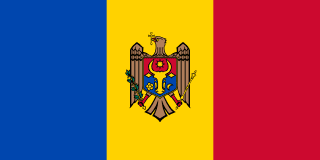
Moldova
Republic of Moldova
Population: UN WPP 2024, revision 1, projection for 1 July 2026. Sources and methodology.
Geography and territory
Moldova occupies a compact stretch of southeastern Europe, wedged between Romania to the west and Ukraine along its northern, eastern, and southern edges. Covering 33,846 km², it ranks among the smaller countries on the continent, yet its landscape carries an outsized agricultural wealth. The territory unfolds between two rivers that define its borders and identity: the Prut, which separates Moldova from Romania, and the Dniester, which divides the breakaway region of Transnistria from the rest of the country.
The terrain is gently rolling rather than dramatic, a landscape of soft hills and fertile lowlands that rarely climbs above 400 meters. Bălănești Hill, at just 430 meters, is the country’s highest point. What Moldova lacks in elevation it makes up for in soil quality: thick bands of chernozem, or black earth, cover much of the territory and rank among the most fertile soils in the world, a resource that has shaped the nation’s economy and culture for centuries. Forests cover roughly a tenth of the land, concentrated in the Codri plateau at the country’s heart, often called its green core.
Moldova’s climate is moderate continental, with relatively mild winters and hot, dry summers well suited to grapevines and orchard fruit. The country is landlocked in the practical sense, but a narrow strip of territory along the Danube in its far south gives it a technical foothold on international river navigation, a small geographic curiosity that has occasionally mattered strategically. Wildlife across the Codri forests and river valleys includes deer, wild boar, foxes, and a wide variety of birdlife, while the Prut and Dniester river valleys support wetlands that are important stopover points for migratory species crossing southeastern Europe.
History
Moldova’s national story begins with the medieval Principality of Moldavia, which flourished from the fourteenth through the sixteenth centuries. Its most celebrated ruler, Stephen the Great, is remembered as a national hero who repelled repeated Ottoman incursions and built his realm into a resilient Christian bulwark in southeastern Europe. His long reign is recalled as a golden age of both military success and cultural achievement, marked by the construction of numerous monasteries and churches that still stand today.
The principality’s independence eroded gradually under Ottoman pressure, and the territory later became a contested prize among the Russian, Ottoman, and Austro-Hungarian empires. In 1812, the Russian Empire annexed the region known as Bessarabia, corresponding roughly to the borders of modern Moldova. After the First World War, Bessarabia united with Romania in 1918, only to be absorbed into the Soviet Union in 1940 under the terms of the Molotov-Ribbentrop Pact.
The Soviet period reshaped Moldovan society profoundly, imposing agricultural collectivization, rapid industrialization, and a deliberate cultivation of a distinct Moldovan identity separate from Romania’s, including the imposed use of the Cyrillic alphabet for writing the local language. Independence came on August 27, 1991, but it arrived alongside the conflict in Transnistria, a breakaway region with a largely Russian and Ukrainian population that declared its own independence and maintains an unrecognized government to this day.
Culture and society
Moldovan culture blends Romanian, Slavic, and Turkic influences into a distinctive regional identity expressed through folk traditions, music, and craft. The official language is Romanian, identical to the language spoken across the border, a linguistic bond that underpins deep cultural ties between the two countries. A rich oral tradition of tales, legends, and ballads has preserved an intangible heritage passed down through generations, particularly in rural communities.
Folk music in Moldova is lively and expressive, performed on traditional instruments such as the nai, a pan flute, the cobza, a plucked string instrument, and the cimbalom. Communal dances like the hora, a joyous circle dance that draws in an entire community, and the joc, a livelier couple’s dance, appear at weddings, harvest festivals, and religious holidays alike. Craftwork traditions remain strong in pottery, woven textiles, and the elaborate embroidery that decorates traditional dress.
Rural life still anchors much of Moldovan society, with customs tied closely to the agricultural calendar and Orthodox religious feasts. Mărțișor, celebrated on March 1, welcomes spring with the exchange of small red-and-white amulets, a tradition beloved across the country. Hospitality runs deep in Moldovan culture: a host’s table is expected to overflow with food and, invariably, wine, and declining an invitation to share a meal is considered a genuine slight.
Economy
With a gross domestic product of roughly $20.4 billion, Moldova remains one of Europe’s more modest economies, though its agricultural resources carry considerable untapped potential. Farming forms the backbone of national production, with grain, sunflower, orchard fruit, and above all grapes among the leading crops. Moldovan winemaking is legendary: the country is home to the underground cellars of Mileștii Mici, recognized by Guinness World Records as the largest wine cellar on Earth, with tunnels stretching more than 200 kilometers and storing close to two million bottles.
Wine is Moldova’s flagship export and a central pillar of national identity. The country dedicates more than 142,000 hectares to vineyards, giving it one of the highest vineyard densities relative to land area found anywhere in the world. Producers such as Cricova, whose sprawling underground galleries welcome visitors by electric car, and Purcari, whose bottles have earned international acclaim, have put Moldova firmly on the global wine map.
An emerging information technology sector has become a genuine growth engine, drawing investment and creating skilled jobs concentrated in Chisinau. Remittances sent home by Moldovans working abroad make up a significant share of GDP, a reflection of the high rates of emigration that have long shaped the country’s demographics and economy. Moldova has also pursued closer integration with the European Union, signing an Association Agreement aimed at modernizing its economy and opening access to European markets, and the country was granted EU candidate status, a milestone that has accelerated reforms in governance, energy independence, and trade.
Food and cuisine
Moldovan cuisine is hearty, flavorful, and deeply rooted in the produce of the land. Sarmale, cabbage rolls stuffed with ground meat, rice, and aromatic herbs and simmered slowly in a tomato-based sauce, is the quintessential festive dish, appearing at nearly every family celebration. Mămăligă, a cornmeal polenta served as a side dish or a meal in itself alongside fresh cheese, sour cream, and meat, is the traditional staple that has sustained generations of Moldovans.
Plăcintă, a flat pastry filled with cheese, pumpkin, apple, or cabbage, is eaten for breakfast, as a snack, or as a light meal at any time of day. Zeamă, a clear chicken soup with noodles and vegetables, is the classic homemade remedy for whatever ails you. Meats are commonly grilled or roasted, and mici, small skinless sausages of spiced ground meat, are a specialty shared with neighboring Romania’s culinary tradition.
Wine accompanies nearly every Moldovan meal and celebration, from robust reds made from the Fetească Neagră grape to aromatic whites crafted from Fetească Albă. Divin, Moldovan brandy aged in oak barrels, has earned international recognition for its smoothness and complexity. For dessert, cozonac, a braided sweet bread studded with walnuts, is a holiday favorite, alongside an array of candied fruit preserves and homemade jams that make the most of Moldova’s abundant orchards.
Tourism and landmarks
Chisinau, the capital, is a city of contrasts, where Soviet-era architecture stands alongside tree-lined parks, Orthodox churches, and a growing food scene. The Triumphal Arch, the Nativity Cathedral, and the National Museum of History together offer a solid introduction to Moldovan identity, while the central market bustles with the colors, smells, and flavors of the country’s rich agricultural output.
Moldova’s wine route is its leading tourist draw. The cellars of Mileștii Mici, whose underground streets are named for grape varieties, and Cricova, where figures ranging from Yuri Gagarin to Angela Merkel have stored private wine collections, offer visitors distinctive wine-tasting experiences. The Purcari wine region, along the banks of the Dniester, pairs pastoral scenery with internationally awarded vintages.
The cave monasteries of Orheiul Vechi, carved into limestone cliffs above the Răut River, form one of the most striking cultural landscapes in Eastern Europe. The perfectly circular fifteenth-century Soroca Fortress and the painted monastery walls at Țipova round out a historical heritage that arguably deserves wider international recognition. Transnistria, with its frozen-in-time Soviet atmosphere and its own currency and symbols, continues to intrigue curious travelers who venture across its de facto border.
Fun facts about Moldova
- The underground cellars of Mileștii Mici form the world’s largest wine cellar, with more than 200 kilometers of tunnels storing close to two million bottles
- Moldova celebrates a National Wine Day every first weekend of October, with festivals held across the entire country
- The country has one of the highest vineyard densities relative to land area found anywhere in the world
- Transnistria, Moldova’s breakaway region, maintains its own currency, postage stamps, and government, though no United Nations member state recognizes it
- For centuries, Moldova served as a crossroads between the Ottoman, Russian, and Austro-Hungarian empires
- On March 1, Moldovans celebrate Mărțișor by exchanging small red-and-white amulets as a symbol of the arrival of spring
Moldova in numbers
Latest World Bank and UNDP observations, each with its own year. “World median” is the middle value among the countries that report the same indicator; “#” ranks from the highest value.
Population since 1960
Moldova had 2.1 million people in 1960 and 2.4 million in 2025 — 15% more.
The population peaked at 3.0 million in 1991 and has since declined.
People
43.7% of people live in towns and cities (world median 63.4%). 19.5% are under 15 and 16.9% are 65 or older — an ageing population. Women have 1.73 children on average, below the replacement level of about 2.1 needed to keep a population stable in the long run without migration.
Economy
The economy grew by 2.4% in real terms in 2025. Consumer prices rose by 7.8% in 2025. Services make up the largest share of output (61.5% of GDP); agriculture contributes 7.4%.
Development and environment
UNDP rates human development in Moldova as high, with an index of 0.785 in 2023 (rank 86 of 193). 77.4% of people use the internet and 100.0% have access to electricity. Forest covers 11.3% of the land (world median 32.8%).
Sources: World Bank, World Development Indicators (CC BY 4.0), most recent observation from 2015 onward; UNDP Human Development Report 2025. Retrieved 2026-10-10. Sector shares need not add up to 100% because taxes and subsidies on products are excluded. Missing values are left blank rather than estimated. Sources and methodology.
Climate of Moldova
Averaged across Moldova, the warmest month is July (22.8 °C) and the coolest is January (−1.7 °C), a seasonal swing of 24.5 °C. The annual mean is 10.9 °C.
1 month has a national mean temperature below freezing.
About 504 mm of precipitation falls in a typical year. June is the wettest month (68 mm) and February the driest (28 mm).
Show monthly values as a table
| Month | Mean °C | Low °C | High °C | Precipitation, mm |
|---|---|---|---|---|
| January | −1.7 | −4.6 | 1.1 | 33 |
| February | 0.0 | −3.3 | 3.2 | 28 |
| March | 4.6 | 0.4 | 8.8 | 30 |
| April | 11.2 | 6.1 | 16.5 | 36 |
| May | 16.9 | 11.4 | 22.4 | 51 |
| June | 20.8 | 15.3 | 26.3 | 68 |
| July | 22.8 | 17.2 | 28.4 | 59 |
| August | 22.4 | 16.6 | 28.3 | 43 |
| September | 17.2 | 11.9 | 22.6 | 48 |
| October | 10.9 | 6.5 | 15.4 | 36 |
| November | 5.1 | 1.9 | 8.3 | 37 |
| December | 0.0 | −2.8 | 2.7 | 35 |
Figures are 1991–2020 averages across the whole land area of Moldova, from the World Bank Climate Change Knowledge Portal, CRU TS 4.08 (CC BY 4.0). They are not readings from one weather station: the capital, the coast and high ground can be much warmer, cooler, wetter or drier.
Travel essentials for Moldova
The practical details visitors ask about first. Traffic in Moldova drives on the right, like most of the world. Mains electricity is 230 V at 50 Hz, so devices made only for 110–120 V (common in North America) need a converter unless they are dual-voltage — most phone and laptop chargers are.
- Emergency number
- 112
- Driving side
- Right
- Plug types
- Type C, Type FC: two round pins (Europlug); F: two round pins with side earth clips (Schuko)
- Voltage
- 230 V50 Hz
- Dialling code
- +373From abroad: your exit code, then 373 and the number
- Currency
- Moldovan Leu (MDL)
- Time zone
- EET (UTC+2)Current local time in Moldova
Compiled from IEC plug and voltage standards, national emergency-service listings and the UN road-traffic conventions. Emergency numbers and local coverage can change — confirm them locally on arrival. Moldova's internet domain is .md.
Where Moldova ranks in the world
Each position counts only the countries with data in that ranking guide. First place is the highest value — for price levels, the most expensive. Select a card to see the full table.
- Population137th of 1963.0 millionUN projection, July 2026
- Land area134th of 19532,930 km²World Bank, 2023
- Population density113th of 19475 per km²World Bank, 2023
- GDP (nominal)129th of 187$18.2BWorld Bank, 2024, current US$
- GDP per capita93rd of 187$7,579World Bank, 2024, current US$
- Life expectancy122nd of 19471.3 yearsWorld Bank, 2024
- Price level124th of 16536 (US = 100)ICP 2021, household consumption
Bordering countries of Moldova


Compare Moldova with another country
Frequently asked questions about Moldova
What is the capital of Moldova?
The capital of Moldova is Chisinau.
What is the population of Moldova?
The UN World Population Prospects projection for Moldova is 2,961,253 people (3.0 million) on 1 July 2026. National statistical offices may publish different estimates.
What language is spoken in Moldova?
The official language of Moldova is Romanian.
What currency is used in Moldova?
The currency of Moldova is the Moldovan Leu (MDL).
How big is Moldova?
Moldova covers an area of 33,846 km².
What type of government does Moldova have?
Moldova is a parliamentary republic.
Which countries border Moldova?
Moldova shares land borders with Romania, Ukraine.
What is the highest point in Moldova?
The highest point in Moldova is Bălănești Hill (430 m).

