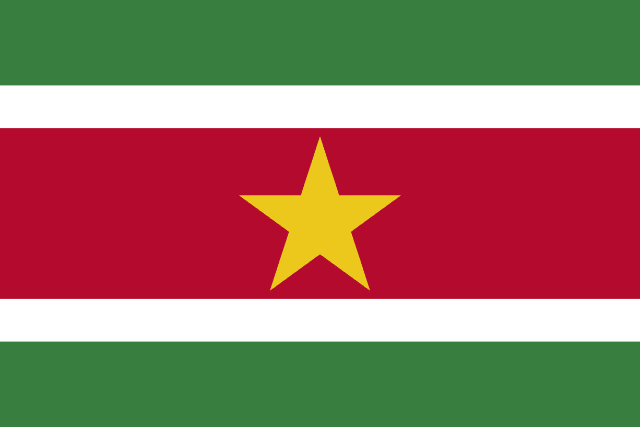
Flag of Suriname
Republic of Suriname
Flag details
- Proportions
- 2:3 height : width
- ISO code
- SR / SUR
- Emoji
- Unicode
- U+1F1F8 U+1F1F7
Flag colors
- green#377e3f39%
- red#b40a2d37%
- white#ffffff19%
Share of the flag's surface, measured from the image. Names describe the measured shade.
Download the flag
Meaning and history of the flag of Suriname
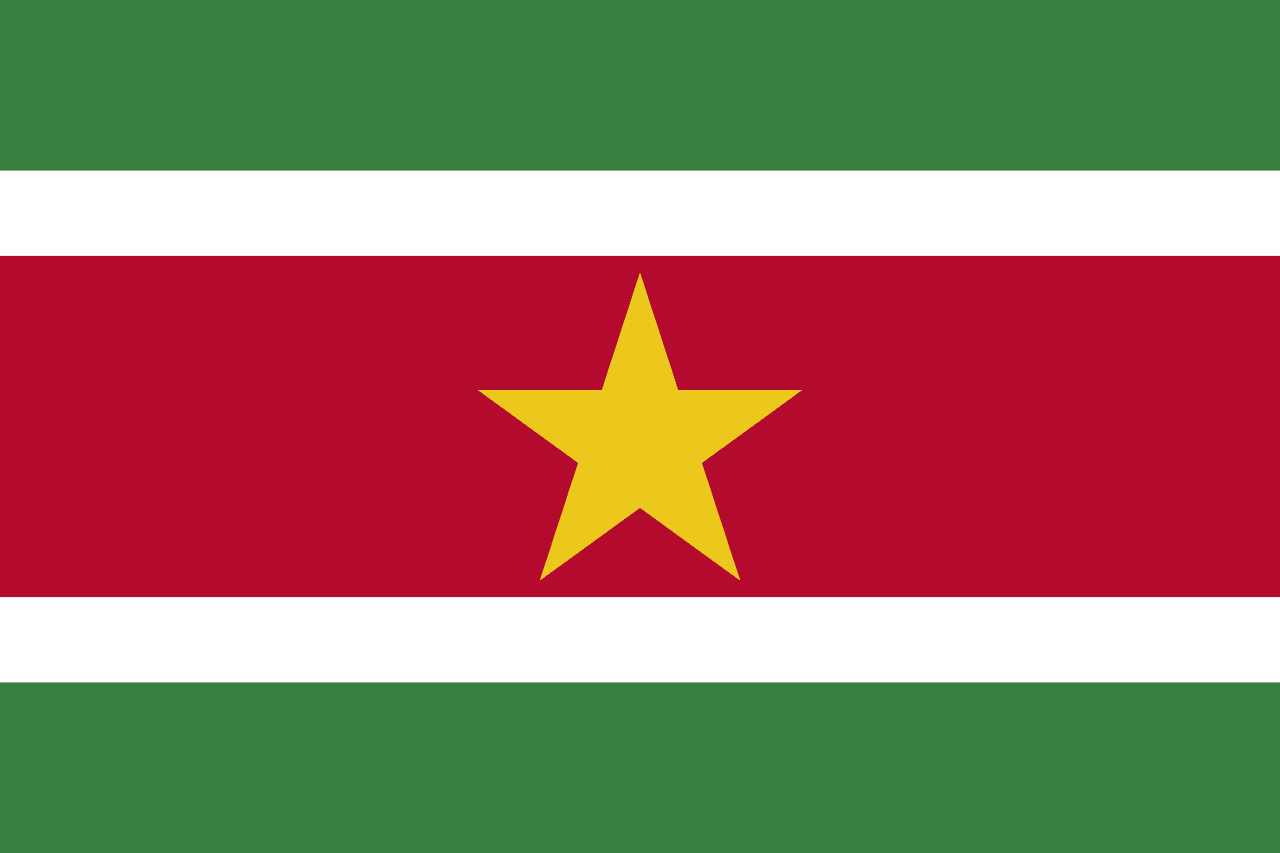
The flag of Suriname has five horizontal stripes of green, white, red, white, and green, with the central red stripe the widest and the white stripes the narrowest. A yellow five-pointed star sits at the center of the red stripe.
It was adopted on November 25, 1975, the day of independence from the Netherlands. Green represents the fertility of the land and hope for progress, white symbolizes justice and freedom, red embodies the love and dedication of the Surinamese people to their country, and the yellow star represents the unity of all the ethnic groups that make up this multicultural nation, including people of African, Indian, Javanese, Chinese, European, and Indigenous descent. Suriname's ethnic diversity is among the most remarkable in the world, and the unifying golden star reflects this central aspect of national identity. The horizontal-stripes-with-central-star design bears some resemblance to the flag of Burkina Faso, though the colors and proportions differ.
Colours and shape
Measured from the image, the main colours of the flag of Suriname are green, red and white. Its official proportions are 2:3 (height to width), the same shape as at least 84 other national flags.
The flag emoji 🇸🇷 is built from the two regional indicator letters S and R (U+1F1F8 U+1F1F7). Most phones and Macs draw it as a flag; Windows shows the two letters instead.