Flag of Japan
Japan
Flag details
- Country
- Japan
- Official name
- Japan
- Capital
- Tokyo
- ISO code
- JP / JPN
- Region
- East Asia
Flag colors
- #ffffff81%
- #bc002d18%
Share of the flag's surface, measured from the image.
Download the flag
Meaning and history of the flag of Japan
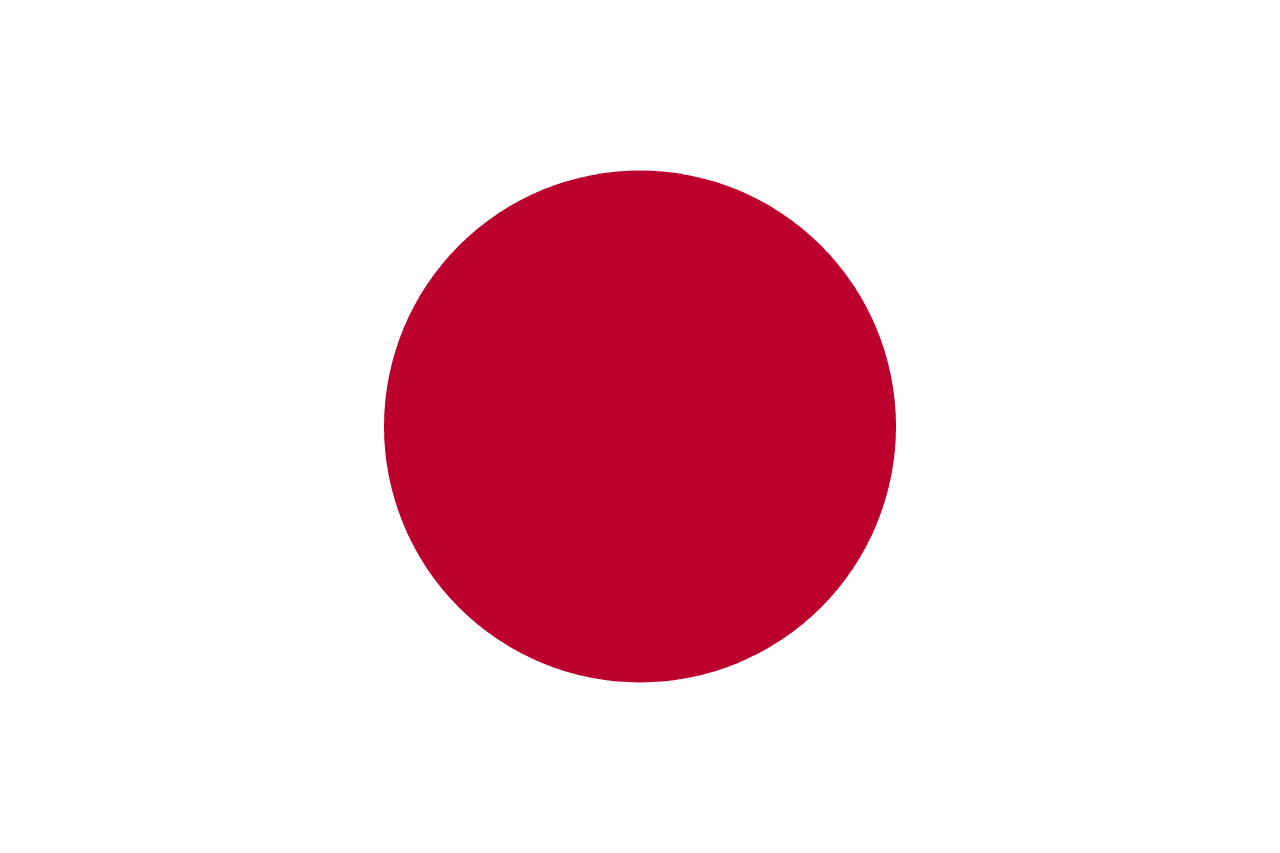
Japan's flag, known as the Nisshoki (sun flag) or more colloquially the Hinomaru (circle of the sun), is a design of extraordinary simplicity: a crimson-red disc centered on a pure white field. The red disc represents the sun, a symbol central to Japanese identity that gives the country its name, Nihon or Nippon, meaning 'origin of the sun.' The white symbolizes honesty and purity. The official proportions are 2:3, and the disc's diameter is three-fifths of the flag's height.
Although the Hinomaru has served as a symbol of Japan for centuries, it was not legally recognized as the national flag until August 13, 1999, under the Act on National Flag and Anthem. Its use dates back at least to the twelfth century, when samurai displayed it on war fans. During the Edo period (1603-1868), the Tokugawa shogunate used it on Japanese merchant ships to identify them at sea.
Japan's flag is one of the most minimalist and recognizable in the world, alongside Bangladesh's, which uses a similar design with a red disc on a green field. The Hinomaru's simplicity has influenced the design of several other Asian flags. However, because of its association with Japanese imperialism during World War II, the flag has historically been a source of controversy in countries such as South Korea and China. The version with rays radiating from the disc, used by Japan's military forces, is especially contentious.
You can view the flag of Japan in high resolution above and download it in several sizes for personal, educational or reference use. To explore more, visit the full Japan profile, its map, or the current local time in Tokyo.