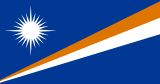
Flag of the Marshall Islands
Republic of the Marshall Islands
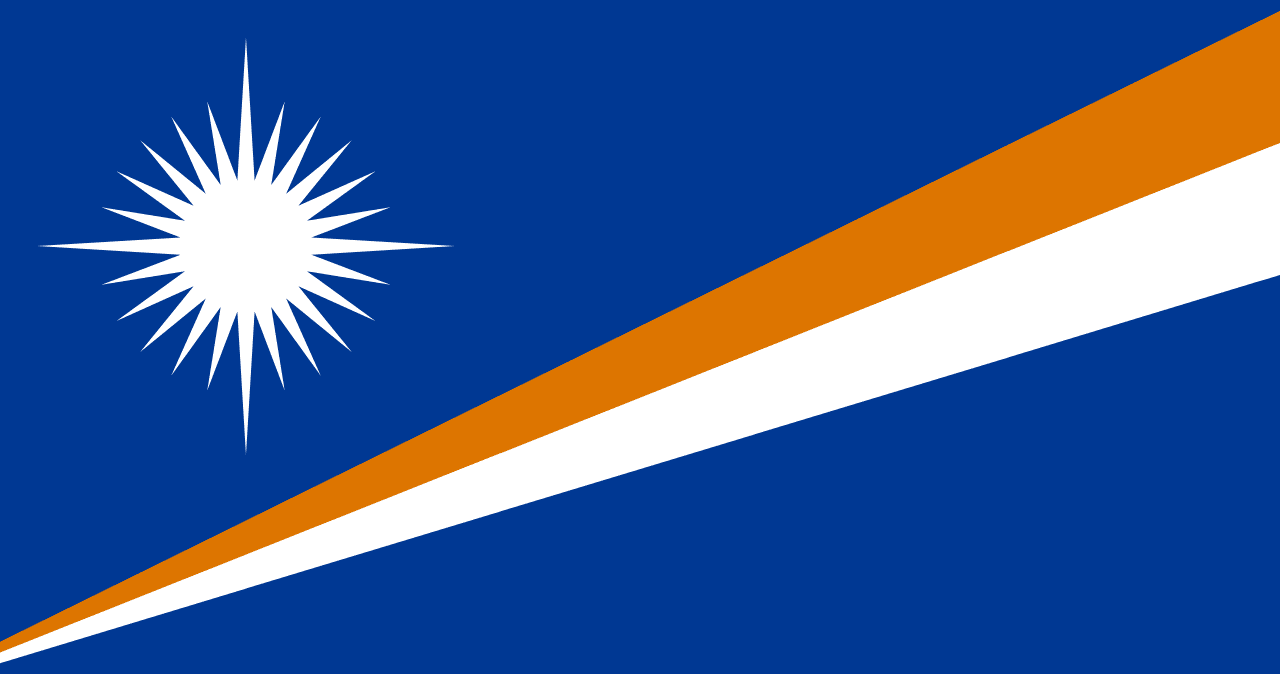
Flag details
- Country
- Marshall Islands
- Official name
- Republic of the Marshall Islands
- Capital
- Majuro
- ISO code
- MH / MHL
- Region
- Micronesia
Flag colors
- #00389373%
- #ffffff13%
- #dd750010%
Share of the flag's surface, measured from the image.
Download the flag
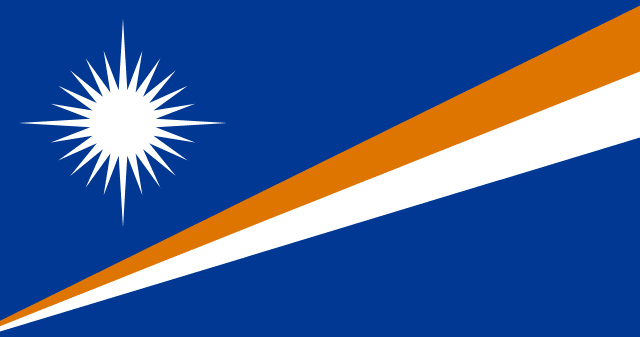
Meaning and history of the flag of the Marshall Islands
The flag of the Marshall Islands has a blue field representing the Pacific Ocean, crossed by two diagonal stripes running from the lower hoist corner to the upper fly corner: an orange stripe below and a white one above. In the upper hoist corner sits a white 24-pointed star. The diagonal stripes represent the equator, orange symbolizes courage and wealth, and white denotes peace.
The 24-pointed star is a central feature of the design: its four longer points represent the cultural centers of Majuro, Jaluit, Wotje, and Ebeye, while the remaining 20 points symbolize the country's municipal councils. The star's placement in the upper hoist corner marks the archipelago's geographic position just above the equator, in the Pacific's northern hemisphere.
Designed by Emlain Kabua, wife of the country's first president, the flag was adopted on May 1, 1979, when the Marshall Islands became a self-governing republic separate from the other territories of the U.S.-administered Trust Territory of the Pacific Islands. It is one of the few flags in the world to use diagonal stripes as its main design element, giving it a dynamic look unique among the flags of the Pacific nations.
You can view the flag of the Marshall Islands in high resolution above and download it in several sizes for personal, educational or reference use. To explore more, visit the full the Marshall Islands profile, its map, or the current local time in Majuro.