Flag of India
Republic of India
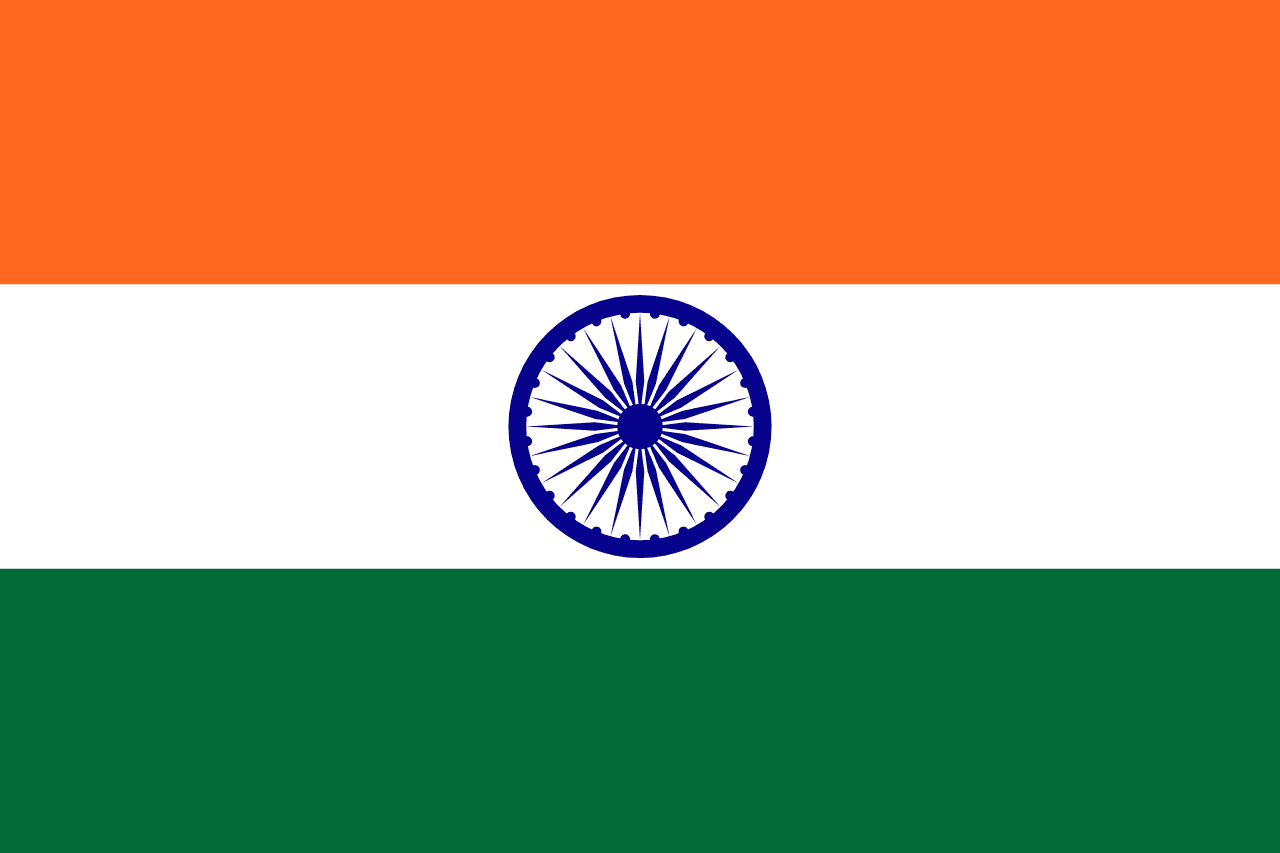
Flag details
- Country
- India
- Official name
- Republic of India
- Capital
- New Delhi
- ISO code
- IN / IND
- Region
- South Asia
Flag colors
- #ff682033%
- #046a3833%
- #ffffff29%
Share of the flag's surface, measured from the image.
Download the flag
Meaning and history of the flag of India
India's flag, known as the Tiranga, or tricolor, features three horizontal bands of equal proportion: saffron on top, white in the middle, and green at the bottom. At the center of the white band sits the Ashoka Chakra, a navy-blue wheel with 24 spokes taken from the lion capital of Ashoka at Sarnath. Saffron represents courage and sacrifice, white stands for truth and peace, and green symbolizes faith, fertility, and the prosperity of the land.
The flag was adopted on July 22, 1947, just days before independence from British rule. It was designed by Pingali Venkayya and approved by India's Constituent Assembly. The Ashoka Chakra, which replaced the spinning wheel (charkha) on the flag proposed earlier by the Indian National Congress and Mahatma Gandhi, symbolizes dharma, the eternal law, and perpetual motion, and also represents the 24 hours of the day.
One distinctive feature of India's flag is that its manufacture is strictly regulated: it must be made exclusively of khadi, a hand-spun cloth that was a symbol of the independence movement. Using any other material is illegal under India's flag code. Its proportions are 2:3, and it shares a horizontal tricolor layout with Ireland's flag, though the colors and symbolism are entirely different.
You can view the flag of India in high resolution above and download it in several sizes for personal, educational or reference use. To explore more, visit the full India profile, its map, or the current local time in New Delhi.