
Flag of Nigeria
Federal Republic of Nigeria
Flag details
- Country
- Nigeria
- Official name
- Federal Republic of Nigeria
- Capital
- Abuja
- ISO code
- NG / NGA
- Region
- West Africa
Flag colors
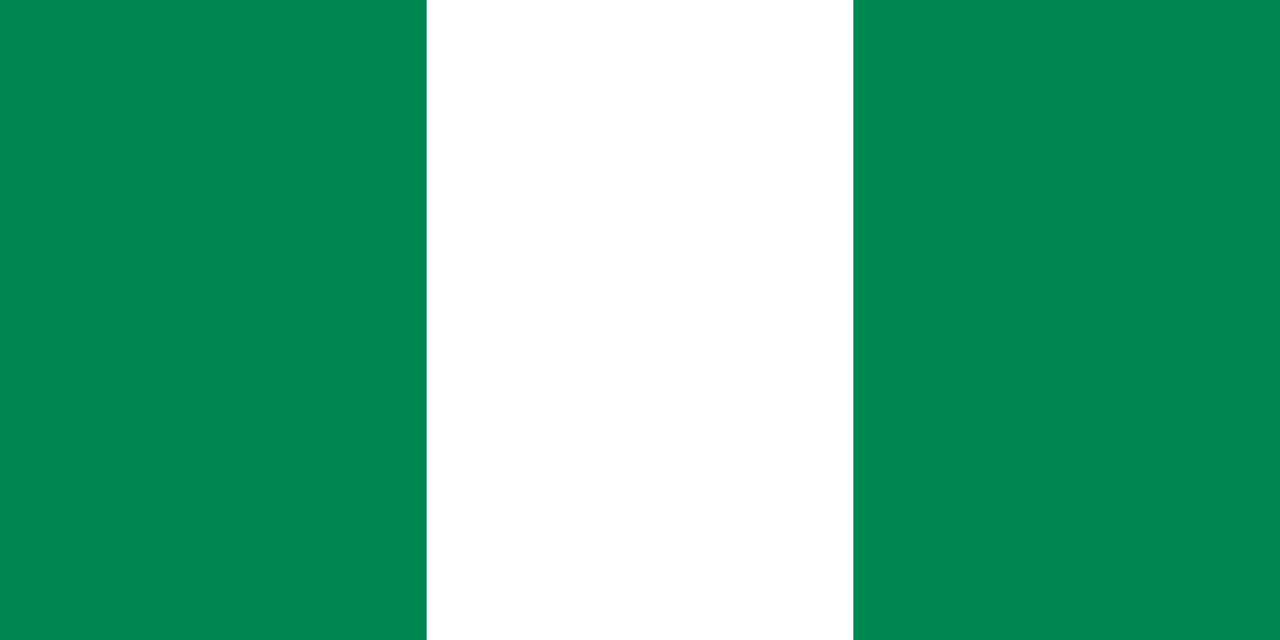
- #00875166%
- #ffffff33%
Share of the flag's surface, measured from the image.
Download the flag
Meaning and history of the flag of Nigeria
Nigeria's flag has three vertical stripes of equal width: green at the hoist, white in the center, and green at the fly. It was adopted on October 1, 1960, the day the country gained independence from the United Kingdom. The design was created by Michael Taiwo Akinkunmi, then a student, who won a national competition against more than two thousand entries.
Green represents Nigeria's abundant agricultural wealth and lush forests, making it one of the most resource-rich nations on the African continent. The white center stripe symbolizes peace and unity, a value of particular significance in a country with more than 250 ethnic groups and deep religious diversity between the largely Muslim north and the largely Christian south.
The simplicity of Nigeria's flag is both its strength and its most notable feature. It is one of the simplest flags in the world, using only two colors with no coat of arms, emblem, or additional symbol. The winning design originally included a red sun on the white stripe, but the judges removed this element, leaving the flag in its current minimalist form. Its green-white-green scheme is not repeated on any other national flag.
You can view the flag of Nigeria in high resolution above and download it in several sizes for personal, educational or reference use. To explore more, visit the full Nigeria profile, its map, or the current local time in Abuja.